

More Black Sabbath
More Rock Classics

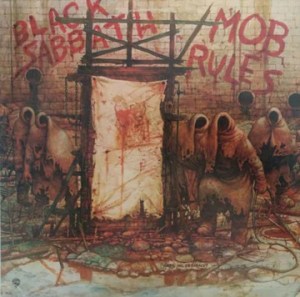
- This Mob Rules rocks like nothing you’ve heard, with outstanding Double Plus (A++) sound or BETTER from start to finish – exceptionally quite vinyl too
- Massive and powerful throughout – this copy is big, rich, full-bodied and solid like you won’t believe
- 4 stars: “…a quick follow-up to Heaven and Hell, continuing…that record’s energy as well as its shift away from dark metal to more commercial hard rock. Mob Rules and Heaven and Hell work well as each other’s companion pieces, making the first round of Dio-fronted Sabbath material a bright spot…”
This vintage Warner Brothers pressing has the kind of Tubey Magical Midrange that modern records can barely BEGIN to reproduce. Folks, that sound is gone and it sure isn’t showing signs of coming back. If you love hearing INTO a recording, actually being able to “see” the performers, and feeling as if you are sitting in the studio with the band, this is the record for you. It’s what vintage all analog recordings are known for — this sound.
If you exclusively play modern repressings of vintage recordings, I can say without fear of contradiction that you have never heard this kind of sound on vinyl. Old records have it — not often, and certainly not always — but maybe one out of a hundred new records do, and those are some pretty long odds.
What The Best Sides Of Mob Rules Have To Offer Is Not Hard To Hear
- The biggest, most immediate staging in the largest acoustic space
- The most Tubey Magic, without which you have almost nothing. CDs give you clean and clear. Only the best vintage vinyl pressings offer the kind of Tubey Magic that was on the tapes in 1981
- Tight, note-like, rich, full-bodied bass, with the correct amount of weight down low
- Natural tonality in the midrange — with all the instruments having the correct timbre
- Transparency and resolution, critical to hearing into the three-dimensional studio space
No doubt there’s more but we hope that should do for now. Playing the record is the only way to hear all of the qualities we discuss above, and playing the best pressings against a pile of other copies under rigorously controlled conditions is the only way to find a pressing that sounds as good as this one does.
What We’re Listening For On Mob Rules
- Energy for starters. What could be more important than the life of the music?
- Then: presence and immediacy. The vocals aren’t “back there” somewhere, lost in the mix. They’re front and center where any recording engineer worth his salt — Martin Birch in this case — would have put them.
- The Big Sound comes next — wall to wall, lots of depth, huge space, three-dimensionality, all that sort of thing.
- Then transient information — fast, clear, sharp attacks, not the smear and thickness so common to these LPs.
- Tight punchy bass — which ties in with good transient information, also the issue of frequency extension further down.
- Next: transparency — the quality that allows you to hear deep into the soundfield, showing you the space and air around all the instruments.
- Extend the top and bottom and voila, you have The Real Thing — an honest to goodness Hot Stamper.
Side One
Turn Up The Night
Voodoo
The Sign Of The Southern Cross
E5150
The Mob Rules
Side Two
Country Girl
Slipping Away
Falling Off The Edge Of The World
Over And Over
AMG Review
1981’s Mob Rules was a quick follow-up to Heaven and Hell, continuing the momentum of that record’s energy as well as its shift away from dark metal to more commercial hard rock. Tony Iommi’s signature guitar playing takes on new forms throughout the album, with Zeppelin-esque riffing on “Slipping Away,” slithering bluesy rock playing on “Voodoo,” and a strikingly different approach to soloing, shifting from the laser-focused slow burn of early Sabbath albums to a more frenetic, technically showy style on some tracks.
Speedy album opener “Turn Up the Night” is one of the more spirited and pop-friendly moments of any Sabbath record, with a hooky and melodic chorus and Iommi running through fast-paced leads and trills that were no doubt taking notes from Eddie Van Halen, who was perhaps the most celebrated guitarist in the world in 1981.
Mob Rules delved more into experimentation with keyboards and synthesizers, with auxiliary player Geoff Nicholls adding cinematic synth bedding to the epic churn of “The Sign of the Southern Cross” and spacy atmosphere to “Falling Off the Edge of the World,” among other synth contributions. New drummer Vinny Appice replaced original Sabbath drummer Bill Ward, pushing the sound even further from the band’s original sludgy approach. These changes, along with Dio’s fantasy-based lyrics and a red-lined mix by producer Martin Birch put Mob Rules closer in line with the emerging New Wave of British Heavy Metal than the druggy devil-worshiping doom metal Black Sabbath first built their name on. While it was a solid album, Mob Rules might have followed the template established on Heaven and Hell a little too closely.
The pacing and flow of the record was almost identical to its predecessor, from the chuggy opener of “Turn Up the Night” mirroring Heaven and Hell’s “Neon Nights” straight through to final track “Over and Over” feeling like a continuation of “Lonely Is the Word,” the searching, midtempo finale of the previous album. It didn’t sell quite as well as Heaven and Hell, and Dio and Appice left the band soon afterward, (though Dio’s relationship with Sabbath would be complex and sprawling) leaving Black Sabbath to reconfigure throughout the ’80s with mixed results. Mob Rules and Heaven and Hell work well as each other’s companion pieces, making the first round of Dio-fronted Sabbath material a bright spot surrounded by relatively grim efforts on either side.