

More of the Music of Thelonious Monk
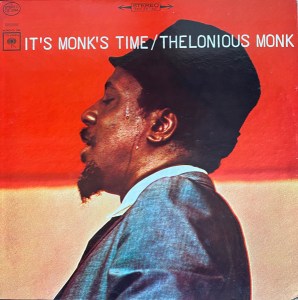

- An incredible 360 label pressing of It’s Monk’s Time, with Shootout Winning Triple Plus (A+++) sound or very close to it throughout
- The piano is clear with a solid bottom end — we’re crazy for that sound, and Columbia knew exactly how to give it to us on these vintage pressings
- 5 stars: “contains some of the best — if not arguably the best — studio sides that the pianist cut during his final years as a recording musician…”
There are three main elements that comprise the sound of a top quality It’s Monk’s Time: piano, sax and drums. You need all three to be balanced and correct. The mix is perfection on the best copies, with the piano, sax and drums clearly audible and in musically correct proportion to each other.
As we played the sides we noted how each of them fared.
- PIANO. Clear, present and lively. Very high-rez.
- SAX. Smooth, rich and tubey, with no RVG squawk to be found.
- DRUMS (and BASS). Big drums in a big room. Listen to how solid that kick is. The standup bass is tight and note-like.
On the top copies, this is a truly superb sounding Thelonious Monk album. We can thank the brilliant Columbia engineers for their service to one of the authentic geniuses of jazz.
And if you own the Speakers Corner Heavy Vinyl reissue, please buy this copy and hear what you’ve been missing.
What The Best Sides Of It’s Monk’s Time Have To Offer Is Not Hard To Hear
- The biggest, most immediate staging in the largest acoustic space
- The most Tubey Magic, without which you have almost nothing. CDs give you clean and clear. Only the best vintage vinyl pressings offer the kind of Tubey Magic that was on the tapes in 1964
- Tight, note-like, rich, full-bodied bass, with the correct amount of weight down low
- Natural tonality in the midrange — with all the instruments having the correct timbre
- Transparency and resolution, critical to hearing into the three-dimensional studio space
No doubt there’s more but we hope that should do for now. Playing the record is the only way to hear all of the qualities we discuss above, and playing the best pressings against a pile of other copies under rigorously controlled conditions is the only way to find a pressing that sounds as good as this one does.
What We’re Listening For on It’s Monk’s Time
- Energy for starters. What could be more important than the life of the music?
- The Big Sound comes next — wall to wall, lots of depth, huge space, three-dimensionality, all that sort of thing.
- Then transient information — fast, clear, sharp attacks, not the smear and thickness so common to these LPs.
- Tight punchy bass — which ties in with good transient information, also the issue of frequency extension further down.
- Next: transparency — the quality that allows you to hear deep into the soundfield, showing you the space and air around all the instruments.
- Extend the top and bottom and voila, you have The Real Thing — an honest to goodness Hot Stamper.
Side One
Lulu’s Back In Town
Memories Of You
Stuffy Turkey
Side Two
Brake’s Sake
Nice Work If You Can Get It
Shuffle Boil
AMG 5 Star Review
It’s Monk’s Time (1964) contains some of the best — if not arguably the best — studio sides that the pianist cut during his final years as a recording musician…
From four sessions in early 1964, It’s Monk’s Time gathers four quartet and two solo sides, presenting the pinnacle of what these musicians offered stylistically as well as from the standpoint of presentation.
There is sense of mischievous playfulness in Monk’s nimble keyboard work, especially notable on the beautifully off-kilter unaccompanied opening to “Lulu’s Back in Town,” and the same practically impish quality also drives the solo performance on “Nice Work if You Can Get It.”