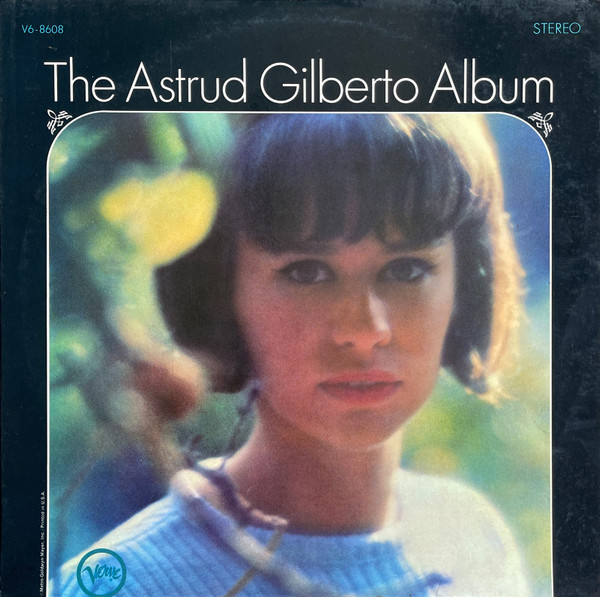
- With seriously good Double Plus (A++) sides or close to them, this Van Gelder mastered copy was one of the best we played in our shootout (but the vinyl is iffy at best)
- The sound here has real texture to the strings and breath to the vocals, key elements if this music is going to work
- 4 1/2 stars: “The Astrud Gilberto Album was at least as good as Getz/Gilberto (despite what jazz fans say), for several reasons. Gilberto sounded beautiful on a range of material, from the sentimental “Dindi” to the playful “Agua de Beber,” and as long as intelligent musicians were playing to her strengths (as they do here), the results were splendid.”
If you can tolerate the slightly noisier surfaces of this pressing you are in for some amazing music and sound. If for any reason you are not happy with the sound or condition of the album,we are of course happy to take it back for a full refund including the domestic return postage.
This is an early stereo LP – the monos may be five times more common, but every last one we played was awful!
Check out this list of top jazz players:
Astrud Gilberto – vocals
Antônio Carlos Jobim – vocals, guitar (track 2)
João Gilberto – guitar
Joe Mondragon – bass
Bud Shank – alto sax, flute
João Donato – piano
Stu Williamson – trumpet
Milt Bernhart – trombone
What outstanding sides such as these have to offer is not hard to hear:
- The biggest, most immediate staging in the largest acoustic space
- The most Tubey Magic, without which you have almost nothing. CDs give you clean and clear. Only the best vintage vinyl pressings offer the kind of Tubey Magic that was on the tapes in 1965
- Tight, note-like, rich, full-bodied bass, with the correct amount of weight down low
- Natural tonality in the midrange — with all the instruments having the correct timbre
- Transparency and resolution, critical to hearing into the three-dimensional studio space
No doubt there’s more but we hope that should do for now. Playing the record is the only way to hear all of the qualities we discuss above, and playing the best pressings against a pile of other copies under rigorously controlled conditions is the only way to find a pressing that sounds as good as this one does.
What We’re Listening For on The Astrud Gilberto Album
- Energy for starters. What could be more important than the life of the music?
- Then: presence and immediacy. The vocals aren’t “back there” somewhere, lost in the mix. They’re front and center where any recording engineer worth his salt would put them.
- The Big Sound comes next — wall to wall, lots of depth, huge space, three-dimensionality, all that sort of thing.
- Then transient information — fast, clear, sharp attacks, not the smear and thickness so common to these LPs.
- Tight punchy bass — which ties in with good transient information, also the issue of frequency extension further down.
- Next: transparency — the quality that allows you to hear deep into the soundfield, showing you the space and air around all the instruments.
- Extend the top and bottom and voila, you have The Real Thing — an honest to goodness Hot Stamper.
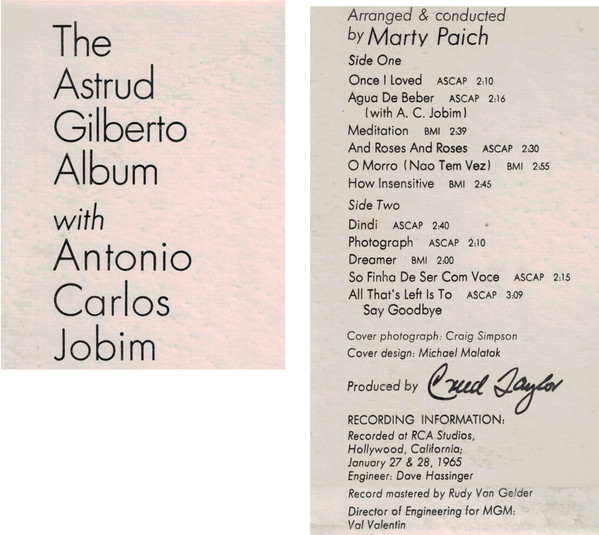
TRACK LISTING
Side One
Once I Loved
Agua de Beber
Meditation
And Roses and Roses
O Morro (Não Tem Vez)
How Insensitive
Side Two
Dindi
Photograph
Dreamer
Só Finha de Ser Com Você
All That’s Left Is to Say Goodbye
AMG Review
The Astrud Gilberto Album was at least as good as Getz/Gilberto (despite what jazz fans say), for several reasons. The Brazilian repertoire plays particularly well to traditionally weak vocalists, her voice was yet more sweet than had been heard previously, and as before, the record featured two strong leaders — arranger Marty Paich and the incomparable Antonio Carlos Jobim.
Paich’s strings positively coated the album with radiance, and his choices for lead instrumental voices — Bud Shank’s flute, João Donato’s piano, Jobim’s guitar — complemented her vocals perfectly. Gilberto sounded beautiful on a range of material, from the sentimental “Dindi” to the playful “Agua de Beber,” and as long as intelligent musicians were playing to her strengths (as they do here), the results were splendid.