

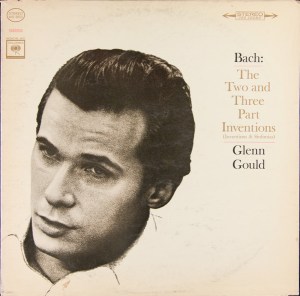

- Bach’s Inventions returns to the site with stunning Shootout Winning Triple Plus (A+++) sound on side two and an outstanding Double Plus (A++) side one – fairly quiet vinyl too
- Amazingly natural “you are there” sound – the room and the piano sound exactly the way I’ve heard them in real life, so what more can you ask for?
- “The little 2 and 3 part creations last just a couple minutes each and present a wealth of creativity from the mind of Johann Sebastian, expertly enunciated by the most technically complete Bach pianist of the century.” Larry VanDeSande
- 4 1/2 stars: “For many, the albums Glenn Gould recorded for Columbia between 1955 and 1981 are documents of unalloyed genius, particularly in his imaginative and masterful performances of Bach’s keyboard works.”
This vintage Columbia stereo pressing has the kind of Tubey Magical Midrange that modern records rarely even BEGIN to reproduce. Folks, that sound is gone and it sure isn’t showing signs of coming back. If you love hearing INTO a recording, actually being able to “see” the performers, and feeling as if you are sitting in the studio with Glenn Gould, this is the record for you. It’s what vintage all analog recordings are known for — this sound.
If you exclusively play modern repressings of vintage recordings, I can say without fear of contradiction that you have never heard this kind of sound on vinyl. Old records have it — not often, and certainly not always — but maybe one out of a hundred new records do, and those are some pretty long odds.
What the best sides of this wonderful classical release have to offer is not hard to hear:
- The biggest, most immediate staging in the largest acoustic space
- The most Tubey Magic, without which you have almost nothing. CDs give you clean and clear. Only the best vintage vinyl pressings offer the kind of Tubey Magic that was on the tapes in 1964
- Tight, note-like, rich, full-bodied bass, with the correct amount of weight down low
- Natural tonality in the midrange — with the piano having the correct timbre
- Transparency and resolution, critical to hearing into the three-dimensional space of the studio
No doubt there’s more but we hope that should do for now. Playing the record is the only way to hear all of the qualities we discuss above, and playing the best pressings against a pile of other copies under rigorously controlled conditions is the only way to find a pressing that sounds as good as this one does.
What We’re Listening For on Gould’s 1964 release
- Energy for starters. What could be more important than the life of the music?
- The Big Sound comes next — wall to wall, lots of depth, huge space, three-dimensionality, all that sort of thing.
- Then transient information — fast, clear, sharp attacks, not the smear and thickness common to most LPs.
- Tight, note-like bass with clear fingering — which ties in with good transient information, as well as the issue of frequency extension further down.
- Next: transparency — the quality that allows you to hear deep into the soundfield, showing you the space and air around the piano.
- Then: presence and immediacy. The piano isn’t “back there” somewhere, way behind the speakers. It’s front and center where any recording engineer worth his salt would have put it.
- Extend the top and bottom and voila, you have The Real Thing — an honest to goodness Hot Stamper.
TRACK LISTING
Side One
No. 1 In C Major
No. 2 In C Major
No. 5 In E Flat Major
No. 14 In B Flat Major
No. 11 In G Minor
No. 10 In G Major
No. 15 In B Minor
No. 7 In E Minor
Side Two
No. 6 In E Major
No. 13 In A Minor
No. 12 In A Major
No. 3 In D Major
No. 4 In D Minor
No. 8 In F Major
No. 9 In F Minor
AMG 4 1/2 Star Review
For many, the albums Glenn Gould recorded for Columbia between 1955 and 1981 are documents of unalloyed genius, particularly in his imaginative and masterful performances of Bach’s keyboard works. For others, less enamored of Gould’s recondite theorizing, studio editing, and distracting personal eccentricities (such as humming along out of tune while he played), these recordings are nonetheless fascinating documents of an original mind and still worth studying for their undeniable musicality.
… his 1964 recording of the Two- and Three-Part Inventions, BWV 772-801, was made less than a month before he made his abrupt departure from public performance, and that fact may affect how listeners receive these performances, as if signs of stress are detectable in his interpretations. Not so: Gould’s accurate touch, transparent voicing, smooth legato, and controlled dynamics indicate quite the opposite. If there was any tension affecting Gould at this time, then it led to music-making at its finest…
Glenn Gould
To this day renowned Canadian pianist Glenn Gould (1932 – 1982) continues to fascinate and entice fans and artists alike. Gould was very forward thinking and embraced technology in a way that was unique among performing artists. Gould has received numerous accolades for his work including four Grammy Awards, three Juno Awards and the RIAA Lifetime Achievement Award. He is one of the best-known and celebrated classical pianists in modern history, with a style that was both deeply expressive and technically precise.
Gould influenced a new generation of performers and listeners through his illuminating interpretations of the music of a variety of composers, including, Gould’s 1956 recording of J.S. Bach’s Goldberg Variations which was re-released last year by his longtime label, Sony Masterworks. Gould’s passion for media and communication technology began with his long association with the Canadian Broadcasting Corporation. In addition to his numerous performances on radio, Gould broke new artistic ground with his documentaries on radio and his television essays and performances.
Gould’s untimely death on October 4, 1982, just days after his 50th birthday, was mourned by music lovers everywhere. Through his recordings and other contributions to the mass media, Glenn Gould has left a rich legacy of musical ideas and performances that find him, each year, the subject of new books, articles, plays, films and documentaries, which continue to challenge and inspire new generations.