

More of the Music of Beethoven
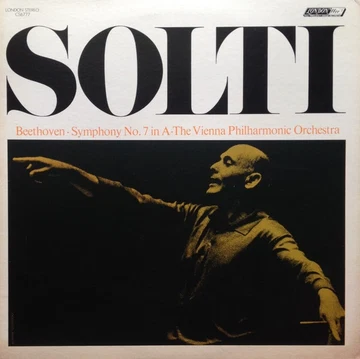
- Solti and the Vienna Phil’s commanding performance of Beethoven’s Symphony No. 7 (CS-6777) debuts on the site with big, spacious, and lively Shootout Winning Triple Plus (A+++) sound or close to it throughout this vintage London pressing
- It’s also fairly quiet at Mint Minus Minus, a grade that even our most well-cared-for vintage classical titles have trouble playing at
- These sides are doing practically everything right – they’re rich, clear, undistorted, open, and has depth and transparency to rival the best recordings you may have heard
- The texture on the strings is captured perfectly – this is an area in which modern pressings fail utterly, and without good string reproduction, especially in the lower registers, a Beethoven symphony is simply not a pleasurable experience on highly resolving equipment
This vintage London Stereo pressing has the kind of Tubey Magical Midrange that modern records can barely BEGIN to reproduce. Folks, that sound is gone and it sure isn’t showing signs of coming back. If you love hearing INTO a recording, actually being able to “see” the performers, and feeling as if you are sitting in the studio with the band, this is the record for you. It’s what vintage all analog recordings are known for — this sound.
If you exclusively play modern repressings of vintage recordings, I can say without fear of contradiction that you have never heard this kind of sound on vinyl. Old records have it — not often, and certainly not always — but maybe one out of a hundred new records do, and those are some pretty long odds.
What The Best Sides Of Beethoven’s Symphony No. 7 Have To Offer Is Not Hard To Hear
- The biggest, most immediate staging in the largest acoustic space
- The most Tubey Magic, without which you have almost nothing. CDs give you clean and clear. Only the best vintage vinyl pressings offer the kind of Tubey Magic that was on the tapes in 1959
- Tight, note-like, rich, full-bodied bass, with the correct amount of weight down low
- Natural tonality in the midrange — with all the instruments having the correct timbre
- Transparency and resolution, critical to hearing into the three-dimensional studio space
No doubt there’s more but we hope that should do for now. Playing the record is the only way to hear all of the qualities we discuss above, and playing the best pressings against a pile of other copies under rigorously controlled conditions is the only way to find a pressing that sounds as good as this one does.
Copies with rich lower mids and nice extension up top did the best in our shootout, assuming they weren’t veiled or smeary of course. So many things can go wrong on a record. We know, we’ve heard them all.
Top end extension is critical to the sound of the best copies. Lots of old records (and new ones) have no real top end; consequently, the studio or stage will be missing much of its natural air and space, and instruments will lack their full complement of harmonic information.
Tube smear is common to most vintage pressings. The copies that tend to do the best in a shootout will have the least (or none), yet are full-bodied, tubey and rich.
A Big Group of Musicians Needs This Kind of Space
One of the qualities that we don’t talk about on the site nearly enough is the SIZE of the record’s presentation. Some copies of the album just sound small — they don’t extend all the way to the outside edges of the speakers, and they don’t seem to take up all the space from the floor to the ceiling. In addition, the sound can often be recessed, with a lack of presence and immediacy in the center.
Other copies — my notes for these copies often read “BIG and BOLD” — create a huge soundfield, with the music positively jumping out of the speakers. They’re not brighter, they’re not more aggressive, they’re not hyped-up in any way, they’re just bigger and clearer.
And most of the time those very special pressings are just plain more involving. When you hear a copy that does all that — a copy like this one — it’s an entirely different listening experience.
What We’re Listening For On Symphony No. 7
- Energy for starters. What could be more important than the life of the music?
- The Big Sound comes next — wall to wall, lots of depth, huge space, three-dimensionality, all that sort of thing.
- Then transient information — fast, clear, sharp attacks, not the smear and thickness so common to these LPs.
- Powerful bass — which ties in with good transient information, also the issue of frequency extension further down.
- Next: transparency — the quality that allows you to hear deep into the soundfield, showing you the space and air around all the instruments.
- Extend the top and bottom and voila, you have The Real Thing — an honest to goodness Hot Stamper.
TRACK LISTING
Side One
Poco Sostenuto – Vivace
Allegretto
Side Two
Presto (Scherzo) – Assai Meno Presto
Allegro Con Brio
Symphony No. 7 (Beethoven)
The Symphony No. 7 in A major, Op. 92, is a symphony in four movements composed by Ludwig van Beethoven between 1811 and 1812, while improving his health in the Bohemian spa town of Teplitz. The work is dedicated to Count Moritz von Fries.
At its premiere at the university in Vienna on 8 December 1813, Beethoven remarked that it was one of his best works. The second movement, “Allegretto,” was so popular that audiences demanded an encore.
Instrumentation
The symphony is scored for two flutes, two oboes, two clarinets in A, two bassoons, two horns in A (E and D in the inner movements), two trumpets in D, timpani, and strings.
Although there is no contrabassoon part in the score, a letter from Beethoven himself shows that two contrabassoons were used at the premiere to add strength to the bass parts.
Form
There are four movements:
- Poco sostenuto – Vivace (A major)
- Allegretto (A minor)
- Presto – Assai meno presto (trio) (F major, Trio in D major)
- Allegro con brio (A major)
A typical performance lasts approximately 33–45 minutes depending on the choice of tempo, and whether the repeats in the 1st, 3rd, and 4th movements are omitted.
The work as a whole is known for its use of rhythmic devices suggestive of a dance, such as dotted rhythm and repeated rhythmic figures. It is also tonally subtle, making use of the tensions between the key centres of A, C and F. For instance, the first movement is in A major but has repeated episodes in C major and F major. In addition, the second movement is in A minor with episodes in A major, and the third movement, a scherzo, is in F major.
Reception
Critics and listeners have often felt stirred or inspired by the Seventh Symphony. For instance, one program-note author writes:
… the final movement zips along at an irrepressible pace that threatens to sweep the entire orchestra off its feet and around the theater, caught up in the sheer joy of performing one of the most perfect symphonies ever written.
Composer and music author Antony Hopkins says of the symphony:
The Seventh Symphony perhaps more than any of the others gives us a feeling of true spontaneity; the notes seem to fly off the page as we are borne along on a floodtide of inspired invention. Beethoven himself spoke of it fondly as “one of my best works.” Who are we to dispute his judgment?
Another admirer, composer Richard Wagner, referring to the lively rhythms which permeate the work, called it the “apotheosis of the dance.”
-Wikipedia