

More of the Music of Shostakovich

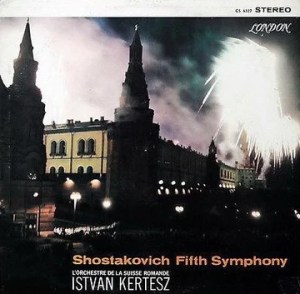
- This stunning classical release returns to the site after a four year hiatus, here with INCREDIBLE Shootout Winning Triple Plus (A+++) grades or close to them on both sides of this early London UK pressing
- It’s also impossibly quiet at Mint Minus to Mint Minus Minus, a grade that practically none of our vintage classical titles – even the most well-cared-for ones – ever play at
- The sound of the orchestra is dramatically richer and sweeter than you will hear on practically all other pressings – what else would you expect from Decca’s engineers and the Suisse Romande?
- The sonics here are glorious, full of all of the qualities that make listening to classical music in analog so involving
- The RCA with Mitchell has a bit more of the vintage Living Stereo Tubey Magical sound from back in the day compared to this London with Kertesz, which, although a bit more modern, is every bit as good, maybe better depending on the system playing it and the preferences of the listener
This vintage UK London pressing has the kind of Tubey Magical Midrange that modern records can barely BEGIN to reproduce. Folks, that sound is gone and it sure isn’t showing signs of coming back. If you love hearing INTO a recording, actually being able to “see” the performers, and feeling as if you are sitting in the studio with the band, this is the record for you. It’s what vintage all analog recordings are known for —this sound.
If you exclusively play modern repressings of vintage recordings, I can say without fear of contradiction that you have never heard this kind of sound on vinyl. Old records have it — not often, and certainly not always — but maybe one out of a hundred new records do, and those are some pretty long odds.
What The Best Sides Of Shostakovich’s Fifth Symphony Have To Offer Is Not Hard to Hear
- The biggest, most immediate staging in the largest acoustic space
- The most Tubey Magic, without which you have almost nothing. CDs give you clean and clear. Only the best vintage vinyl pressings offer the kind of Tubey Magic that was on the tapes in 1962
- Tight, note-like, rich, full-bodied bass, with the correct amount of weight down low
- Natural tonality in the midrange — with all the instruments having the correct timbre
- Transparency and resolution, critical to hearing into the three-dimensional studio space
No doubt there’s more but we hope that should do for now. Playing the record is the only way to hear all of the qualities we discuss above, and playing the best pressings against a pile of other copies under rigorously controlled conditions is the only way to find a pressing that sounds as good as this one does.
Copies with rich lower mids and nice extension up top did the best in our shootout, assuming they weren’t veiled or smeary of course. So many things can go wrong on a record. We know, we’ve heard them all.
Top end extension is critical to the sound of the best copies. Lots of old records (and new ones) have no real top end; consequently, the studio or stage will be missing much of its natural air and space, and instruments will lack their full complement of harmonic information.
Tube smear is common to most vintage pressings. The copies that tend to do the best in a shootout will have the least (or none), yet are full-bodied, tubey and rich.
Standard Operating Procedures
What are sonic qualities by which a record — any record — should be judged? Pretty much the ones we discuss in most of our Hot Stamper listings: energy, frequency extension (on both ends), transparency, spaciousness, harmonic textures (freedom from smear is key), rhythmic drive, tonal correctness, fullness, richness, three-dimensionality, and on and on down the list.
When we can get a number of these qualities to come together on the side we’re playing, we provisionally give it a ballpark Hot Stamper grade, a grade that is often revised during the shootout as we hear what the other copies are doing, both good and bad.
Once we’ve been through all the side ones, we play the best of the best against each other and arrive at a winner for that side. Other copies from earlier in the shootout will frequently have their grades raised or lowered based on how they sounded compared to the eventual shootout winner. If we’re not sure about any pressing, perhaps because we played it early on in the shootout before we had learned what to listen for, we take the time to play it again.
Repeat the process for side two and the shootout is officially over. All that’s left is to see how the sides of each pressing match up.
It may not be rocket science, but it’s a science of a kind, one with strict protocols that we’ve developed over the course of many years to insure that the results we arrive at are as accurate as we can make them.
The result of all our work speaks for itself, on this very record in fact. We guarantee you have never heard this music sound better than it does on our Hot Stamper pressing — or your money back.
What We’re Listening For On Shostakovich’s Fifth Symphony
- Energy for starters. What could be more important than the life of the music?
- The Big Sound comes next — wall to wall, lots of depth, huge space, three-dimensionality, all that sort of thing.
- Then transient information — fast, clear, sharp attacks, not the smear and thickness so common to these LPs.
- Next: transparency — the quality that allows you to hear deep into the soundfield, showing you the space and air around all the instruments.
- Extend the top and bottom and voila, you have The Real Thing — an honest to goodness Hot Stamper.
Side One
1st Movement: Moderato
2nd Movement: Allegretto
Side Two
3rd Movement: Largo
4th Movement: Allegro Non Troppo
Wikipedia on Symphony No. 5
The Symphony No. 5 in D minor, Op. 47, by Dmitri Shostakovich is a work for orchestra composed between April and July 1937. Its first performance was on November 21, 1937, in Leningrad by the Leningrad Philharmonic Orchestra under Yevgeny Mravinsky. The premiere was a huge success and received an ovation that lasted well over half an hour.
The symphony is approximately 45 minutes in length and has four movements:
I. Moderato – Allegro non troppo (D minor)
The symphony opens with a strenuous string figure in canon, initially leaping and falling in minor sixths then narrowing to minor thirds. Then, we hear a broadly lyric first theme played by the violins. The second theme is built out of octaves and sevenths. The two themes are expanded in the development section, by having different instruments playing them, and in different styles, including a march section. In the recapitulation, themes heard earlier on are brought back again either identically or somewhat varied. Near the end of the movement, the second subject is heard again in the form of a canon played by flute and horn, then the same material is played by the violin and piccolo. The movement ends with the celesta playing a rising figure, and slowly fading away.
II. Allegretto (A minor)
This movement is in ternary form.[2] The movement opens with a heavy, loud introduction in the basses, followed by a softer solo on the E♭ clarinet. There is also a theme played by the woodwinds that is repeated later. In the recapitulation, some of the material heard earlier is repeated piano and staccato, not loudly and sustained as at the start.
III. Largo (F♯ minor)
Shostakovich begins this movement with violins in three sections, rather than the more usual two. The opening theme is played by the third violins. Second and first violins are slowly added and continue the melody. After the assertive trumpets of the first movement and the raucous horns of the second, this movement uses no brass at all, so there is a limited palette of sounds. This section yields to a pair of flutes in widely-separated counterpoint, the second of which makes reference to the first subject of the first movement. The solo is then passed on to the oboe with string accompaniment. The third movement ends like the first, with a celesta solo that slowly fades away. The strings are divided throughout the entire movement (3 groups of violins, violas in 2, cellos in 2; basses in 2).
IV. Allegro non troppo (D minor – D major)
This movement, also in ternary form (ABA), differs greatly from its predecessors, mostly with regard to melodic structure and motives. Various themes from earlier in the work are expanded until we get to a new theme played on the trumpet. This new theme is passed on to the strings and eventually the piece becomes quieter. The central section is much quieter and more tranquil, and is ultimately replaced by a march, where the melodies from earlier are played like a funeral dirge, accompanied by timpani. The music builds as the new accompaniment passes from timpani to woodwinds and then to strings, finally reaching a point where the piece changes from a minor key into a major key.