

More Classical and Orchestral Recordings

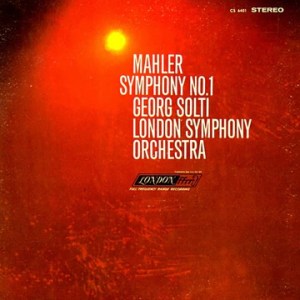
- Boasting two huge, powerful and tubey Double Plus (A++) sides or BETTER, we guarantee you’ve never heard Mahler’s Symphony No. 1 sound remotely as good as it does on this vintage London pressing
- The sonic are big and rich, lively and open, with an abundance of depth and huge climaxes that hold together
- Everything that we listen for in a great classical recording can be heard on this copy – it’s immediate, dynamic, very low distortion, spacious, and alive
- We had one original unboxed Decca, and what a disappointment it was after hearing so many great sounding London pressings
- Mastered by Stan Goodall, it was not remotely competitive on either side with the work of Harry Fisher
- There are about 150 orchestral recordings we think offer the best performances with the highest quality sound. This record is certainly deserving of a place on that list.
This vintage London pressing has the kind of Tubey Magical Midrange that modern records can barely BEGIN to reproduce. Folks, that sound is gone and it sure isn’t showing signs of coming back. If you love hearing INTO a recording, actually being able to “see” the performers, and feeling as if you are sitting in the studio with the band, this is the record for you. It’s what vintage all analog recordings are known for — this sound.
If you exclusively play modern repressings of vintage recordings, I can say without fear of contradiction that you have never heard this kind of sound on vinyl. Old records have it — not often, and certainly not always — but maybe one out of a hundred new records do, and those are some pretty long odds.
What The Best Sides Of Mahler’s Symphony No. 1 Have To Offer Is Not Hard To Hear
- The biggest, most immediate staging in the largest acoustic space
- The most Tubey Magic, without which you have almost nothing. CDs give you clean and clear. Only the best vintage vinyl pressings offer the kind of Tubey Magic that was on the tapes in 1964
- Tight, note-like, rich, full-bodied bass, with the correct amount of weight down low
- Natural tonality in the midrange — with all the instruments having the correct timbre
- Transparency and resolution, critical to hearing into the three-dimensional studio space
No doubt there’s more but we hope that should do for now. Playing the record is the only way to hear all of the qualities we discuss above, and playing the best pressings against a pile of other copies under rigorously controlled conditions is the only way to find a pressing that sounds as good as this one does.
Copies with rich lower mids and nice extension up top did the best in our shootout, assuming they weren’t veiled or smeary of course. So many things can go wrong on a record. We know, we’ve heard them all.
Top end extension is critical to the sound of the best copies. Lots of old records (and new ones) have no real top end; consequently, the studio or stage will be missing much of its natural air and space, and instruments will lack their full complement of harmonic information.
Tube smear is common to most vintage pressings. The copies that tend to do the best in a shootout will have the least (or none), yet are full-bodied, tubey and rich.
Standard Operating Procedures
What are sonic qualities by which a record — any record — should be judged? Pretty much the ones we discuss in most of our Hot Stamper listings: energy, frequency extension (on both ends), transparency, spaciousness, harmonic textures (freedom from smear is key), rhythmic drive, tonal correctness, fullness, richness, three-dimensionality, and on and on down the list.
When we can get a number of these qualities to come together on the side we’re playing, we provisionally give it a ballpark Hot Stamper grade, a grade that is often revised during the shootout as we hear what the other copies are doing, both good and bad.
Once we’ve been through all the side ones, we play the best of the best against each other and arrive at a winner for that side. Other copies from earlier in the shootout will frequently have their grades raised or lowered based on how they sounded compared to the eventual shootout winner. If we’re not sure about any pressing, perhaps because we played it early on in the shootout before we had learned what to listen for, we take the time to play it again.
Repeat the process for side two and the shootout is officially over. All that’s left is to see how the sides of each pressing match up.
It may not be rocket science, but it’s a science of a kind, one with strict protocols that we’ve developed over the course of many years to insure that the results we arrive at are as accurate as we can make them.
The result of all our work speaks for itself, on this very record in fact. We guarantee you have never heard this music sound better than it does on our Hot Stamper pressing — or your money back.
What We’re Listening For On Symphony No. 1
- Energy for starters. What could be more important than the life of the music?
- The Big Sound comes next — wall to wall, lots of depth, huge space, three-dimensionality, all that sort of thing.
- Then transient information — fast, clear, sharp attacks, not the smear and thickness so common to these LPs.
- Powerful bass — which ties in with good transient information, also the issue of frequency extension further down.
- Next: transparency — the quality that allows you to hear deep into the soundfield, showing you the space and air around all the instruments.
- Extend the top and bottom and voila, you have The Real Thing — an honest to goodness Hot Stamper.
Side One
Langsam, Schleppend, Wie Ein Naturlaut
Kräftig Bewegt, Doch Nicht Zu Schnell
Side Two
Feierlich Und Gemessen, Ohne Zu Schleppen
Stürmisch Bewegt
About this Piece
The genesis of Mahler’s First Symphony was protracted—15 years separate his first sketches from his final revision. During that time, the young composer went from apprentice to journeyman to master. In 1884, when he first scribbled down themes that would eventually find their way into the symphony, Mahler was conductor of the opera in Kassel, a moderate post; by the time the work achieved its final form, he was director of the Court Opera in Vienna. The years in between had taken him to Prague, Leipzig, Budapest (where the First Symphony premiered in its original, five-movement version in 1889), and Hamburg, as well as a two-month stint as a guest conductor at Covent Garden in London. The symphony, too, circulated widely: After its Budapest premiere, Mahler revised it for performances in Hamburg (1893) and Weimar (1894), finally excising an entire movement and premiering the work in (nearly) its present form in Berlin in 1896. The version published in 1899 reflects further revisions, primarily to the work’s orchestration.
Several facts about Mahler the composer emerge in connection with this symphony. First and foremost, his activities as a composer of songs were inextricably intertwined with his work as a symphonist. In this case, themes from his Songs of a Wayfarer, which he started in 1883, play a central role in the First Symphony’s opening and third movements. Mahler also needed an extramusical stimulus to get started on his symphonies, but he would later discard that narrative, usually a mark that the work had achieved its final form. Here, Mahler began with an elaborate program derived from early German Romantics Jean Paul and E.T.A. Hoffmann—writers whose ecstatic nature imagery and descriptions of the grotesque and macabre certainly left their mark on Mahler’s music—and the Italian medieval poet Dante Alighieri, the symphony’s finale at one time bore the descriptive title “Dall’Inferno al Paradiso.” The visual arts also played a role, especially the woodcut The Hunter’s Funeral Procession (1850) by Moritz von Schwind, in which the animals of the forest carry the bier of the dead hunter, a key impetus for the third-movement funeral procession, a minor-key version of the children’s tune “Frère Jacques.”
But Mahler eventually distanced himself from these influences, leaving a four-movement symphony with a sonata-allegro opening, a spirited and earthy dance movement, the funeral procession, and a finale whose storm dissolves in light. And though a product of his journeyman years, the symphony, in its final form, already affirms Mahler’s complete mastery, an unequivocal announcement that the wayfarer has definitely arrived.
—John Mangum, LAPhil.com