

More Jazz Recordings Featuring the Piano

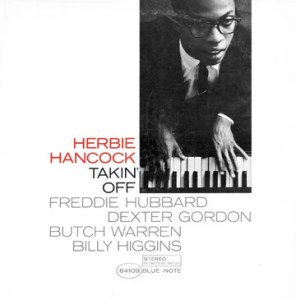
- With solid Double Plus (A++) grades from first note to last, this 70s Blue Note reissue is doing just about everything right – remarkably quiet vinyl too
- Once again Rudy Van Gelder delivers the sound that audiophiles and jazz fans alike thrill to
- These sides are lively, dynamic and full-bodied, and there’s real weight to the piano, always critically important to the piano recordings we play
- Problems in the vinyl are sometimes the nature of the beast with these vintage LPs, but once you hear how excellent sounding this copy is, you might be inclined, as we were, to stop counting stitches and just be swept away by the music
- 4 1/2 stars: “…Takin’ Off is an exceptional first effort, laying the groundwork for Hancock to begin pushing the boundaries of hard bop on his next several records.”
I just learned the secret to getting this one to sound right, and I am happy to share it with you. Turn it up! When you get some volume going, the musicians really come to life on this album. It may sound crazy, but you need to play this one as loud as you would play your average rock record.
Billy Higgins whacks the hell out of his snare on the second track on side one. He really goes to town on that thing. Imagine you are sitting twenty feet from him in a jazz club; it would be plenty loud, right? Now find the equivalent volume setting on your preamp, drop the needle and get ready to feel the music, the way you would feel it if you were in that club.
This vintage Blue Note pressing has the kind of Tubey Magical Midrange that modern records can barely BEGIN to reproduce. Folks, that sound is gone and it sure isn’t showing signs of coming back. If you love hearing INTO a recording, actually being able to “see” the performers, and feeling as if you are sitting in the studio with the band, this is the record for you. It’s what vintage all analog recordings are known for — this sound.
If you exclusively play modern repressings of vintage recordings, I can say without fear of contradiction that you have never heard this kind of sound on vinyl. Old records have it — not often, and certainly not always — but maybe one out of a hundred new records do, and those are some pretty long odds.
What the Best Sides of Takin’ Off Have to Offer Is Not Hard to Hear
- The biggest, most immediate staging in the largest acoustic space
- The most Tubey Magic, without which you have almost nothing. CDs give you clean and clear. Only the best vintage vinyl pressings offer the kind of Tubey Magic that was on the tapes in 1962
- Tight, note-like, rich, full-bodied bass, with the correct amount of weight down low
- Natural tonality in the midrange — with all the instruments having the correct timbre
- Transparency and resolution, critical to hearing into the three-dimensional studio space
No doubt there’s more but we hope that should do for now. Playing the record is the only way to hear all of the qualities we discuss above, and playing the best pressings against a pile of other copies under rigorously controlled conditions is the only way to find a pressing that sounds as good as this one does.
Copies with rich lower mids and nice extension up top did the best in our shootout, assuming they weren’t veiled or smeary of course. So many things can go wrong on a record. We know, we’ve heard them all.
Top end extension is critical to the sound of the best copies. Lots of old records (and new ones) have no real top end; consequently, the studio or stage will be missing much of its natural air and space, and instruments will lack their full complement of harmonic information.
Tube smear is common to most vintage pressings. The copies that tend to do the best in a shootout will have the least (or none), yet are full-bodied, tubey and rich.
Size and Space
One of the qualities that we don’t talk about on the site nearly enough is the SIZE of the record’s presentation. Some copies of the album just sound small — they don’t extend all the way to the outside edges of the speakers, and they don’t seem to take up all the space from the floor to the ceiling. In addition, the sound can often be recessed, with a lack of presence and immediacy in the center.
Other copies — my notes for these copies often read “BIG and BOLD” — create a huge soundfield, with the music positively jumping out of the speakers. They’re not brighter, they’re not more aggressive, they’re not hyped-up in any way, they’re just bigger and clearer.
And most of the time those very special pressings are just plain more involving. When you hear a copy that does all that — a copy like this one — it’s an entirely different listening experience.
What We’re Listening For On Takin’ Off
- Energy for starters. What could be more important than the life of the music?
- The Big Sound comes next — wall to wall, lots of depth, huge space, three-dimensionality, all that sort of thing.
- Then transient information — fast, clear, sharp attacks, not the smear and thickness so common to these LPs.
- Tight, full-bodied bass — which ties in with good transient information, also the issue of frequency extension further down.
- Next: transparency — the quality that allows you to hear deep into the soundfield, showing you the space and air around all the instruments.
- Extend the top and bottom and voila, you have The Real Thing — an honest to goodness Hot Stamper.
Side One
Watermelon Man
Three Bags Full
Empty Pockets
Side Two
The Maze
Driftin’
Alone And I
AMG 4 1/2 Star Review
Herbie Hancock’s debut as a leader, Takin’ Off, revealed a composer and pianist able to balance sophistication and accessibility, somewhat in the vein of Blue Note’s prototype hard bopper Horace Silver. Yet while Hancock could be just as funky and blues-rooted as Silver, their overall styles diverged in several ways: Hancock was lighter and more cerebral, a bit more adventurous in his harmonies, and more apt to break his solos out of a groove (instead of using them to create one).
So even if, in retrospect, Takin’ Off is among Hancock’s most conventional albums, it shows a young stylist already strikingly mature for his age, and one who can interpret established forms with spirit and imagination. Case in point: the simple, catchy “Watermelon Man,” which became a Hancock signature tune and a jazz standard in the wake of a hit cover by Latin jazz star Mongo Santamaria. Hancock’s original version is classic Blue Note hard bop: spare, funky piano riffing and tight, focused solo statements. The other compositions are memorable and well-constructed too (if not quite hit material); all have their moments, but particular highlights include the ruminative ballad “Alone and I,” the minor-key “The Maze” (which features a little bit of free improvisation in the rhythm section), and the bluesy “Empty Pockets.”
The backing group includes then up-and-coming trumpeter Freddie Hubbard, tenor saxophonist Dexter Gordon, bassist Butch Warren, and drummer Billy Higgins. All in all, Takin’ Off is an exceptional first effort, laying the groundwork for Hancock to begin pushing the boundaries of hard bop on his next several records.