

More Squeeze

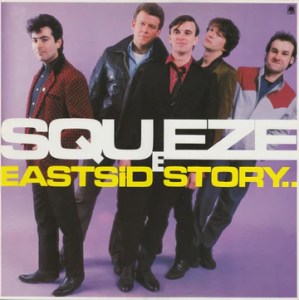
- With solid Double Plus (A++) grades or close to them throughout, this original British A&M pressing is guaranteed to handily beat any other East Side Story you’ve heard – fairly quiet vinyl too
- The sound on side two of this superb import is rich, full-bodied, lively, and warm, with solid bass and breathy, clear vocals, and side one is not far behind in all those areas
- Don’t waste your money on whatever dead-as-a-doornail Heavy Vinyl record they’re making these days – if you want to hear the Tubey Magic, size and energy of Squeeze’s fourth studio album, a vintage 80s pressing like this one is the only way to go (particularly on this side two)
- 5 stars: “…it stands as Squeeze’s tour de force, the best pop band of their time stretching every one of its muscles.”
This vintage A&M pressing has the kind of Tubey Magical Midrange that modern records can barely BEGIN to reproduce. Folks, that sound is gone and it sure isn’t showing signs of coming back. If you love hearing INTO a recording, actually being able to “see” the performers, and feeling as if you are sitting in the studio with the band, this is the record for you. It’s what vintage all analog recordings are known for — this sound.
If you exclusively play modern repressings of vintage recordings, I can say without fear of contradiction that you have never heard this kind of sound on vinyl. Old records have it — not often, and certainly not always — but maybe one out of a hundred new records do, and those are some pretty long odds.
What The Best Sides Of East Side Story Have To Offer Is Not Hard To Hear
- The biggest, most immediate staging in the largest acoustic space
- The most Tubey Magic, without which you have almost nothing. CDs give you clean and clear. Only the best vintage vinyl pressings offer the kind of Tubey Magic that was on the tapes even as late as 1981
- Tight, note-like, rich, full-bodied bass, with the correct amount of weight down low
- Natural tonality in the midrange — with all the instruments having the correct timbre
- Transparency and resolution, critical to hearing into the three-dimensional studio space
No doubt there’s more but we hope that should do for now. Playing the record is the only way to hear all of the qualities we discuss above, and playing the best pressings against a pile of other copies under rigorously controlled conditions is the only way to find a pressing that sounds as good as this one does.
Pop and Rock Shootouts
What are the sonic qualities by which a Pop or Rock record — any Pop or Rock record — should be judged?
Pretty much the ones we discuss in most of our Hot Stamper listings: energy, vocal presence, frequency extension (on both ends), transparency, spaciousness, harmonic textures (freedom from smear is key), rhythmic drive, tonal correctness, fullness, richness, three-dimensionality, and on and on down the list.
When we can get a number of these qualities to come together on the side we’re playing, we provisionally give it a ballpark Hot Stamper grade, a grade that is often revised during the shootout as we hear what the other copies are doing, both good and bad.
Once we’ve been through all the side ones, we play the best of the best against each other and arrive at a winner for that side. Other copies from earlier in the shootout will frequently have their grades raised or lowered based on how they sounded compared to the eventual shootout winner. If we’re not sure about any pressing, perhaps because we played it early on in the shootout before we had learned what to listen for, we take the time to play it again.
Repeat the process for side two and the shootout is officially over. All that’s left is to see how the sides of each pressing match up.
It may not be rocket science, but it’s a science of a kind, one with strict protocols that we’ve developed over the course of many years to insure that the results we arrive at are as accurate as we can make them.
The result of all our work speaks for itself, on this very record in fact. We guarantee you have never heard this music sound better than it does on our Hot Stamper pressing — or your money back.
What We’re Listening For On East Side Story
- Energy for starters. What could be more important than the life of the music?
- Then: presence and immediacy. The vocals aren’t “back there” somewhere, lost in the mix. They’re front and center where any recording engineer worth his salt would put them.
- The Big Sound comes next — wall to wall, lots of depth, huge space, three-dimensionality, all that sort of thing.
- Then transient information — fast, clear, sharp attacks, not the smear and thickness so common to these LPs.
- Tight punchy bass — which ties in with good transient information, also the issue of frequency extension further down.
- Next: transparency — the quality that allows you to hear deep into the soundfield, showing you the space and air around all the instruments.
- Extend the top and bottom and voila, you have The Real Thing — an honest to goodness Hot Stamper.
Side One
In Quintessence
Someone Else’s Heart
Tempted
Piccadilly
There’s No Tomorrow
Heaven
Woman’s World
Side Two
Is That Love
F-Hole
Labelled With Love
Someone Else’s Bell
Mumbo Jumbo
Vanity Fair
Messed Around
AMG 5 Star Rave Review
Roundly regarded as Squeeze’s grand masterpiece, in its planned incarnation East Side Story was going to be much grander: it was designed as a double-album with each side produced by a different musician, all a forefather of a different aspect of Squeeze. Dave Edmunds and his Rockpile cohort Nick Lowe were both contracted, as was Lowe’s main producing success story Elvis Costello, and then Paul McCartney was slated for a side, but as the sessions started all but Elvis and Edmunds pulled out, with Dave only contributing one track.
Costello was enough to make a big, big difference, helping to highlight a band in flux. Jools Holland left the group after Argybargy, taking with him a penchant for boogie-woogie novelty tunes. His replacement was Paul Carrack, veteran of pub rockers Ace who gave Squeeze another lead singer with true commercial potential — something that Costello exploited by having Carrack sing lead for the brilliant piece of blue-eyed soul, “Tempted” (Costello and Glenn Tilbrook sneak in for the second verse). “Tempted” was a misleading hit — at least it was a hit in America, where it turned into a 80s standard — in that it suggested Carrack was a larger presence in the band than he really was, yet it also suggested the richness of East Side Story, and in how the band’s music deepened and found a sympathetic producer in Costello.
Far from reprising his skeletal, nervy production for The Specials, Costello smoothes out the lingering rough edges in the band, giving them a hint of gloss that has more to do with its new wave era than commercial considerations. One thing that is missing is the frenzied beat that had been Squeeze’s signature throughout their first three albums: despite the echoey rockabilly of “Messed Around” — if you didn’t check the credits, you’d be sure this is Edmunds’ production, but he was responsible for tightening up the almost ideal opener “In Quintessence,” which strangely enough sounds like Costello’s 1981 album, Trust (it really was an incestuous scene) — this isn’t a rock & roll album, it’s a pop album through and through, from its sounds to its songs. It’s bright, colorful, immediate even when things get ambitious, as they do on the dense, grandly psychedelic “F-Hole,” which is cleverly deflated — musically and lyrically — by its juxtaposition with “Labelled with Love,” a lazy country-rock stroll that doesn’t seem out of place among the rest of the clever, immaculately constructed pop songs.
Instead, it acts as further proof that Difford and Tilbrook could write and play almost anything at this point: they perfected their barbed, bouncy pop — best heard on the single “Is That Love,” but also “Someone Else’s Heart” and terrific, percolating “Piccadilly” — but they also slowed down to a hazy crawl on “There’s No Tomorrow,” turned intimate and sensitive on the jangly “Woman’s World,” and crafted the remarkably fragile, Baroque “Vanity Fair.” All this variety gave East Side Story the feel of the double-album it was originally intended to be and it stands as Squeeze’s tour de force, the best pop band of their time stretching every one of its muscles.