

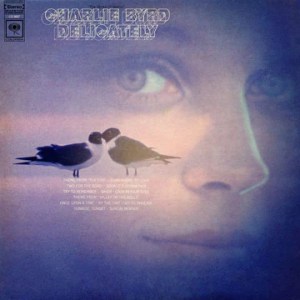

- Superb sound for Byrd’s 1968 release, with solid Double Plus (A++) grades on both sides of this original 360 Stereo pressing
- Teo Macero‘s production here is rich, sweet, and highly resolving, with all the space and three-dimensionality that Frank Laico‘s brilliant engineering is known for
- The music on this enchanting jazz / pop guitar album is every bit as good as the sound quality (and that is rarely the case with these kinds of records – we should know, we’ve played scores of them)
Hearing is definitely believing, especially in our unique corner of the record business — we don’t give a fig about who, why or when a record was made; we just play it and judge it based on what we hear in its grooves. Needless to say. this pressing of the album was judged to be a knockout.
Apparently the album has garnered attention from other audiophiles – HDTracks offers a high-rez digital download of it!
This vintage Columbia 360 Stereo pressing has the kind of Tubey Magical Midrange that modern records rarely even BEGIN to reproduce. Folks, that sound is gone and it sure isn’t showing signs of coming back. If you love hearing INTO a recording, actually being able to “see” the performers, and feeling as if you are sitting in the studio with the band, this is the record for you. It’s what vintage all analog recordings are known for — this sound.
If you exclusively play modern repressings of vintage recordings, I can say without fear of contradiction that you have never heard this kind of sound on vinyl. Old records have it — not often, and certainly not always — but maybe one out of a hundred new records do, and those are some pretty long odds.
What The Best Sides Of Delicately Have To Offer Is Not Hard To Hear
- The biggest, most immediate staging in the largest acoustic space
- The most Tubey Magic, without which you have almost nothing. CDs give you clean and clear. Only the best vintage vinyl pressings offer the kind of Tubey Magic that was on the tapes in 1968
- Tight, note-like, rich, full-bodied bass, with the correct amount of weight down low
- Natural tonality in the midrange — with all the instruments having the correct timbre
- Transparency and resolution, critical to hearing into the three-dimensional studio space
No doubt there’s more but we hope that should do for now. Playing the record is the only way to hear all of the qualities we discuss above, and playing the best pressings against a pile of other copies under rigorously controlled conditions is the only way to find a pressing that sounds as good as this one does.
Copies with rich lower mids and nice extension up top did the best in our shootout, assuming they weren’t veiled or smeary of course. So many things can go wrong on a record! We know, we’ve heard them all.
Top end extension is critical to the sound of the best copies. Lots of old records (and new ones) have no real top end; consequently, the studio or stage will be missing much of its natural air and space, and instruments will lack their full complement of harmonic information.
Tube smear is common to most vintage pressings. The copies that tend to do the best in a shootout will have the least (or none), yet are full-bodied, tubey and rich.
What We’re Listening For On Delicately
- Energy for starters. What could be more important than the life of the music?
- The Big Sound comes next — wall to wall, lots of depth, huge space, three-dimensionality, all that sort of thing.
- Then transient information — fast, clear, sharp attacks, not the smear and thickness so common to these LPs.
- Tight, full-bodied bass — which ties in with good transient information, also the issue of frequency extension further down.
- Next: transparency — the quality that allows you to hear deep into the soundfield, showing you the space and air around all the instruments.
- Extend the top and bottom and voila, you have The Real Thing — an honest to goodness Hot Stamper.
The Players
- Bass – Joe Byrd
- Flute – Mario Darpino
- Guitar – Charlie Byrd
The Players
Bass – Joe Byrd
Flute – Mario Darpino
Guitar – Charlie Byrd
Side One
Theme From “The Fox”
Somewhere, My Love
Theme From “Valley Of The Dolls”
Try To Remember
Two For The Road
When I Look In Your Eyes
Side Two
Walking on a Thin Line
Finally Found a Home
If This Is It
You Crack Me Up
Honky Tonk Blues
Charlie Byrd
Tasteful, low-key, and ingratiatingly melodic, Charlie Byrd had two notable accomplishments to his credit — applying acoustic classical guitar techniques to jazz and popular music and helping to introduce Brazilian music to mass North American audiences.
Born into a musical family, Byrd experienced his first brush with greatness while a teenager in France during World War II, playing with his idol Django Reinhardt. After some postwar gigs with Sol Yaged, Joe Marsala and Freddie Slack, Byrd temporarily abandoned jazz to study classical guitar with Sophocles Papas in 1950 and Andrés Segovia in 1954. However he re-emerged later in the decade gigging around the Washington D.C. area in jazz settings, often splitting his sets into distinct jazz and classical segments.
He started recording for Savoy as a leader in 1957, and also recorded with the Woody Herman Band in 1958-59. A tour of South America under the aegis of the U.S. State Department in 1961, proved to be a revelation, for it was in Brazil that Byrd discovered the emerging bossa nova movement. Once back in D.C., he played some bossa nova tapes to Stan Getz, who then convinced Verve’s Creed Taylor to record an album of Brazilian music with himself and Byrd. That album, Jazz Samba, became a pop hit in 1962 on the strength of the single “Desafinado” and launched the bossa nova wave in North America. Thanks to the bossa nova, several albums for Riverside followed, including the defining Bossa Nova Pelos Passaros, and he was able to land a major contract with Columbia…
In 1973, he formed the group Great Guitars with Herb Ellis and Barney Kessel and also that year, wrote an instruction manual for the guitar that has become widely used. From 1974 onward, Byrd recorded for the Concord Jazz label in a variety of settings, including sessions with Laurindo Almeida and Bud Shank. He died December 2, 1999 after a long bout with cancer.
-Richard S. Ginell for Allmusic