



Insanely good Shootout Winning Triple Plus (A+++) sound on both sides AND fairly quiet vinyl – the best copy to ever hit the site bar none.
Unbeatable richness and freedom from artificiality in the midrange allowed this one to tower over the rest of the field.
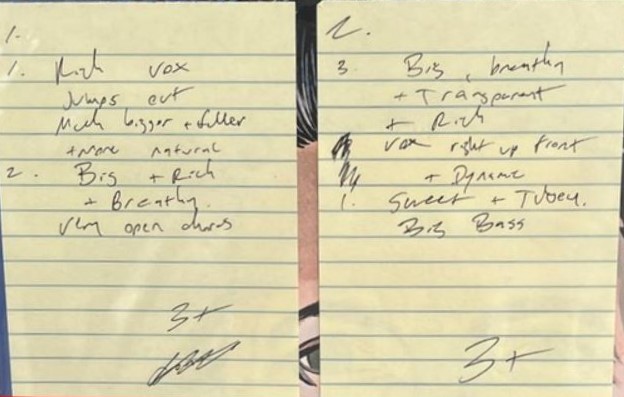

As you can see from the notes, both sides of our most recent White Hot stamper shootout winning copy were doing everything right. We marvelled at these specific qualities in the sound:
Side One
Track one
-
- Rich vocals
- Jumps out
- Much bigger and fuller and more natural
Track two
-
- Big and rich and breathy
- Very open chorus
Side Two
Track three
-
- Big, breathy and transparent and rich
- Vocals are right up front and dynamic
Track one
-
- Sweet and tubey
- Big bass
Midrange presence is one of the most important qualities of any rock or pop recording we might be evaluating, and for a Leonard Cohen album it is absolutely essential.
You want Cohen to be front and center, neither recessed in space nor behind a veil.
The notes for track three on side two say it all:
Vocals are right up front and dynamic
That is what gets this music to sound the way it is supposed to. You can be very sure that no Heavy Vinyl remastered pressing is going to put Leonard Cohen front and center. They practically never do. (Here is an especially offensive remaster with a bad case of recessed vocals. Funny how none of the audiophile reviewers noticed. What does that say about the quality of their playback, or the standards to which they hold their records?)
DIY Advice
To aid you in doing your own evaluations, here is a list of records that we’ve found to be good for testing midrange presence.
This is exactly why we do shootouts. If you really want to be able to recognize subtle (and not so subtle!) differences between pressings, you must learn to do them too.
And make sure to take notes about what you are hearing, good and bad.
We love Cohen’s albums here at Better Records. No, they’re not audiophile spectaculars, but much like the best Dylan recordings, when they work the sound fits the music perfectly.
UPDATE 2025
In previous listings we had noted:
The vocals are right up front and fairly dry, throwing the words and phrasing into high relief.
But we would no longer agree with the vocals being dry. On the best copies they are rich, full-bodied and tubey.
What does that say about the quality of our playback? How about: It’s better now than it used to be!
Side One
The Guests
Humbled In Love
The Window
Came So Far For Beauty
The Lost Canadian (Un Canadien Errant)
Side Two
The Traitor
Our Lady Of Solitude
The Gypsy’s Wife
The Smokey Life
Ballad Of the Absent Mare
AMG 4 Star Review
The first thing Leonard Cohen’s music fans noticed about his sixth new studio album, given the typically open-ended title Recent Songs, was that, musically, it marked a return to the gypsy folk sound of his early records after the incongruous arrangements Phil Spector imposed on its predecessor, Death of a Ladies’ Man, only two years earlier…
Though often abstract, Recent Songs suggested Cohen had regained a certain equilibrium after a long dark period.
The first thing Leonard Cohen’s music fans noticed about his sixth new studio album, given the typically open-ended title Recent Songs, was that, musically, it marked a return to the gypsy folk sound of his early records after the incongruous arrangements Phil Spector imposed on its predecessor, Death of a Ladies’ Man, only two years earlier.
There were subtle musical developments, particularly a flavor of the American Southwest, courtesy of the band Passenger, which played on several tracks, but the acoustic guitars and violin recalled classic Cohen. Fans of the artist’s poetry noticed something else. His writing had become increasingly bitter and angry during the 1970s in the books The Energy of Slaves and Death of a Lady’s Man as well as in his lyrics, but there was a new equanimity in these Recent Songs that began with the welcoming introduction of “The Guests.”
All was not suddenly well, of course, but “the open-hearted many” outnumbered “the broken-hearted few.” Cohen’s usual mixture of religious and sexual imagery in the songs was elegant and evocative rather than painful. If he was conscious of the sacrifices he had made in vain in “Came So Far for Beauty,” he was nevertheless able to make a sincere plea to a woman in “The Window,” mixing it with a prayer to “gentle this soul.”
The album was full of references to absence and dislocation, but Cohen deliberately countered them with humor. The cover of “The Lost Canadian (Un Canadient Errant)” was enlivened by a mariachi arrangement, and the album ended with “Ballad of the Absent Mare,” an allegory about a cowboy’s search for a horse that ended with the suggestion that the pursuit was only a romantic game. Though often abstract, Recent Songs suggested Cohen had regained a certain equilibrium after a long dark period.