

More Recordings with Janos Starker
Hot Stamper Pressings of Mercury Classical Recordings Available Now

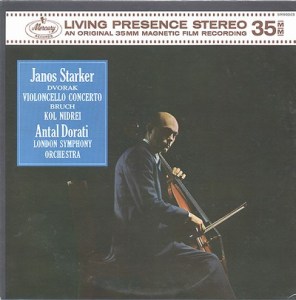
- Starker and the LSO’s sublime performance debuts on the site with the big, lively and rich sound we had been waiting for
- The cello is present and immediate, with sound that is wonderfully full and harmonically natural
- Some old record collectors (like me) say classical recording quality ain’t what it used to be – here’s all the proof anyone with two working ears and top quality audiophile equipment needs to make the case
- As you may well imagine, shootouts for this album are exceedingly rare. For a sought-after TAS List title such as this, we’re lucky to be able to do one every five years or so. Until the next one comes around, please consider trying some of our other classical and orchestral Hot Stamper pressings
Problems in the vinyl are sometimes the nature of the beast with these early pressings, but once you hear just how superb sounding this copy is, you might be inclined, as we were, to stop counting ticks and pops and just be swept away by the music
We wish we could find some quieter copies, but after ten years of searching, we’re fairly resigned to the fact that pressings with the right stampers are so rare that expecting them to be quiet is just asking too much
This vintage Mercury pressing has the kind of Tubey Magical Midrange that modern records can barely BEGIN to reproduce. Folks, that sound is gone and it sure isn’t showing signs of coming back. If you love hearing INTO a recording, actually being able to “see” the performers, and feeling as if you are sitting in the studio with the band, this is the record for you. It’s what vintage all analog recordings are known for — this sound.
If you exclusively play modern repressings of vintage recordings, I can say without fear of contradiction that you have never heard this kind of sound on vinyl. Old records have it — not often, and certainly not always — but maybe one out of a hundred new records do, and those are some pretty long odds.
What The Best Sides Of Dvorak’s Cello Concerto Have To Offer Is Not Hard To Hear
- The biggest, most immediate staging in the largest acoustic space
- The most Tubey Magic, without which you have almost nothing. CDs give you clean and clear. Only the best vintage vinyl pressings offer the kind of Tubey Magic that was on the tapes in 1962
- Tight, note-like, rich, full-bodied bass, with the correct amount of weight down low
- Natural tonality in the midrange — with all the instruments having the correct timbre
- Transparency and resolution, critical to hearing into the three-dimensional studio space
No doubt there’s more but we hope that should do for now. Playing the record is the only way to hear all of the qualities we discuss above, and playing the best pressings against a pile of other copies under rigorously controlled conditions is the only way to find a pressing that sounds as good as this one does.
Copies with rich lower mids and nice extension up top did the best in our shootout, assuming they weren’t veiled or smeary of course. So many things can go wrong on a record. We know, we’ve heard them all.
Top end extension is critical to the sound of the best copies. Lots of old records (and new ones) have no real top end; consequently, the studio or stage will be missing much of its natural air and space, and instruments will lack their full complement of harmonic information.
Tube smear is common to most vintage pressings. The copies that tend to do the best in a shootout will have the least (or none), yet are full-bodied, tubey and rich.
Learning the Record
For our shootout of this album, we had at our disposal a variety of pressings that had the potential for Hot Stamper sound. We cleaned them carefully, then unplugged everything in the house we could, warmed up the system, Talisman’d it, found the right VTA for our Triplanar arm (by ear of course) and proceeded to spend the next hour or so playing copy after copy on side one, after which we repeated the process for side two.
If you have five or more copies of a record and play them over and over against each other, the process itself teaches you what’s right and what’s wrong with the sound of the album. Once your ears are completely tuned to what the best pressings do well that the other pressings do not do as well, using a few carefully chosen passages of music, it quickly becomes obvious how well a given copy can reproduce those passages. You’ll hear what’s better and worse — right and wrong would be another way of putting it — about the sound.
This approach is simplicity itself. First, you go deep into the sound. There you find a critically important passage in the music, one which most copies struggle — or fail — to reproduce as well as the best. Now, with the hard-won knowledge of precisely what to listen for, you are perfectly positioned to critique any and all pressings that come your way.
It may be a lot of work but it sure ain’t rocket science, and we’ve never pretended otherwise. Just the opposite: from day one we’ve explained step by step precisely how to go about finding the Hot Stampers in your own collection. Not the good sounding pressings you happen to own — those may or may not have Hot Stampers — but the records you actually cleaned, shot out, and declared victorious.
What We’re Listening For On Cello Concerto
- Energy for starters. What could be more important than the life of the music?
- The Big Sound comes next — wall to wall, lots of depth, huge space, three-dimensionality, all that sort of thing.
- Then transient information — fast, clear, sharp attacks, not the smear and thickness so common to these LPs.
- Next: transparency — the quality that allows you to hear deep into the soundfield, showing you the space and air around all the instruments.
- Extend the top and bottom and voila, you have The Real Thing — an honest to goodness Hot Stamper.
Side One
Cello Concerto – Dvorak
Allegro
Adagio Ma Non Troppo
Side Two
Cello Concerto – Dvorak
Finale (Allegro Moderato)
Kol Nidrei – Bruch
Cello Concerto (Dvořák)
The Cello Concerto in B minor, Op. 104, B. 191, is the last solo concerto by Antonín Dvořák.
The piece is scored for a full romantic orchestra (with the exception of a 4th horn), containing two flutes (second doubling piccolo), two oboes, two clarinets, two bassoons, three horns, two trumpets, three trombones, tuba, timpani, triangle (last movement only), and strings, and is in the standard three-movement concerto format:
- Allegro (B minor then B major; about 15 minutes)
- Adagio, ma non troppo (G major; about 12 minutes)
- Finale: Allegro moderato — Andante — Allegro vivo (B minor then B major; about 13 minutes)
-Wikipedia
The Cello Concerto was one of only two works Dvořák composed during his last year in New York. Cellist and composer Victor Herbert was Dvořák’s unwitting muse after Dvořák attended a performance of Herbert’s Second Cello Concerto. After the performance, Dvořák is said to have gone backstage, thrown his arms around Herbert, and exclaimed, “Splendid! Splendid!” Dvořák especially liked Herbert’s brilliant use of the cello’s upper registers, which until then Dvořák had regarded as weak and limited. He also observed the three trombones used to accompany the soloist in the slow movement. Dvořák would abandon conventional instrumentation in his own Concerto by adding three trombones, as well as tuba, piccolo, and triangle.
Dvořák’s abandonment of the Classical concerto scoring for a more symphonic orchestra by augmenting the brass with three trombones and tuba could have presented a twofold problem for any soloist: Not only are the brass instruments louder than the cello, but they also play in the same low register. Dvořák skillfully avoids obscuring the cello’s sound by allowing a reversal of roles as the cello at times accompanies the orchestra. There are also a number of lush and prominent solos given to various instruments as well as long passages where the cello is silent. It seems obvious that Dvořák desired his Concerto to be much more a dialogue and less a virtuoso showcase.
The first movement’s opening section is constructed like a symphonic exposition and begins with a theme reminiscent of a funeral march. This dark and brooding theme is soon taken up by the full orchestra, builds to a climax, then gently quiets and gives way to the movement’s second theme, a wonderfully tender melody played by a single horn. The cello’s entrance, marked quasi improvisando, develops in the remote key of A-flat minor over anxious violin and viola tremolando.
The Adagio ma non troppo begins peacefully in G major. The expansive and lyrical development of the first subject leads to a gentle climax and denouement. We are not given time to reflect before the orchestra explodes with a loud and jarring G-minor chord. It is here that Dvořák quotes “Leave Me Alone” from his Four Songs, Op. 82, a favorite of his sister-in-law, Josefina Kaunitzová, with whom a younger Dvořák had fallen in love long before deciding to marry her sister. Josefina, who became gravely ill while the composer was in America, died soon after his return to Bohemia. This quote is sung with passionate intensity by solo cello over anxious arpeggios in the violins. The cello then takes up arpeggios, with woodwinds playing the theme. After passing through several ambiguous tonalities, the opening section repeats and draws the movement to a reluctant close.
The finale is a lively, dance-like movement partly shaped by Dvořák’s warm thoughts of his impending return home to Bohemia. The melancholy and longing of the first two movements is cast off and replaced with an exuberant hopefulness. Once in the bright key of B major, the soloist joins solo violin in a duet of absolute warmth and brilliance. The movement includes one last reference to “Leave Me Alone,” this time in a major key, as well as subtle echoes of the first movement’s theme. A brilliant crescendo for the full orchestra takes us to the thunderous final chords.
—J. Anthony McAlister, LAPhil.com