More Imported Pressings on Decca and London

- With two INSANELY GOOD Shootout Winning Triple Plus (A+++) sides, this copy of this orchestral spectacular (the first to hit the site in over two and a half years) is certainly as good as we have ever heard
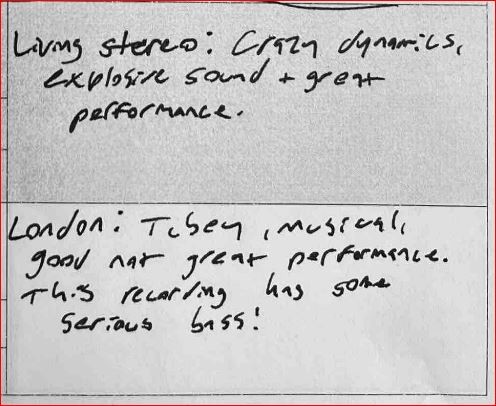
- Here are just a few of the things we had to say about this amazing copy in our notes: “big and spacious with textured strings”…”fully extended from top to bottom”…”tubey bass and brass”…”huge and open”…”rich and transparent”
- We love the performance of The Paris Conservatoire Orchestra under Argenta, and this original London pressing shows you just how well recorded that performance was back in 1958
- The sound is clear and open and wonderfully smooth and the bottom is big — the tympani and lower strings are powerful and dynamic
- You will have a hard time finding better sound in the lower registers for this work — most of the pressings we’ve played were simply too anemic to take seriously
- Marks and problems in the vinyl are sometimes the nature of the beast with these early pressings, but once you hear just how stunning sounding this copy is, you might be inclined, as we were, to stop counting ticks and pops and just be swept away by the music
- It’s worth noting that this is the only copy from our shootout that will make it to the site this time ’round – all of the others had far worse issues that rendered them unacceptable for listing, so those of you hoping for a Nearly White Hot or Super Hot copy with audiophile surfaces and no marks that play are going to be almost as disappointed as we were
This original London pressing has the kind of Tubey Magical Midrange that modern records can barely BEGIN to reproduce. Folks, that sound is gone and it sure isn’t showing signs of coming back. If you love hearing INTO a recording, actually being able to “see” the performers, and feeling as if you are sitting in the studio with the band, this is the record for you. It’s what vintage all analog recordings are known for —this sound.
If you exclusively play modern repressings of vintage recordings, I can say without fear of contradiction that you have never heard this kind of sound on vinyl. Old records have it — not often, and certainly not always — but maybe one out of a hundred new records do, and those are some pretty long odds.
What the Best Sides of Symphonie Fantastique Have to Offer Is Not Hard to Hear
- The biggest, most immediate staging in the largest acoustic space
- The most Tubey Magic, without which you have almost nothing. CDs give you clean and clear. Only the best vintage vinyl pressings offer the kind of Tubey Magic that was on the tapes in 1958
- Tight, note-like, rich, full-bodied bass, with the correct amount of weight down low
- Natural tonality in the midrange — with all the instruments having the correct timbre
- Transparency and resolution, critical to hearing into the three-dimensional studio space
No doubt there’s more but we hope that should do for now. Playing the record is the only way to hear all of the qualities we discuss above, and playing the best pressings against a pile of other copies under rigorously controlled conditions is the only way to find a pressing that sounds as good as this one does.
Copies with rich lower mids and nice extension up top did the best in our shootout, assuming they weren’t veiled or smeary of course. So many things can go wrong on a record! We know, we’ve heard them all.
Top end extension is critical to the sound of the best copies. Lots of old records (and new ones) have no real top end; consequently, the studio or stage will be missing much of its natural air and space, and instruments will lack their full complement of harmonic information.
Tube smear is common to most vintage pressings and this is no exception. The copies that tend to do the best in a shootout will have the least (or none), yet are full-bodied, tubey and rich.
What We’re Listening For on Symphonie Fantastique
- Energy for starters. What could be more important than the life of the music?
- The Big Sound comes next — wall to wall, lots of depth, huge space, three-dimensionality, all that sort of thing.
- Then transient information — fast, clear, sharp attacks, not the smear and thickness so common to these LPs.
- Next: transparency — the quality that allows you to hear deep into the soundfield, showing you the space and air around all the instruments.
- Extend the top and bottom and voila, you have The Real Thing — an honest to goodness Hot Stamper.
Our Difficulty of Reproduction Scale
This album is especially Difficult to Reproduce. Do not attempt to play it on anything but the highest quality equipment.
It took a long time to get to the point where we could clean the record properly, twenty years or so, and about the same amount of time to get the stereo to the level it needed to be, involving, you guessed it, many of the Revolutionary Changes in Audio we tout so obsessively.
It’s not easy to find a pressing with the low end whomp factor, midrange energy and overall dynamic power that this music needs, and it takes one helluva stereo to play one too.
As we’ve said before, these kinds of recordings – Ambrosia; Blood, Sweat and Tears; The Yes Album; Dark Side of the Moon, Led Zeppelin II – they are designed to bring an audio system to its knees.
If you have the kind of big system that a record like this demands, when you drop the needle on the best of our Hot Stamper pressings, you are going to hear some amazing sound .
A Must Own Classical Record
This Demo Disc Quality recording should be part of any serious Classical Music Collection. Others that belong in that category can be found here.
Side One
Rêveries, Passions (Largo – Allegro Agitato Ed Appassionato Assai)
Un Bal (Valse: Allegro Non Troppo)
Scène Aux Champs (Adagio) (Pt. 1)
Side Two
Scène Aux Champs (Adagio) (Pt. 2)
Marche Au Supplice (Allegretto Non Troppo)
Songe D’Une Nuit Du Sabbat (Larghetto – Allegro)
Symphonie Fantastique
Symphonie fantastique is a program symphony written by the French composer Hector Berlioz in 1830. It is an important piece of the early Romantic period.
Leonard Bernstein described the symphony as the first musical expedition into psychedelia because of its hallucinatory and dream-like nature, and because history suggests Berlioz composed at least a portion of it under the influence of opium. According to Bernstein, “Berlioz tells it like it is. You take a trip, you wind up screaming at your own funeral.”
-Wikipedia