

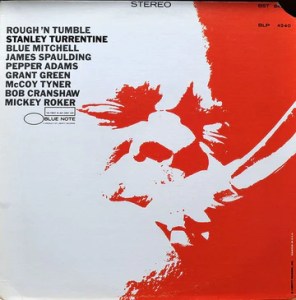

- Boasting INCREDIBLE Shootout Winning Triple Plus (A+++) sound or close to it from first note to last, we guarantee you’ve never heard this kind of life and energy on any other Stanley Turrentine album – remarkably quiet vinyl too
- It’s rare for us to find New York label stereo pressings in audiophile playing condition, but here’s a killer one, and it simply takes the recording (and the music) to another level
- This session boasts all the top players: Blue Mitchell, Pepper Adams, McCoy Tyner, Grant Green, Bob Cranshaw, and Mickey Roker and more
- “…the star of the show is Turrentine, and his warmth and playing make this a necessity, especially for fans ’60s pre-funk Blue Note jazz.”
- If you’re a fan of Stanley’s, this title from 1966 is clearly one of his best, and one of his best sounding
This vintage Blue Note stereo pressing has the kind of Tubey Magical Midrange that modern records can barely BEGIN to reproduce. Folks, that sound is gone and it sure isn’t showing signs of coming back. If you love hearing INTO a recording, actually being able to “see” the performers, and feeling as if you are sitting in the studio with the band, this is the record for you. It’s what vintage all analog recordings are known for — this sound.
If you exclusively play modern repressings of vintage recordings, I can say without fear of contradiction that you have never heard this kind of sound on vinyl. Old records have it — not often, and certainly not always — but maybe one out of a hundred new records do, and those are some pretty long odds.
What The Best Sides Of Rough ‘N Tumble Have To Offer Is Not Hard To Hear
- The biggest, most immediate staging in the largest acoustic space
- The most Tubey Magic, without which you have almost nothing. CDs give you clean and clear. Only the best vintage vinyl pressings offer the kind of Tubey Magic that was on the tapes in 1966
- Tight, note-like, rich, full-bodied bass, with the correct amount of weight down low
- Natural tonality in the midrange — with all the instruments having the correct timbre
- Transparency and resolution, critical to hearing into the three-dimensional studio space
No doubt there’s more but we hope that should do for now. Playing the record is the only way to hear all of the qualities we discuss above, and playing the best pressings against a pile of other copies under rigorously controlled conditions is the only way to find a pressing that sounds as good as this one does.
The Right Sound For This Many Horn Players
Top end extension is critical to the sound of the better copies. Lots of old records (and new ones) have no real top end; consequently, the studio or stage will be missing much of its natural air and space, and instruments will lack the full complement of harmonic information.
In addition, when the top end is lacking, the upper midrange and high frequencies get jammed together — the highs can’t extend up and away from the upper mids. This causes a number of much-too-common problems that we hear in the upper midrange of many of the records we play: congestion, hardness, harshness, and squawk.
(Painstaking Vertical Tracking Angle adjustment is absolutely critical if you want your records to play with the least amount of these problems, a subject we discuss in the Commentary section of the site at length.)
Smear is common to most pressings from the ’50s and ’60s. The copies that tend to do the best in a shootout will have little or none, yet are full-bodied, tubey and rich.
Full-bodied sound is especially critical to the horns; any blare, leanness or squawk ruins at least some of the fun, certainly at the louder levels the record should be playing at.
The frequency extremes (on the better copies) are not boosted in any way. When you play this record quietly, the bottom and top will disappear (due to the way the ear handles quieter sounds as described by the Fletcher-Munson curve).
Most records (like most audiophile stereos) are designed to sound correct at moderate levels. Not this album. It wants you to turn it up. Only then will everything sound completely right musically and tonally from top to bottom.
What We’re Listening For On Rough ‘N Tumble
- Energy for starters. What could be more important than the life of the music?
- Then: presence and immediacy. The musicians aren’t “back there” somewhere, way behind the speakers. They’re front and center where any recording engineer — Rudy Van Gelder in this case — would have put them.
- The Big Sound comes next — wall to wall, lots of depth, huge space, three-dimensionality, all that sort of thing.
- Then transient information — fast, clear, sharp attacks, not the smear and thickness so common to these LPs.
- Tight, full-bodied bass — which ties in with good transient information, also the issue of frequency extension further down.
- Next: transparency — the quality that allows you to hear deep into the soundfield, showing you the space and air around all the instruments.
- Extend the top and bottom and voila, you have The Real Thing — an honest to goodness Hot Stamper.
The Players
- Alto Saxophone – James Spaulding
- Arranged By – Duke Pearson
- Baritone Saxophone – Pepper Adams
- Bass – Bob Cranshaw
- Drums – Mickey Roker
- Guitar – Grant Green
- Piano – McCoy Tyner
- Trumpet – Blue Mitchell
Vinyl Condition
Mint Minus Minus is about as quiet as any vintage pressing will play, and since only the right vintage pressings have any hope of sounding good on this album, that will most often be the playing condition of the copies we sell. (The copies that are even a bit noisier get listed on the site are seriously reduced prices or traded back in to the local record stores we shop at.)
Those of you looking for quiet vinyl will have to settle for the sound of other pressings and Heavy Vinyl reissues, purchased elsewhere of course as we have no interest in selling records that don’t have the vintage analog magic of these wonderful recordings.
If you want to make the trade-off between bad sound and quiet surfaces with whatever Heavy Vinyl pressing might be available, well, that’s certainly your prerogative, but we can’t imagine losing what’s good about this music — the size, the energy, the presence, the clarity, the weight — just to hear it with less background noise.
TRACK LISTING
Side One
And Satisfy
What Could I Do Without You
Feeling Good
Side Two
Shake
Walk On By
Baptismal
AMG Review
In the mid- to late ’60s, Blue Note was beginning to take on the affectations of funk and a new kind of “cool.” For the most part, Turrentine steers clear of that style, and Rough ‘n’ Tumble is a pretty straight-ahead set, especially for 1966. “And Satisfy” and “Feelin’ Good” typify the comfortable sessions, and both show off Turrentine’s trademark tasteful playing.
To its credit, Rough ‘n’ Tumble isn’t rife with covers of songs that were doomed to be ephemeral, and Turrentine tackled two of the more lasting songs. His cover of Sam Cooke’s “Shake” adheres closely to the original. Bacharach and David no doubt figured into jazz albums of the time, and “Walk On By” gets a suitably downcast reading here.
The album’s final track, the intricate “Baptismal,” seems to get most of Turrentine’s attention, and the song is perfect for his emotional yet poised playing technique. Rough ‘n’ Tumble features a great lineup of players, including Pepper Adams, Blue Mitchell, and McCoy Tyner …