

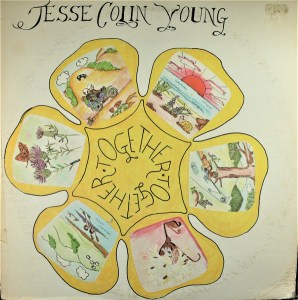

- Together returns to the site with outstanding Double Plus (A++) sound from first note to last
- The sound here is richer, fuller, more musical and more natural – Young’s breathy voice is reproduced with a solidity and immediacy that’s not easy to find on vinyl
- As an eclectic collection of both covers and original material, this album showcases Jesse’s versatility and expansive artistic range
- “[Young] played favorite songs from a variety of genres… Having covered those bases, Young also introduced some timely originals, such as “Peace Song,” an anti-war anthem, and “Good Times,” which was very reminiscent of the rustic sound Van Morrison had found recently on such albums as Tupelo Honey.”
This vintage Warner Bros. stereo pressing has the kind of Tubey Magical Midrange that modern records rarely even BEGIN to reproduce. Folks, that sound is gone and it sure isn’t showing signs of coming back. If you love hearing INTO a recording, actually being able to “see” the performers, and feeling as if you are sitting in the studio with the Young, this is the record for you. It’s what vintage all analog recordings are known for — this sound.
If you exclusively play modern repressings of vintage recordings, I can say without fear of contradiction that you have never heard this kind of sound on vinyl. Old records have it — not often, and certainly not always — but maybe one out of a hundred new records do, and those are some pretty long odds.
What the best sides of Together have to offer is not hard to hear:
- The biggest, most immediate staging in the largest acoustic space
- The most Tubey Magic, without which you have almost nothing. CDs give you clean and clear. Only the best vintage vinyl pressings offer the kind of Tubey Magic that was on the tapes in 1972
- Tight, note-like, rich, full-bodied bass, with the correct amount of weight down low
- Natural tonality in the midrange — with all the instruments having the correct timbre
- Transparency and resolution, critical to hearing into the three-dimensional space of the studio
No doubt there’s more but we hope that should do for now. Playing the record is the only way to hear all of the qualities we discuss above, and playing the best pressings against a pile of other copies under rigorously controlled conditions is the only way to find a pressing that sounds as good as this one does.
What We’re Listening For on Together
- Energy for starters. What could be more important than the life of the music?
- The Big Sound comes next — wall to wall, lots of depth, huge space, three-dimensionality, all that sort of thing.
- Then transient information — fast, clear, sharp attacks, not the smear and thickness common to most LPs.
- Tight, note-like bass with clear fingering — which ties in with good transient information, as well as the issue of frequency extension further down.
- Next: transparency — the quality that allows you to hear deep into the soundfield, showing you the space and air around all the players.
- Then: presence and immediacy. The musicians aren’t “back there” somewhere, way behind the speakers. They’re front and center where any recording engineer worth his salt would have put them.
- Extend the top and bottom and voila, you have The Real Thing — an honest to goodness Hot Stamper.
TRACK LISTING
Side One
Good Times
Sweet Little Child
Together
Sweet Little Sixteen
Peace Song
Side Two
Six Days On The Road
It’s A Lovely Day
Creole Belle
6000 Miles
Born In Chicago
Pastures Of Plenty
AMG Review
Made while the Youngbloods were still together, Jesse Colin Young’s first solo album since 1965’s Young Blood was a busman’s holiday on which he played favorite songs from a variety of genres — ’50s rock & roll (Chuck Berry’s “Sweet Little 16”), country (the Dave Dudley hit “6 Days on the Road”), folk-blues (Mississippi John Hurt’s “Creole Belle”), Chicago blues (the Butterfield Blues Band song “Born in Chicago”), and folk (Woody Guthrie’s “Pastures of Plenty”).
Having covered those bases, Young also introduced some timely originals, such as “Peace Song,” an anti-war anthem, and “Good Times,” which was very reminiscent of the rustic sound Van Morrison had found recently on such albums as Tupelo Honey. It all made for an enjoyable, if unambitious album that reached the charts for several weeks, which inspired Young to give the Youngbloods notice and, after one more album and tour with them, relaunch his solo career full-time.