

More Paul Simon
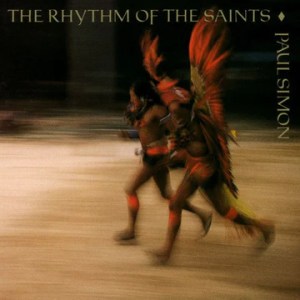

- The Rhythm of the Saints finally makes its Hot Stamper debut here with a Shootout Winning Triple Plus (A+++) side two married with an outstanding Double Plus (A++) side one
- Richer, warmer, more natural, more relaxed, this is what vintage analog is all about, that smooth sound that never calls attention to itself and just lets the music flow
- 4 stars: “Though he recorded the album’s prominent percussion tracks in Brazil, Paul Simon fashioned The Rhythm of the Saints as a deliberate follow-up to the artistic breakthrough and commercial comeback that was the South Africa-tinged Graceland.”
*NOTES: On side one, a tiny mark makes 4 light ticks during the outro of Track 1, The Obvious Child.
This vintage Warner Bros. pressing has the kind of Tubey Magical Midrange that modern records rarely even BEGIN to reproduce. Folks, that sound is gone and it sure isn’t showing signs of coming back. If you love hearing INTO a recording, actually being able to “see” the performers, and feeling as if you are sitting in the studio with the band, this is the record for you. It’s what vintage all analog recordings are known for — this sound.
If you exclusively play modern repressings of vintage recordings, I can say without fear of contradiction that you have never heard this kind of sound on vinyl. Old records have it — not often, and certainly not always — but maybe one out of a hundred new records do, and those are some pretty long odds.
What the best sides of The Rhythm of the Saints have to offer is not hard to hear:
- The biggest, most immediate staging in the largest acoustic space
- The most Tubey Magic, without which you have almost nothing. CDs give you clean and clear. Only the best vintage vinyl pressings offer the kind of Tubey Magic that was on the tapes even as late as 1990
- Tight, note-like, rich, full-bodied bass, with the correct amount of weight down low
- Natural tonality in the midrange — with all the instruments having the correct timbre
- Transparency and resolution, critical to hearing into the three-dimensional space of the studio
No doubt there’s more but we hope that should do for now. Playing the record is the only way to hear all of the qualities we discuss above, and playing the best pressings against a pile of other copies under rigorously controlled conditions is the only way to find a pressing that sounds as good as this one does.
What We’re Listening For on The Rhythm of the Saints
- Energy for starters. What could be more important than the life of the music?
- The Big Sound comes next — wall to wall, lots of depth, huge space, three-dimensionality, all that sort of thing.
- Then transient information — fast, clear, sharp attacks for the guitars, horns and drums, not the smear and thickness common to most LPs.
- Tight, note-like bass with clear fingering — which ties in with good transient information, as well as the issue of frequency extension further down.
- Next: transparency — the quality that allows you to hear deep into the soundfield, showing you the space and air around all the players.
- Then: presence and immediacy. The vocals aren’t “back there” somewhere, way behind the speakers. They’re front and center where any recording engineer worth his salt would have put them.
- Extend the top and bottom and voila, you have The Real Thing — an honest to goodness Hot Stamper.
TRACK LISTING
Side One
The Obvious Child
Can’t Run But
The Coast
Proof
Further To Fly
Side Two
She Moves On
Born At The Right Time
The Cool, Cool River
Spirit Voices
The Rhythm Of The Saints
AMG 4 Star Review
Though he recorded the album’s prominent percussion tracks in Brazil, Paul Simon fashioned The Rhythm of the Saints as a deliberate follow-up to the artistic breakthrough and commercial comeback that was the South Africa-tinged Graceland. Several of the musicians who had appeared previously were back, along with some of the New York session players who had worked with Simon in the 1970s, and the overall sound was familiar to fans of Graceland.
Further, Simon’s nonlinear lyrical approach was carried over: he continued to ruminate about love, aging, and the onslaught of modern life in disconnected phrases and images that created impressions rather than telling straightforward stories.