

More of the Music of Ludwig van Beethoven
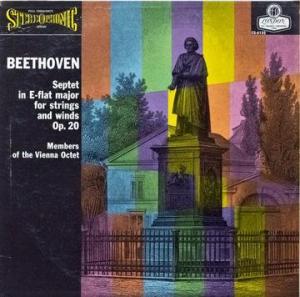

- With outstanding grades on both sides, the sound here is realistic and natural, if not DEMO DISC quality
- Both sides are full, rich, spacious, big and present, with no smear and a healthy dose of Tubey Magic
- At the right level, the level at which these instruments are heard in performance, the sound is perfection
- We’ve been raving about this album forever, on Blueback and on UK Stereo Treasury – both can be superb
We normally do not put as much effort into finding top quality pressings of chamber music as we do for the large orchestral works favored by audiophiles (or at least the audiophiles who are willing to spend the money to buy our records), works such as Scheherazade and The Planets. However, if more of them sounded as good as this one we would be more than happy to do just that.
This vintage London pressing (the first cover pictured is the one on offer here) has the kind of Tubey Magical Midrange that modern records can barely BEGIN to reproduce. Folks, that sound is gone and it sure isn’t showing signs of coming back. If you love hearing INTO a recording, actually being able to “see” the performers, and feeling as if you are sitting in the studio with the band, this is the record for you. It’s what vintage all analog recordings are known for — this sound.
If you exclusively play modern repressings of vintage recordings, I can say without fear of contradiction that you have never heard this kind of sound on vinyl. Old records have it — not often, and certainly not always — but maybe one out of a hundred new records do, and those are some pretty long odds.
What the Best Sides of This Wonderful Classical Release Have to Offer Is Not Hard to Hear
- The biggest, most immediate staging in the largest acoustic space
- The most Tubey Magic, without which you have almost nothing. CDs give you clean and clear. Only the best vintage vinyl pressings offer the kind of Tubey Magic that was on the tapes in 1960
- Tight, note-like, rich, full-bodied bass, with the correct amount of weight down low
- Natural tonality in the midrange — with all the instruments having the correct timbre
- Transparency and resolution, critical to hearing into the three-dimensional studio space
No doubt there’s more but we hope that should do for now. Playing the record is the only way to hear all of the qualities we discuss above, and playing the best pressings against a pile of other copies under rigorously controlled conditions is the only way to find a pressing that sounds as good as this one does.
The Legendary Decca Tree Sound
On the best pressings, the sound is both rich and sweet, with easily recognized, unerringly correct timbres for all seven of the instruments in the work. The legendary 1960 Decca Tree microphone setup had worked its magic once again. The sound is spacious and exceptionally transparent.
If you want to hear a gorgeous clarinet, this is the album for you. So big and open, with space for every player, each of them clearly laid out across the stage, this is vintage analog at its best.
This is precisely what careful shootouts and critical listening are all about. If you like Heavy Vinyl, what exactly is your frame of reference? How many good early pressings could you possibly own, and how were they cleaned?
Without the best pressings around to compare, Heavy Vinyl can sound fine; it’s only when you have something better that its faults come into focus. (We, of course, have something much, much better, and we like to call them Hot Stampers!)
What We’re Listening For on Beethoven’s Septet In E Minor
- Energy for starters. What could be more important than the life of the music?
- The Big Sound comes next — wall to wall, lots of depth, huge space, three-dimensionality, all that sort of thing.
- Then transient information — fast, clear, sharp attacks, not the smear and thickness so common to these LPs.
- Next: transparency — the quality that allows you to hear deep into the soundfield, showing you the space and air around all the instruments.
- Extend the top and bottom and voila, you have The Real Thing — an honest to goodness Hot Stamper.
Moon and Gray
The famous Moon and Gray London/Decca guide raves about this title, scoring it for music and sound at 9 each. I don’t always agree with their estimates — knowing that they could not possibly have the number of copies necessary to definitively judge the vast majority of titles they’ve written about, how could I? — but here I would agree completely.
A nearly flawless recording with a performance to match.
Side One
Adagio – Allegro Con Brio
Adagio Cantabile
Tempo Di Minuetto
Side Two
Tema Con Variazioni. Andante
Scherzo: Allegro Molto E Vivace
Andante Con Moto Alla Marcia – Presto
Review
The Septet in E-flat major, Opus 20, by Ludwig van Beethoven, was sketched out in 1799, completed and first performed in 1800 and published in 1802. The score contains the notation: “Der Kaiserin Maria Theresia gewidmet”, or translated, “Dedicated to the Empress Maria Theresa.” It is scored for clarinet, horn, bassoon, violin, viola, cello, and double bass. It is in six movements.


The scoring of the Septet for a single clarinet, horn and bassoon (rather than for pairs of these wind instruments) was innovative. So was the usually prominent role of the clarinet, as important as the violin, quite innovative.
The Septet was one of Beethoven’s most successful and popular works and circulated in many editions and arrangements for different forces. In about 1803 Beethoven himself arranged the work as a Trio for clarinet (or violin), cello and piano, and this version was published as his op. 38 in 1805.
Wikipedia