

Lately I have been listening to this piece of music from start to finish over and over again, at this point easily ten times through, immersed in the glorious display of more orchestral color than one could possibly imagine in a single piece of music (including The Planets I dare say), in all of 35 minutes no less.
What triggered this behavior you ask? Hearing it performed live a few months back (5/2026?) planted the seed, and rediscovering the CD in my collection allowed me to get obsessed with it, something I tend to do when a piece of music is as full of life as this one is. We describe Muti’s performance of the work this way:
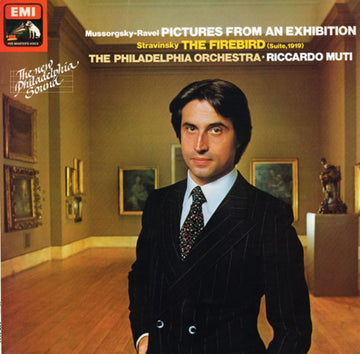
The EMI import pressing you see here gives you the complete Pictures at an Exhibition with a top performance and superb sonics.
Pictures is a piece of music that has been recorded countless times. I’ve played scores of different recordings starting at about the age of twenty, but the only one that still satisfies is this one, Muti’s 1979 recording with the Philadelphia Orchestra. Much like Previn and the LSO’s performance of The Planets, he brings out musical qualities in the work better than any other conductor with which I am familiar.
If I were limited to only one record to test a system with, it would be hard to choose a better one than a top copy of the Muti on EMI. (It’s almost, but not quite, all you would need.)
My advice would be to go and find yourself a clean UK pressing as quickly as possible.
It may eventually become your favorite orchestral recording of all time the way it has become mine, at the tender age of 72 in my case!

In the meantime, check out the wonderful performance recorded by the Oslo Philharmonic available on youtube. If you have big speakers hooked up to your TV and are willing and able to play them good and loud, you are in for a treat.
The performance is easily one of the best I’ve ever heard, although a bit slower and more measured than ideal. However, it would clearly be superior to those on offer by second- and third-rate orchestras, of which there are many in my experience.
Here is the precision and energy that is surely missing from those performances, as well as most recordings truth be told, whether analog or digital. (The CD on EMI by the way is excellent and highly recommended.) As I said, the pacing is a bit slow, but the ability to see all the players and their instruments is a huge bonus on a powerful work such as this.
List of Instruments (AI Assisted)
-
Woodwinds: 3 Flutes (1 doubling piccolo), 3 Oboes (1 doubling English horn), 2 Clarinets, 1 Bass Clarinet, 2 Bassoons, 1 Contrabassoon, and 1 Alto Saxophone (featured prominently in The Old Castle).
-
Brass: 4 Horns, 3 Trumpets, 3 Trombones, 1 Tuba, and 1 Euphononium (or Saxhorn, often performed on Euphonium or Tuba for the Bydło soloist movement).
-
Percussion: Timpani, Snare Drum, Bass Drum, Cymbals, Triangle, Tam-tam (Gong), Tubular Bells, Glockenspiel, Whip (Slapstick), and Xylophone.
-
Keyboards & Harp: Celesta and 2 Harps.
-
Strings: First and Second Violins, Violas, Cellos, and Double Basses.
For his 1979 review of the Mussorgsky, Robert Layton in the GRAMOPHONE writes of Muti and The Philadelphia Orchestra :
…what orchestral playing they offer us. The lower strings in ‘Samuel Goldenberg and Schmuyle’ have an extraordinary richness, body and presence, and “Baba Yaga”, which opens the second side, has an unsurpassed virtuosity and attack as well as being of demonstration standard as a recording. The glorious body of tone, the richly glowing colours, the sheer homogeneity of the strings and perfection of the ensemble is a constant source of pleasure.
If only I could write like that!
Pictures at an Exhibition – NPR Background by Ted Libby
As an orchestral showpiece – the form in which it is familiar to most listeners – Pictures at an Exhibition is two times over a work of enlargement. Moussorgsky’s original suite for piano, composed in 1874 as a memorial to the painter Victor Hartmann, took as its point of departure ten pictures displayed at a posthumous exhibition of the artist’s work.
Though pianistically crude, Moussorgsky’s renderings of his friend’s images convey their rich fantasy with sincerity and great imaginative force. Ravel’s celebrated orchestration of Pictures at an Exhibition, undertaken in 1922 at the request of conductor Serge Koussevitzky, in turn faithfully amplifies both the wit and deep feeling of Moussorgsky’s tribute.
One is surprised, listening to the orchestral version, to discover that Hartmann’s originals were modest little sketches and watercolors. For example, the Ballet of Chicks in their Shells was inspired by a whimsical costume sketch for a children’s ballet. Moussorgsky had turned that into a lively scene painting, and Ravel’s scoring, with its clucking oboes and scurrying scale passages in the bassoon and strings, transforms the children in their eggshell costumes into real chicks.
The inspiration for The Hut on Fowl’s Legs came from a quaint design for a clock in the shape of cabin built on a chicken’s feet – the unlikely abode of the witch Baba Yaga. Moussorgsky decided to portray the legendary hag’s frightful ride through the air. Ravel marshals the heavy brass and a business-like array of percussion to create a thunderous chase.
In The Great Gate of Kiev, the most breathtaking and at the same time most touching part of the suite, Moussorgsky apostrophized his departed friend with a monumental realization of Hartmann’s lopsided, ornately decorated drawing of a city gate in the old Russian style, with a cupola in the shape of a helmet surmounting the gatehouse.
Based on the theme Moussorgsky called Promenade – which opens Pictures at an Exhibition and is meant to depict the viewer’s passing from one work to the next – this finale was the composer’s way of saying farewell and, at least in music, giving substance to one of his friend’s fondest dreams. In Ravel’s hands, Moussorgsky’s vision of a gate that was never built becomes one of the architectural wonders of the world, magnificently brought to life by full brass, pulsing strings, pealing bells, and triumphant cymbals.
Further Reading
- New to the Blog? Start here
- Big speakers and loud levels bring out the power of the orchestra
- Orchestral recordings are the only way to get to the highest levels in audio