

More of the Music of Queen
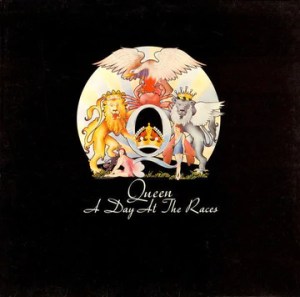

- Boasting INCREDIBLE Shootout Winning Triple Plus (A+++) grades or close to them from top to bottom, you’ll have a hard time finding a copy that sounds remotely as good as this vintage UK pressing
- We shot out a number of other imports and the midrange presence, bass, and dynamics on this outstanding copy placed it head and shoulders above most other pressings we played
- You may be interested in reading about a copy very much like this one that fell short in one aspect of sound important to us (and we hope you as well)
- Forget the domestic pressings – they may be cut at Sterling, but they never sound like these shockingly good British LPs
- “A Day at the Races is a bit tighter than its predecessor… its sleek, streamlined finish is the biggest indication that Queen has entered a new phase, where they’re globe-conquering titans instead of underdogs on the make.”
- If you’re a Queen fan, their 1976 followup to A Night at the Opera is surely a Must Own
- The complete list of titles from 1976 that we’ve reviewed to date — more than one hundred as of 2026 — can be found here
Forget the dubby domestic pressings and whatever crappy Heavy Vinyl record they’re making these days — the UK LPs are the only way to fly.
This British pressing has the kind of Tubey Magical Midrange that most modern records barely begin to reproduce.
Folks, that sound is gone and it sure isn’t showing signs of coming back. If you love hearing INTO a recording, actually being able to “see” the performers, and feeling as if you are sitting in the studio with the band, this is the record for you. It’s what vintage all analog recordings are known for — this sound.
If you exclusively play modern repressings of vintage recordings, I can say without fear of contradiction that you have never heard this kind of sound on vinyl. Old records have it — not often, and certainly not always — but maybe one out of a hundred new records do, and those are some pretty long odds.
What The Best Sides Of A Day At The Races Have To Offer Is Not Hard To Hear
- The biggest, most immediate staging in the largest acoustic space
- The most Tubey Magic, without which you have almost nothing. CDs give you clean and clear. Only the best vintage vinyl pressings offer the kind of Tubey Magic that was on the tapes in 1976
- Tight, note-like, rich, full-bodied bass, with the correct amount of weight down low
- Natural tonality in the midrange — with all the instruments having the correct timbre
- Transparency and resolution, critical to hearing into the three-dimensional space of the studio
No doubt there’s more but we hope that should do for now. Playing the record is the only way to hear all of the qualities we discuss above, and playing the best pressings against a pile of other copies under rigorously controlled conditions is the only way to find a pressing that sounds as good as this one does.
Many copies were gritty, some were congested in the louder sections, some never got big, some were thin and lacking the lovely analog richness of the best — we heard plenty of copies whose faults were obvious when played against two top sides such as these.
What We’re Listening For On A Day At The Races
- Energy for starters. What could be more important than the life of the music?
- The Big Sound comes next — wall to wall, lots of depth, huge space, three-dimensionality, all that sort of thing.
- Then transient information — fast, clear, sharp attacks, not the smear and thickness common to most LPs.
- Tight, note-like bass with clear fingering — which ties in with good transient information, as well as the issue of frequency extension further down.
- Next: transparency — the quality that allows you to hear deep into the soundfield, showing you the space and air around all the players.
- Then: presence and immediacy. The vocals aren’t “back there” somewhere, way behind the speakers. They’re front and center where any recording engineer worth his salt — Mike Stone in this case — would have put them.
- Extend the top and bottom and voila, you have The Real Thing — an honest to goodness Hot Stamper.
Choruses Are Key
Three distinctive qualities of vintage analog recordings — richness, sweetness, and freedom from artificiality — are most clearly heard on a big production rock record like A Day At The Races in the loudest, densest, most climactic choruses of songs like “Tie Your Mother Down” (side one) and “Somebody to Love” (side two).
We set the playback volume so that the loudest parts of the record are as huge and powerful as they can possibly become without crossing the line into distortion or congestion. On some records, Dark Side of the Moon comes instantly to mind, the guitar solos on “Money” are the loudest thing on the record.
On Breakfast In America, the sax toward the end of “The Logical Song” is bigger and louder than anything on the record — louder even than Roger Hodgson’s near-hysterical multi-tracked screaming ‘Who I am’ about three quarters of the way through the track. Those, however, are clearly exceptions to the rule. Most of the time it’s the final chorus of a pop song that gets bigger and louder than what has come before.
A pop song is usually designed to build momentum as it works its way through the verses and choruses, past the bridge, coming back around to make one final push, releasing all its energy in the final chorus, the climax of the song. On a good recording — one with real dynamics — that part of the song should be very loud and very powerful.
The climax of the biggest, most dynamic songs are almost always the toughest tests for a pop record, and it’s the main reason we play our records loud. The copies that hold up through the final choruses of their album’s largest scaled productions are the ones that provide the biggest thrills and the most emotionally powerful musical experiences one can have sitting in front of two speakers. Our Top 100 is full of records that reward that kind of intense listening at loud levels.
We live for that sound here at Better Records. It’s precisely what the best vintage analog pressings do brilliantly. In fact, they do it so much better than any other medium that there is really no comparison, and certainly no substitute. If you’re on this site you probably already know that.
Side One
Tie Your Mother Down
You Take My Breath Away
Long Away
The Millionaire Waltz
You and I
Side Two
Somebody to Love
White Man
Good Old-Fashioned Lover Boy
Drowse
Teo Torriatte (Let Us Cling Together)
AMG Review
In every sense, A Day at the Races is an unapologetic sequel to A Night at the Opera, the 1975 breakthrough that established Queen as rock & roll royalty. The band never attempts to hide that the record is a sequel — the two albums boast the same variation on the same cover art, the titles are both taken from old Marx Brothers films and serve as counterpoints to each other.
But even though the two albums look the same, they don’t quite sound the same, A Day at the Races is a bit tighter than its predecessor… its sleek, streamlined finish is the biggest indication that Queen has entered a new phase, where they’re globe-conquering titans instead of underdogs on the make.