

Mercury Living Presence Records Available Now

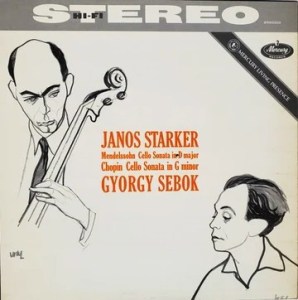
- Starker and Sebok’s virtuoso performances debut on the site with the rich, dynamic, and tubey sound we were hoping for, earning INSANELY GOOD Shootout Winning Triple Plus (A+++) grades throughout this original Plum Label Mercury pressing
- Both of these sides are big, full-bodied, clean and clear, with a wonderfully present and solid piano, and plenty of 3D space around it
- The cello is present and immediate, with sound that is remarkably textured, full and harmonically natural
- Not only is this the best sounding copy we have to offer from our recent shootout, but we are happy to report that the vinyl is reasonably quiet for a vintage Plum Label Mercury stereo pressing, with no marks that play or problems with the inner grooves
This vintage Mercury pressing has the kind of Tubey Magical Midrange that modern records can barely BEGIN to reproduce. Folks, that sound is gone and it sure isn’t showing signs of coming back. If you love hearing INTO a recording, actually being able to “see” the performers, and feeling as if you are sitting in the studio with the band, this is the record for you. It’s what vintage all analog recordings are known for — this sound.
If you exclusively play modern repressings of vintage recordings, I can say without fear of contradiction that you have never heard this kind of sound on vinyl. Old records have it — not often, and certainly not always — but maybe one out of a hundred new records do, and those are some pretty long odds.
What The Best Sides Of Mendelssohn and Chopin’s Cello Sonatas Have To Offer Is Not Hard To Hear
- The biggest, most immediate staging in the largest acoustic space
- The most Tubey Magic, without which you have almost nothing. CDs give you clean and clear. Only the best vintage vinyl pressings offer the kind of Tubey Magic that was on the tapes in 1963
- Tight, note-like, rich, full-bodied bass, with the correct amount of weight down low
- Natural tonality in the midrange — with all the instruments having the correct timbre
- Transparency and resolution, critical to hearing into the three-dimensional studio space
No doubt there’s more but we hope that should do for now. Playing the record is the only way to hear all of the qualities we discuss above, and playing the best pressings against a pile of other copies under rigorously controlled conditions is the only way to find a pressing that sounds as good as this one does.
Copies with rich lower mids and nice extension up top did the best in our shootout, assuming they weren’t veiled or smeary of course. So many things can go wrong on a record. We know, we’ve heard them all.
Top end extension is critical to the sound of the best copies. Lots of old records (and new ones) have no real top end; consequently, the studio or stage will be missing much of its natural air and space, and instruments will lack their full complement of harmonic information.
Tube smear is common to most vintage pressings. The copies that tend to do the best in a shootout will have the least (or none), yet are full-bodied, tubey and rich.
Standard Operating Procedures
What are sonic qualities by which a record — any record — should be judged? Pretty much the ones we discuss in most of our Hot Stamper listings: energy, frequency extension (on both ends), transparency, spaciousness, harmonic textures (freedom from smear is key), rhythmic drive, tonal correctness, fullness, richness, three-dimensionality, and on and on down the list.
When we can get a number of these qualities to come together on the side we’re playing, we provisionally give it a ballpark Hot Stamper grade, a grade that is often revised during the shootout as we hear what the other copies are doing, both good and bad.
Once we’ve been through all the side ones, we play the best of the best against each other and arrive at a winner for that side. Other copies from earlier in the shootout will frequently have their grades raised or lowered based on how they sounded compared to the eventual shootout winner. If we’re not sure about any pressing, perhaps because we played it early on in the shootout before we had learned what to listen for, we take the time to play it again.
Repeat the process for side two and the shootout is officially over. All that’s left is to see how the sides of each pressing match up.
It may not be rocket science, but it’s a science of a kind, one with strict protocols that we’ve developed over the course of many years to insure that the results we arrive at are as accurate as we can make them.
The result of all our work speaks for itself, on this very record in fact. We guarantee you have never heard this music sound better than it does on our Hot Stamper pressing — or your money back.
What We’re Listening For On Mendelssohn and Chopin’s Cello Sonatas
- Energy for starters. What could be more important than the life of the music?
- The Big Sound comes next — wall to wall, lots of depth, huge space, three-dimensionality, all that sort of thing.
- Then transient information — fast, clear, sharp attacks, not the smear and thickness so common to these LPs.
- Powerful bass — which ties in with good transient information, also the issue of frequency extension further down.
- Next: transparency — the quality that allows you to hear deep into the soundfield, showing you the space and air around all the instruments.
- Extend the top and bottom and voila, you have The Real Thing — an honest to goodness Hot Stamper.
Side One
Sonata In D Major, Opus 58, For Violoncello And Piano (Mendelssohn)
Allegro Assai Vivace
Allegro Scherzando
Adagio
Molto Allegro E Vivace
Side Two
Sonata In G Minor, Opus 65, For Violoncello And Piano (Chopin)
Allegro Moderato
Scherzo: Allegro Con Brio
Largo
Finale: Allegro
About these Pieces
Felix Mendelssohn’s Cello Sonata No. 2 in D major, Op. 58, was composed in late 1842 / the first half of 1843. The main theme of the first movement is a reworking of an unrealised Piano Sonata in G major.
The Cello Sonata, which was dedicated to the Russian/Polish cellist Count Mateusz Wielhorski, has four movements:
- Allegro assai vivace
- Allegretto scherzando (in B minor)
- Adagio (in G major)
- Molto allegro e vivace
A typical performance lasts 25 minutes.
Of particular interest is the Adagio, because it mirrors Mendelssohn’s fascination with the music of J.S. Bach. (He was then musical director of the Gewandhaus concerts at Leipzig and, as such, Bach’s distant successor.) The movement consists of a chorale in Bach’s typical style, played by the piano in rich arpeggios. In between the phrases of the chorale, the cello plays recitative-like passages, which resemble the recitative of the Fantasia in the Chromatic Fantasia and Fugue, BWV 903, and quotes its final passage.
The Cello Sonata in G minor, Op. 65, was written by Frédéric Chopin in 1846-1847. It is one of only nine works of Chopin published during his lifetime that were written for instruments other than piano (although the piano still appears in every work he wrote). Chopin composed four sonatas, the other three being piano sonatas. The cello sonata was the last of Chopin’s works to be published in his lifetime.
The sonata was written for and dedicated to Auguste Franchomme. The sonata is remarkable for the concentration of its material: much of the music of the first movement grows out of the cello’s opening statement, and certain theme-shapes appear in all its movements. The last three movements were first publicly performed by Franchomme and Chopin at the composer’s last public concert, at the Salle Pleyel on 16 February 1848.
-Wikipedia