



The section of the stamper sheet we wrote up after our most recent shootout belongs to George Benson’s White Rabbit album, the one released by CTI in 1972.
We think these stampers illustrate an important reality regarding the variability of record pressings, and it’s one that we run into on regularly during shootouts.
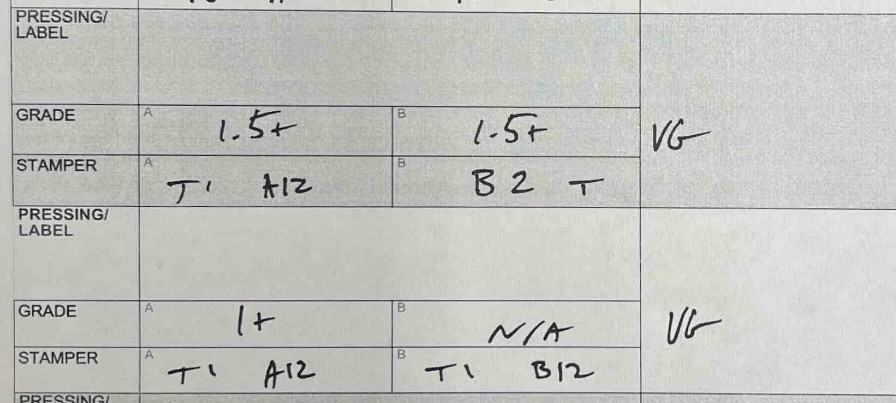
Keep in mind that the notes you see were made without the listener knowing what the stamper numbers were for the copy being evaluated. Some relevant facts:
- Rudy Van Gelder cut all the original domestic pressings for the album that we played in our shootout since those are the only ones we know of to have the potential for Hot Stamper sound. (Hint: forget the reissues, imports, etc.)
- The stampers for the two copies you see below were the two worst performers out of the six we had to work with. (We started out with more than six copies to audition. Unfortunately, some of the copies we clean and play get tossed out during the shootout for having noise issues — scratches that play, bad vinyl, inner groove distortion, etc. Noisy copies of fairly common jazz records are not saleable no matter how good they sound.)
- The top pressing shown below earned good, not great Hot Stamper grades of 1.5+ on both sides. This is the minimal rating any Hot Stamper pressing must earn to be offered to our customers. As you can see, A12/B2 are the stampers for this pressing.
- There was another A12 side one in our shootout that did slightly better, earning a 2+ grade. The pressing you see at the bottom also had an A12 side one, but it did not make the grade. (The N/A means we didn’t play side two of that copy because the 1+ side one makes the record not worth the bother.)

We know that White Rabbit is an outstanding George Benson album, recorded by the immensely talented Rudy Van Gelder himself. All the original pressings were mastered by him as well. We’ve been doing shootouts for the album for more than a decade and in that time have heard some amazing sounding copies. I don’t recall one ever being returned, for any reason.
Here’s the Point
If you saw the words VAN GELDER stamped into the dead wax of a copy sitting in the bins at your local record store, one with either set of the stampers you see above — maybe you found two copies and bought both! — what would you most likely conclude about the album based on the somewhat unimpressive sound of the pressings you just bought (keeping in mind you haven’t cleaned them yet)?
Probably that by 1972 Rudy had lost some of his mojo and was turning out titles with decent, maybe even fairly good sound, but sound that fell well short of the amazing work he was doing in the fifties with albums like Somethin’ Else, and Blowin’ the Blues Away, or in the sixties with Out to Lunch and The Sidewinder, as well as scores of others that we’ve auditioned but cannot find enough clean copies with which to do a shootout (which is best left as a story for another day).
But that’s not fair and, more importantly, not true, regardless of what his critics would have you believe.
RVG was doing great work in the 70s, and the best pressings of White Rabbit prove it, along with albums such as Red Clay, Prelude, All the King’s Horses, Fingers and plenty of others.
Bad Samples
The problem for record collectors and record reviewers has always been inadequate sample sizes. If you pick up a copy or two of a record that has been stamped out thousands of times too many, or for some other reasons simply does not sound good, the Van Gelder in the dead wax is simply not a useful guide to finding the best sounding pressings.
In fact it is completely misleading.
The lessons you might take from the two copies you see above tell you nothing about how good the recording quality of the album might be, or whether the mastering of the best pressings is right, because those are not the pressings you happened to pick up!
Shootouts are the only way to find the best pressings of any record.
That’s why you must do them if you want to own and play records with the ultimate in fidelity. Nothing else works. If you’re not doing shootouts — or buying the winners of shootouts from us — you simply don’t have top quality copies in your collection — unless you are extremely lucky and know how to clean your records the way we do.
In a collection of a thousand records, you might have ten or twenty that would earn top grades from us in a shootout.
You just don’t know which ones they are.
On the other side of the coin, depending on the quality of your playback and how long you have been collecting, and what kinds of records you collect, there is a very real possibility that you would have none.
In the unpredictable world of records, luck is not a strategy. Luck really doesn’t get you very far. In the real world, the journey to better sound requires a serious commitment of time, effort and money. If you would like some help in making progress toward better sound, please consider taking our advice.
Robert Brook has plenty of good advice for the dedicated analog audiophile as well.

