

More Exotica Recordings

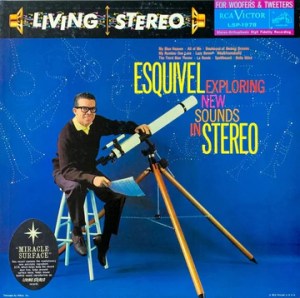
- An original Living Stereo pressing (one of only a handful of copies to ever hit the site) with two solid Double Plus (A++) sides
- This copy is remarkably spacious and open, yet rich and and oh-so-Tubey Magical, with brass that has little to none of the “blarey” quality that plagues so many copies
- Speaking of blarey brass, the first track on side one of every copy we played had a bad case of it, probably an EQ choice made in the mix to help it get more play on the radio
- Folks, I can tell you right now, most original Living Stereo Popular (LSP) pressings, of this or any other LSP title, do not begin to recreate the studio wizardry found on this 1959 album
- 4 1/2 stars: “There is a lot to recommend it. ‘Whatchamacallit’ is probably his second best-loved tune… Other highlights include the exotic ‘Bella Mora,’ the cheesy ‘My Number One Love,’ and ‘The 3rd Man Theme.'”
This vintage Living Stereo pressing has the kind of Tubey Magical Midrange that modern records can barely BEGIN to reproduce. Folks, that sound is gone and it sure isn’t showing signs of coming back. If you love hearing INTO a recording, actually being able to “see” the performers, and feeling as if you are sitting in the studio with the band, this is the record for you. It’s what vintage all analog recordings are known for — this sound.
If you exclusively play modern repressings of vintage recordings, I can say without fear of contradiction that you have never heard this kind of sound on vinyl. Old records have it — not often, and certainly not always — but maybe one out of a hundred new records do, and those are some pretty long odds.
What The Best Sides Of Exploring New Sounds in Stereo Have To Offer Is Not Hard To Hear
- The biggest, most immediate staging in the largest acoustic space
- The most Tubey Magic, without which you have almost nothing. CDs give you clean and clear. Only the best vintage vinyl pressings offer the kind of Tubey Magic that was on the tapes in 1959
- Tight, note-like, rich, full-bodied bass, with the correct amount of weight down low
- Natural tonality in the midrange — with all the instruments having the correct timbre
- Transparency and resolution, critical to hearing into the three-dimensional studio space
No doubt there’s more but we hope that should do for now. Playing the record is the only way to hear all of the qualities we discuss above, and playing the best pressings against a pile of other copies under rigorously controlled conditions is the only way to find a pressing that sounds as good as this one does.
Vintage Living Stereo Recordings – What to Listen For
Top end extension is critical to the sound of the best copies. Lots of old records (and new ones) have no real top end; consequently the studio or stage will be missing much of its natural air and space, and instruments will lack their full complement of harmonic information.
Tube smear is common to most pressings from the 50s and 60s. The copies that tend to do the best in a shootout will have the least (or none), yet are full-bodied, tubey and rich. (Full sound is especially critical to the horns; any blare, leanness or squawk ruins some of the fun, certainly at the louder levels the record should be playing at.)
Which brings up a point that needs making. The tonality of this record is correct when it is playing loud. The trumpets do not get harsh at loud volumes the way they will on, say, a Chicago record. The timbre of the instruments is correct when loud, which means that it was mixed loud to sound correct when loud.
The frequency extremes (on the best copies) are not boosted in any way. When you play this record quietly, the bottom and top will disappear (due to the way the ear handles quieter sounds as described by the Fletcher-Munson curve).
Most records (like most audiophile stereos) are designed to sound correct at moderate levels. Not this album. It wants you to turn it up. Then, and only then, will everything sound completely right from top to bottom.
What We’re Listening For On Exploring New Sounds in Stereo
- Energy for starters. What could be more important than the life of the music?
- Then: presence and immediacy. The vocals aren’t “back there” somewhere, lost in the mix. They’re front and center where any recording engineer worth his salt would put them.
- The Big Sound comes next — wall to wall, lots of depth, huge space, three-dimensionality, all that sort of thing.
- Then transient information — fast, clear, sharp attacks, not the smear and thickness so common to these LPs.
- Tight punchy bass — which ties in with good transient information, also the issue of frequency extension further down.
- Next: transparency — the quality that allows you to hear deep into the soundfield, showing you the space and air around all the instruments.
- Extend the top and bottom and voila, you have The Real Thing — an honest to goodness Hot Stamper.
Side One
My Blue Heaven
Bella Mora
Boulevard Of Broken Dreams
Lazy Bones
Spellbound
Side Two
All Of Me
Whatchamacallit
La Ronde
My Number One Love
The 3rd Man Theme
AMG 4 1/2 Star Review
There is a lot to recommend it. “Whatchamacallit” is probably his second best-loved tune (released also as a single backed with the non-LP track, “I Feel Merely Marvelous”). The track features the ondioline, an electronic-organ-like instrument often associated with the theremin.
And on Exploring New Sounds in Stereo, there is indeed theremin in Esquivel’s spacy treatment of “Spellbound” (from the movie of the same name). Other highlights include the exotic “Bella Mora,” the cheesy “My Number One Love,” and “The 3rd Man Theme.” The album also has slightly different arrangements than the monaural Exploring New Sounds in Hi-Fi.