

More of the Music of Benjamin Britten


- Superb sound throughout this unboxed UK Decca stereo pressing, with both sides earning solid Double Plus (A++) grades
- It’s also exceptionally quiet at the high end of Mint Minus Minus, a grade that even our most well-cared-for vintage classical titles have trouble playing at, and it should be noted that early Decca pressings rarely can be found in this condition
- This is our favorite recording of the work – those of you looking for a Young Person’s Guide can stop looking, this is the one
- We’ve learned from shootouts past (and were reminded again during our most recent) that the London pressing can also be quite good, but none of them can hold a candle to these early Deccas
- For those who have never heard the work, check out The Young Person’s Guide on YouTube – it is a tour de force of orchestral excitement, especially the percussion section
Wikipedia
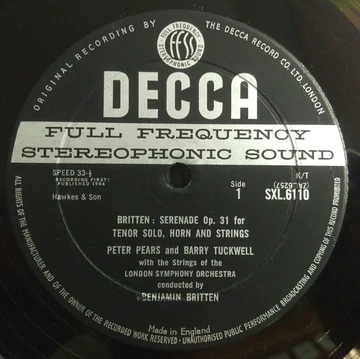

If you exclusively play modern repressings of vintage recordings, I can say without fear of contradiction that you have never heard this kind of sound on vinyl. Old records have it — not often, and certainly not always — but maybe one out of a hundred new records do, and those are some pretty long odds.
What The Best Sides Of Serenade Opus 31 / Young Person’s Guide To The Orchestra Have To Offer Is Not Hard To Hear
- The biggest, most immediate staging in the largest acoustic space
- The most Tubey Magic, without which you have almost nothing. CDs give you clean and clear. Only the best vintage vinyl pressings offer the kind of Tubey Magic that was on the tapes in 1964
- Tight, note-like, rich, full-bodied bass, with the correct amount of weight down low
- Natural tonality in the midrange — with all the instruments having the correct timbre
- Transparency and resolution, critical to hearing into the three-dimensional studio space
No doubt there’s more but we hope that should do for now. Playing the record is the only way to hear all of the qualities we discuss above, and playing the best pressings against a pile of other copies under rigorously controlled conditions is the only way to find a pressing that sounds as good as this one does.
Copies with rich lower mids and nice extension up top did the best in our shootout, assuming they weren’t veiled or smeary of course. So many things can go wrong on a record! We know, we’ve heard them all.
Top end extension is critical to the sound of the best copies. Lots of old records (and new ones) have no real top end; consequently, the studio or stage will be missing much of its natural air and space, and instruments will lack their full complement of harmonic information.
Tube smear is common to most vintage pressings. The copies that tend to do the best in a shootout will have the least (or none), yet are full-bodied, tubey and rich.
Size and Space
One of the qualities that we don’t talk about on the site nearly enough is the SIZE of the record’s presentation. Some copies of the album just sound small — they don’t extend all the way to the outside edges of the speakers, and they don’t seem to take up all the space from the floor to the ceiling. In addition, the sound can often be recessed, with a lack of presence and immediacy in the center.
Other copies — my notes for these copies often read “BIG and BOLD” — create a huge soundfield, with the music positively jumping out of the speakers. They’re not brighter, they’re not more aggressive, they’re not hyped-up in any way, they’re just bigger and clearer.
And most of the time those very special pressings are just plain more involving. When you hear a copy that does all that — a copy like this one — it’s an entirely different listening experience.
What We’re Listening For On Serenade Opus 31 / Young Person’s Guide To The Orchestra
- Energy for starters. What could be more important than the life of the music?
- The Big Sound comes next — wall to wall, lots of depth, huge space, three-dimensionality, all that sort of thing.
- Then transient information — fast, clear, sharp attacks, not the smear and thickness so common to these LPs.
- Powerful bass — which ties in with good transient information, also the issue of frequency extension further down.
- Next: transparency — the quality that allows you to hear deep into the soundfield, showing you the space and air around all the instruments.
- Extend the top and bottom and voila, you have The Real Thing — an honest to goodness Hot Stamper.
A Must Own Record
We consider this album a masterpiece. It’s a recording that belongs in any serious Classical Collection.
Others that belong in that category can be found here.
Side One
Serenade Opus 31 For Tenor Solo, Horn And Strings
Side Two
Young Person’s Guide To The Orchestra
Serenade for Tenor, Horn and Strings
The Serenade for Tenor, Horn and Strings, Op. 31, is a song cycle written in 1943 by Benjamin Britten for tenor, solo horn and a string orchestra. Composed during the Second World War at the request of the horn player Dennis Brain, it is a setting of a selection of six poems by English poets on the subject of night, including both its calm and its sinister aspects. The poets Britten chose to set for the Serenade range from an anonymous 15th-century writer to poets from the 17th, 18th and 19th centuries.
The settings are framed by a horn prologue and epilogue; Britten had employed a framing device in his 1942 A Ceremony of Carols, and did so again in the prologue and epilogue to Billy Budd. In the Serenade both prologue and epilogue are performed by the horn alone, and in these movements Britten instructs the player to use only the horn’s natural harmonics; this lends these short movements a distinctive character, as some harmonics sound sharp or flat to an audience accustomed to the western chromatic scale. The epilogue is to sound from afar, and to this end the final song does not include a part for the horn to allow the player to move off-stage.
The Serenade has eight movements:
- “Prologue” (horn solo)
- “Pastoral”, a setting of “The Evening Quatrains” by Charles Cotton (1630–1687)
- “Nocturne”, a setting of “Blow, bugle, blow” by Alfred, Lord Tennyson (1809–1892)
- “Elegy”, a setting of “The Sick Rose” by William Blake (1757–1827)
- “Dirge”, a setting of the anonymous “Lyke-Wake Dirge” (15th century)
- “Hymn”, a setting of “Hymn to Diana” by Ben Jonson (1572–1637)
- “Sonnet”, a setting of “To Sleep” by John Keats (1795–1821)
- “Epilogue” (horn solo; reprise of Prologue, played offstage)
– Wikipedia