

More Kris Kristofferson

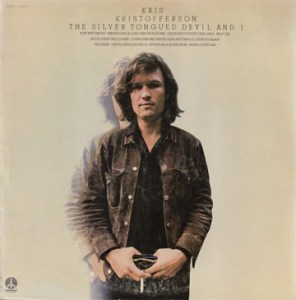
- Seriously good sound for Kristofferson’s sophomore release, with Double Plus (A++) grades from top to bottom – exceptionally quiet vinyl too
- It’s richer, fuller, more musical and more natural that a lot of what we played – Kristofferson’s breathy voice is reproduced with a solidity and immediacy that’s not easy to find
- Both of these sides are wonderfully full-bodied and warm, exactly the way you want your vintage analog to sound
- 5 stars: “On its way to becoming a gold record, The Silver Tongued Devil and I reached the pop Top 20, Kristofferson’s career high on that chart, and the country Top Five; thus, Kristofferson made the transition from being a successful songwriter to a successful recording artist.”
This vintage Monument pressing has the kind of Tubey Magical Midrange that modern records can barely BEGIN to reproduce. Folks, that sound is gone and it sure isn’t showing signs of coming back. If you love hearing INTO a recording, actually being able to “see” the performers, and feeling as if you are sitting in the studio with the band, this is the record for you. It’s what vintage all analog recordings are known for — this sound.
If you exclusively play modern repressings of vintage recordings, I can say without fear of contradiction that you have never heard this kind of sound on vinyl. Old records have it — not often, and certainly not always — but maybe one out of a hundred new records do, and those are some pretty long odds.
What The Best Sides Of The Silver Tongued Devil and I Have To Offer Is Not Hard To Hear
- The biggest, most immediate staging in the largest acoustic space
- The most Tubey Magic, without which you have almost nothing. CDs give you clean and clear. Only the best vintage vinyl pressings offer the kind of Tubey Magic that was on the tapes in 1971
- Tight, note-like, rich, full-bodied bass, with the correct amount of weight down low
- Natural tonality in the midrange — with all the instruments having the correct timbre
- Transparency and resolution, critical to hearing into the three-dimensional studio space
No doubt there’s more but we hope that should do for now. Playing the record is the only way to hear all of the qualities we discuss above, and playing the best pressings against a pile of other copies under rigorously controlled conditions is the only way to find a pressing that sounds as good as this one does.
Learning the Record
For our shootout for The Silver Tongued Devil and I, we had at our disposal a variety of pressings that had the potential for Hot Stamper sound. We cleaned them carefully, then unplugged everything in the house we could, warmed up the system, Talisman’d it, found the right VTA for our Triplanar arm (by ear of course) and proceeded to spend the next hour or so playing copy after copy on side one, after which we repeated the process for side two.
If you have five or more copies of a record and play them over and over against each other, the process itself teaches you what’s right and what’s wrong with the sound of the album. Once your ears are completely tuned to what the best pressings do well that the other pressings do not do as well, using a few carefully chosen passages of music, it quickly becomes obvious how well a given copy can reproduce those passages. You’ll hear what’s better and worse — right and wrong would be another way of putting it — about the sound.
This approach is simplicity itself. First, you go deep into the sound. There you find a critically important passage in the music, one which most copies struggle — or fail — to reproduce as well as the best. Now, with the hard-won knowledge of precisely what to listen for, you are perfectly positioned to critique any and all pressings that come your way.
It may be a lot of work but it sure ain’t rocket science, and we’ve never pretended otherwise. Just the opposite: from day one we’ve explained step by step precisely how to go about finding the Hot Stampers in your own collection. Not the good sounding pressings you happen to own — those may or may not have Hot Stampers — but the records you actually cleaned, shot out, and declared victorious.
What We’re Listening For On The Silver Tongued Devil and I
- Energy for starters. What could be more important than the life of the music?
- Then: presence and immediacy. The vocals aren’t “back there” somewhere, lost in the mix. They’re front and center where any recording engineer worth his salt would put them.
- The Big Sound comes next — wall to wall, lots of depth, huge space, three-dimensionality, all that sort of thing.
- Then transient information — fast, clear, sharp attacks, not the smear and thickness so common to these LPs.
- Tight punchy bass — which ties in with good transient information, also the issue of frequency extension further down.
- Next: transparency — the quality that allows you to hear deep into the soundfield, showing you the space and air around all the instruments.
- Extend the top and bottom and voila, you have The Real Thing — an honest to goodness Hot Stamper.
Side One
The Silver Tongued Devil And I
Jody And The Kid
Billy Dee
Good Christian Soldier
Breakdown (A Long Way From Home)
Side Two
Loving Her Was Easier (Than Anything I’ll Ever Do Again)
The Taker
When I Loved Her
The Pilgrim – Chapter 33
Epitaph (Black And Blue)
AMG 5 Star Rave Review
By the time Monument came to release Kristofferson’s second album, The Silver Tongued Devil and I, in July 1971, he was the author of four songs that had topped the country or pop charts for others. Kristofferson himself had not yet reached the charts with a recording of his own, but his spectacular success as a songwriter made The Silver Tongued Devil and I a much-anticipated record. One consequence of this was that Monument was willing to spend more money; three of the album’s songs boasted strings and another a horn section. But the key, of course, was still the songwriting, and though there were several excellent songs, the album could not live up to its predecessor, which was the culmination of years of writing.
Typically for a second album, Kristofferson reached back into his catalog, presenting his own treatments of “Jody and the Kid” and “The Taker,” which had been hits for Roy Drusky and Waylon Jennings, respectively. In his newly written material, Kristofferson continued to examine the lives of society’s outcasts, but the antiestablishment tone of some of Kristofferson was gone along with much of the wry humor, and in their place were touches of morbidity and sentimentality. Kristofferson retained his gift for intimate love songs, and the album’s most memorable selections turned out to be “Loving Her Was Easier (Than Anything I’ll Ever Do Again)” (which became a semi-standard) and “When I Loved Her.” And even if his observations seemed less acute, his talent for wordplay often rescued the songs from banality.
On its way to becoming a gold record, The Silver Tongued Devil and I reached the pop Top 20, Kristofferson’s career high on that chart, and the country Top Five; thus, Kristofferson made the transition from being a successful songwriter to a successful recording artist.