

More John Coltrane

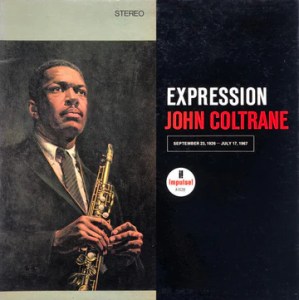
- Both sides of this original Stereo Impulse pressing were giving us the big and bold sound we were looking for, earning superb Double Plus (A++) grades – fairly quiet vinyl too
- Huge space, size and clarity, with Tubey Magical richness befitting the 1967 recording dates of these sessions at Van Gelder Studio
- That Tubey Magic is surely long gone by now, so those of you looking for this kind of sound on a modern pressing should face it: that ship has sailed
- 4 stars: “Recorded at two sessions in early 1967, Expression represents John Coltrane’s final recording sessions just months before his death. It’s remarkable that [the album] is not some world-weary harbinger of death and sickness, but an endlessly jubilant affair. Even in what must have been a time of tremendous pain and darkness, Coltrane’s single-minded quest for understanding and transcendence took him to places of new exploration and light.”
This vintage Impulse pressing has the kind of Tubey Magical Midrange that modern records can barely BEGIN to reproduce. Folks, that sound is gone and it sure isn’t showing signs of coming back. If you love hearing INTO a recording, actually being able to “see” the performers, and feeling as if you are sitting in the studio with the band, this is the record for you. It’s what vintage all analog recordings are known for — this sound.
If you exclusively play modern repressings of vintage recordings, I can say without fear of contradiction that you have never heard this kind of sound on vinyl. Old records have it — not often, and certainly not always — but maybe one out of a hundred new records do, and those are some pretty long odds.
What The Best Sides Of Expression Have To Offer Is Not Hard To Hear
- The biggest, most immediate staging in the largest acoustic space
- The most Tubey Magic, without which you have almost nothing. CDs give you clean and clear. Only the best vintage vinyl pressings offer the kind of Tubey Magic that was on the tapes in 1967
- Tight, note-like, rich, full-bodied bass, with the correct amount of weight down low
- Natural tonality in the midrange — with all the instruments having the correct timbre
- Transparency and resolution, critical to hearing into the three-dimensional studio space
No doubt there’s more but we hope that should do for now. Playing the record is the only way to hear all of the qualities we discuss above, and playing the best pressings against a pile of other copies under rigorously controlled conditions is the only way to find a pressing that sounds as good as this one does.
Copies with rich lower mids and nice extension up top did the best in our shootout, assuming they weren’t veiled or smeary of course. So many things can go wrong on a record! We know, we’ve heard them all.
Top end extension is critical to the sound of the best copies. Lots of old records (and new ones) have no real top end; consequently, the studio or stage will be missing much of its natural air and space, and instruments will lack their full complement of harmonic information.
Tube smear is common to most vintage pressings. The copies that tend to do the best in a shootout will have the least (or none), yet are full-bodied, tubey and rich.
What We’re Listening For On Expression
- Energy for starters. What could be more important than the life of the music?
- The Big Sound comes next — wall to wall, lots of depth, huge space, three-dimensionality, all that sort of thing.
- Then transient information — fast, clear, sharp attacks, not the smear and thickness so common to these LPs.
- Tight, full-bodied bass — which ties in with good transient information, also the issue of frequency extension further down.
- Next: transparency — the quality that allows you to hear deep into the soundfield, showing you the space and air around all the instruments.
- Extend the top and bottom and voila, you have The Real Thing — an honest to goodness Hot Stamper.
Side One
Ogunde
To Be
Side Two
Offering
Expression
AMG 4 Star Review
Recorded at two sessions in early 1967, Expression represents John Coltrane’s final recording sessions just months before his death. A varied and searching record, Coltrane shares space with fellow universal travelers Pharoah Sanders, Jimmy Garrison, Rashied Ali, and wife Alice Coltrane.
This band, working hard during the time leading up to Coltrane’s demise, was performing in the most spiritually reaching territory Coltrane would aspire to. This is evidenced by the burning tenor/drum duet section of “Offering,” perhaps the highlight of these sessions. Coltrane and Ali spiral into the far reaches here with a boundless energy that somehow remains controlled and restrained even in its rawest moments. The group succeeds in lifting the piece up to its highest peak and then setting it back down in a way so organic it feels almost ordained by a mass mind.
The track, like all Coltrane at his best, becomes a guided meditation. The 16-minute vamp of “To Be” is perhaps the most quizzical and interesting piece here, finding Trane on flute, an instrument that he never gave much air time to on previous sessions. Coltrane trades gentle, lilting runs with Sanders’ sometimes distant, sometimes atonal piccolo flute, stretching out into discordant waters somewhere in the middle of this lingering piece.
Bedded by Alice Coltrane’s brightly mystical piano clouds, the track would sound more at home on one of her solo albums than her husband’s, but denotes their mingling inspirations. At the time these sessions were put to tape, Coltrane had been silently suffering from undiagnosed liver cancer for some while. His death was a shock to many in the jazz community who had no idea he was even sick, let alone nearing the end.
It’s remarkable that Expression is not some world-weary harbinger of death and sickness, but an endlessly jubilant affair. Even in what must have been a time of tremendous pain and darkness, Coltrane’s single-minded quest for understanding and transcendence took him to places of new exploration and light. [Some issues of Expression include final track “Number One,” a nearly 12-minute surge of raw, rolling interplay between Coltrane’s tenor and Sanders’ upper-register woodwinds.]