

More Spandau Ballet
More Pure Pop Recordings

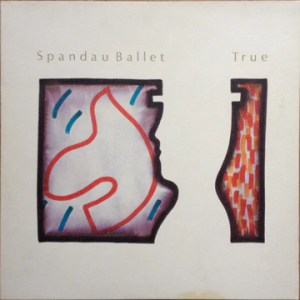
- Boasting two surprisingly rich and natural – dare we say Analog? – sides, this early UK Chrysalis pressing had the sound we were looking for on the band’s third studio album
- Forget the dubby domestic pressings and whatever dead-as-a-doornail Heavy Vinyl record they’re making these days – if you want to hear the Tubey Magic, size and energy of this wonderful Brit Pop album, an import pressing like this one is the only way to go
- “… a set of tunes aimed squarely at the charts. The one that succeeded most spectacularly, of course, was the title cut, a glossily-updated Motown-style ballad that became one of the decade’s biggest hits – aided by a video that cast singer Tony Hadley as a young Frank Sinatra, crooning about the sound of his soul.”
- This is clearly the band’s best sounding album. Roughly 150 other listings for the best sounding album by an artist or group can be found here on the blog
- In our opinion, True is the only Spandau Ballet record you’ll ever need. Click on this link to see more titles we like to call one and done
Forget the dubby domestic pressings. Like so many British bands on the Chrysalis label, when it came time to master the album for our domestic market, not theirs, the people in charge (whoever they may have been) took the easy way out and simply ordered up a dub of the tape to send across the pond.
Too many wonderful albums by highly accomplished bands had their records ruined by sub-generation masters. (Ruined for audiophiles. The general public couldn’t care less.)
But this is the real British-pressed vinyl from the real master tape, and that makes all the difference in the world. It has the kind of Tubey Magical midrange that modern records can barely BEGIN to reproduce.
Folks, that sound is gone and it sure isn’t showing signs of coming back. If you love hearing INTO a recording, actually being able to “see” the performers, and feeling as if you are sitting in the studio with the band, this is the record for you. It’s what vintage all analog recordings are known for — this sound.
If you exclusively play modern repressings of vintage recordings, I can say without fear of contradiction that you have never heard this kind of sound on vinyl. Old records have it — not often, and certainly not always — but maybe one out of a hundred new records do, and those are some pretty long odds.
What The Best Sides Of True Have To Offer Is Not Hard To Hear
- The biggest, most immediate staging in the largest acoustic space
- The most Tubey Magic, without which you have almost nothing. CDs give you clean and clear. Only the best vintage vinyl pressings offer the kind of Tubey Magic that was on the tapes even as late as 1983
- Tight, note-like, rich, full-bodied bass, with the correct amount of weight down low
- Natural tonality in the midrange — with all the instruments having the correct timbre
- Transparency and resolution, critical to hearing into the three-dimensional studio space
No doubt there’s more but we hope that should do for now. Playing the record is the only way to hear all of the qualities we discuss above, and playing the best pressings against a pile of other copies under rigorously controlled conditions is the only way to find a pressing that sounds as good as this one does.
What We’re Listening For On True
- Energy for starters. What could be more important than the life of the music?
- Then: presence and immediacy. The vocals aren’t “back there” somewhere, lost in the mix. They’re front and center where any recording engineer worth his salt would put them.
- The Big Sound comes next — wall to wall, lots of depth, huge space, three-dimensionality, all that sort of thing.
- Then transient information — fast, clear, sharp attacks, not the smear and thickness so common to these LPs.
- Tight punchy bass — which ties in with good transient information, also the issue of frequency extension further down.
- Next: transparency — the quality that allows you to hear deep into the soundfield, showing you the space and air around all the instruments.
- Extend the top and bottom and voila, you have The Real Thing — an honest to goodness Hot Stamper.
Side One
Pleasure
Communication
Code Of Love
Gold
Side Two
Lifeline
Heaven Is A Secret
Foundation
True
AMG Review
By 1983, with the new romantic movement they’d sprung from a rapidly fading memory, the members of Spandau Ballet showed they had no intention of traveling the same path. Always ambitious, the British quintet really got down to business: Gone were the kilts, frilly shirts, and makeup — as well as the sometimes chilly electronics of their first two albums. Instead, after recording at Compass Point Studios in the sun-soaked Bahamas, the group turned up in smartly tailored suits, with a sleek and mainstream sound to match.
That came courtesy of producers Steve Jolley and Tony Swain, who gave Spandau the sort of pop-R&B sheen that had produced hits for clients like Imagination. And it also reflected the growing skill of guitarist Gary Kemp, the band’s primary songwriter, who crafted a set of tunes aimed squarely at the charts. The one that succeeded most spectacularly, of course, was the title cut, a glossily-updated Motown-style ballad that became one of the decade’s biggest hits — aided by a video that cast singer Tony Hadley as a young Frank Sinatra, crooning about the sound of his soul. But Kemp had more arrows in his quiver, as well; the catchy soft disco of “Communication” and “Lifeline” coyly suggests, rather than demands, listeners’ presence on the dancefloor, while the suave, spy flick-inspired “Gold” finally gives Hadley an appropriately rich setting for his dramatic warble.
Some listeners at the time called the album an MOR sellout, but its slick surfaces remain tough to resist, and while none of the cuts generate the excitement of past singles like “To Cut a Long Story Short” or “Chant No. 1,” True remains Spandau Ballet’s most consistent and best all-around album.