

More Exotica Recordings
Hot Stamper Percussion Records Available Now

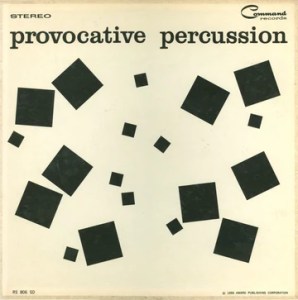
- Provocative Percussion makes its Hot Stamper debut with STUNNING Shootout Winning Triple Plus (A+++) grades throughout this original Stereo Command pressing – exceptionally quiet vinyl too
- Both sides here are doing justice to the live-in-the-studio sound – they were bigger, richer, more Tubey Magical, with more space, more energy, more of everything that makes a vintage analog pressing the thrill we know it can be
- Explosive energy, but surprisingly the sound is both relaxed and sweet at the same time, never squawky
- Exceptional extension up high and down low — this is the copy that showed us just how good the album could sound
- Simply amazing space, ambience and depth – if you have never heard one of these kinds of records, you are really in for a treat with this one
This vintage Command pressing has the kind of Tubey Magical Midrange that modern records can barely BEGIN to reproduce. Folks, that sound is gone and it sure isn’t showing signs of coming back. If you love hearing INTO a recording, actually being able to “see” the performers, and feeling as if you are sitting in the studio with the band, this is the record for you. It’s what vintage all analog recordings are known for — this sound.
If you exclusively play modern repressings of vintage recordings, I can say without fear of contradiction that you have never heard this kind of sound on vinyl. Old records have it — not often, and certainly not always — but maybe one out of a hundred new records do, and those are some pretty long odds.
What The Best Sides Of Provocative Percussion Have To Offer Is Not Hard To Hear
- The biggest, most immediate staging in the largest acoustic space
- The most Tubey Magic, without which you have almost nothing. CDs give you clean and clear. Only the best vintage vinyl pressings offer the kind of Tubey Magic that was on the tapes in 1959
- Tight, note-like, rich, full-bodied bass, with the correct amount of weight down low
- Natural tonality in the midrange — with all the instruments having the correct timbre
- Transparency and resolution, critical to hearing into the three-dimensional studio space
No doubt there’s more but we hope that should do for now. Playing the record is the only way to hear all of the qualities we discuss above, and playing the best pressings against a pile of other copies under rigorously controlled conditions is the only way to find a pressing that sounds as good as this one does.
Copies with rich lower mids and nice extension up top did the best in our shootout, assuming they weren’t veiled or smeary of course. So many things can go wrong on a record! We know, we’ve heard them all.
Top end extension is critical to the sound of the best copies. Lots of old records (and new ones) have no real top end; consequently, the studio or stage will be missing much of its natural air and space, and instruments will lack their full complement of harmonic information.
Tube smear is common to most vintage pressings. The copies that tend to do the best in a shootout will have the least (or none), yet are full-bodied, tubey and rich.
A Big Group of Musicians Needs This Kind of Space
One of the qualities that we don’t talk about on the site nearly enough is the SIZE of the record’s presentation. Some copies of the album just sound small — they don’t extend all the way to the outside edges of the speakers, and they don’t seem to take up all the space from the floor to the ceiling. In addition, the sound can often be recessed, with a lack of presence and immediacy in the center.
Other copies — my notes for these copies often read “BIG and BOLD” — create a huge soundfield, with the music positively jumping out of the speakers. They’re not brighter, they’re not more aggressive, they’re not hyped-up in any way, they’re just bigger and clearer.
And most of the time those very special pressings are just plain more involving. When you hear a copy that does all that — a copy like this one — it’s an entirely different listening experience.
What We’re Listening For On Provocative Percussion
- Energy for starters. What could be more important than the life of the music?
- The Big Sound comes next — wall to wall, lots of depth, huge space, three-dimensionality, all that sort of thing.
- Then transient information — fast, clear, sharp attacks, not the smear and thickness so common to these LPs.
- Tight, full-bodied bass — which ties in with good transient information, also the issue of frequency extension further down.
- Next: transparency — the quality that allows you to hear deep into the soundfield, showing you the space and air around all the instruments.
- Extend the top and bottom and voila, you have The Real Thing — an honest to goodness Hot Stamper.
TRACK LISTING
Side One
You’re The Top
Somebody Loves Me
Blues In The Night
Perhaps, Perhaps, Perhaps
Love For Sale
Fascinating Rhythm
Side Two
S’Wonderful
Mood Indigo
Ain’t Misbehavin’
The Man I Love
Song Of India
Mad About The Boy
AMG on Provocative Percussion
This is the first in a series of Provocative Percussion platters under the supervision of Enoch Light. He led his own Light Brigade big band during the 1930s, then became a prolific arranger and producer for the better part of the 40s and early 50s. Later in the decade he formed the Grand Award label and then in 1959 the Command Records moniker. It was here where Light began to create products specifically for the burgeoning stereo LP market, which at the time was more or less a hi-fi audiophile novelty.
Under the direction of Terry Snyder, Light and the revolving cast known as either the Command All-Stars or simply just the All-Stars, began to experiment with extreme stereophonics, using close microphone techniques and hard-left or hard-right panning to re-create a comparatively austere sense of what could be accomplished with two distinct channels of sound. This contrasted the conventional monophonic playback medium, which delivered a solitary audio source. As innocuous as that may seem, it was cutting-edge technology for its time. Light’s interest extended into the recording process itself as he was one of the early proponents of 35 millimeter film rather than magnetic-based audio tape.
This would significantly increase both frequency response, as well as the permanence of playback. In many ways, Provocative Percussion is the fraternal twin of Persuasive Percussion (1959). They are both borne of the same motivation and are “modern” interpretations of familiar and popular music standards circa 1960.
Stylistically, however, the Provocative collections utilize a much more aggressive approach to the presentation, as if it were a novelty rather than actually furthering the dimension to the listening experience. The bongo intro that harshly pans from left to right during the introduction to “You’re the Top” is essentially replicated with a wooden guiro during the incipient moments of “Love for Sale.”
These are notably austere when compared to the extended instrumental ensemble scores that follow. They evoke the late-50s Atomic Age retro chic and space-age bachelor pad sensibility borne of John Lautner’s Googie-inspired abstract architecture, which likewise informed a majority of the gatefold LP jackets.