

More Kris Kristofferson
More Singer-Songwriter Albums

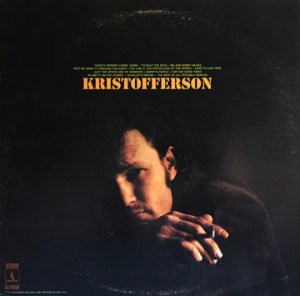
- Boasting KILLER Shootout Winning Triple Plus (A+++) grades or close to them on both sides, this vintage Monument pressing was giving us the sound we were looking for on Kristofferson’s debut LP
- You won’t believe how rich, Tubey Magical, big, undistorted and present this copy is (until you play it anyway)
- Both of these sides are full-bodied, natural and clear, with Kristofferson front and center, exactly where he should be
- Problems in the vinyl are sometimes the nature of the beast with these vintage LPs – there simply is no way around them if the superior sound of vintage analog is important to you
- 5 stars:: “[Kristofferson] brought a conviction to his vocals and a complete understanding of the nuances of the lyrics. The songs were so personal that they seemed to demand a personal interpretation, and established the persona of a poor songwriter struggling against despair.”
- This is an excellent title from 1970, which just happens to be a great year for Rock and Pop Music, maybe the greatest of them all
This vintage Monument pressing has the kind of Tubey Magical Midrange that modern records can barely BEGIN to reproduce. Folks, that sound is gone and it sure isn’t showing signs of coming back. If you love hearing INTO a recording, actually being able to “see” the performers, and feeling as if you are sitting in the studio with the band, this is the record for you. It’s what vintage all analog recordings are known for — this sound.
If you exclusively play modern repressings of vintage recordings, I can say without fear of contradiction that you have never heard this kind of sound on vinyl. Old records have it — not often, and certainly not always — but maybe one out of a hundred new records do, and those are some pretty long odds.
What The Best Sides Of Kristofferson Have To Offer Is Not Hard To Hear
- The biggest, most immediate staging in the largest acoustic space
- The most Tubey Magic, without which you have almost nothing. CDs give you clean and clear. Only the best vintage vinyl pressings offer the kind of Tubey Magic that was on the tapes in 1970
- Tight, note-like, rich, full-bodied bass, with the correct amount of weight down low
- Natural tonality in the midrange — with all the instruments having the correct timbre
- Transparency and resolution, critical to hearing into the three-dimensional studio space
No doubt there’s more but we hope that should do for now. Playing the record is the only way to hear all of the qualities we discuss above, and playing the best pressings against a pile of other copies under rigorously controlled conditions is the only way to find a pressing that sounds as good as this one does.
Learning the Record
For our shootout for Kristofferson, we had at our disposal a variety of pressings that had the potential for Hot Stamper sound. We cleaned them carefully, then unplugged everything in the house we could, warmed up the system, Talisman’d it, found the right VTA for our Triplanar arm (by ear of course) and proceeded to spend the next hour or so playing copy after copy on side one, after which we repeated the process for side two.
If you have five or more copies of a record and play them over and over against each other, the process itself teaches you what’s right and what’s wrong with the sound of the album. Once your ears are completely tuned to what the best pressings do well that the other pressings do not do as well, using a few carefully chosen passages of music, it quickly becomes obvious how well a given copy can reproduce those passages. You’ll hear what’s better and worse — right and wrong would be another way of putting it — about the sound.
This approach is simplicity itself. First, you go deep into the sound. There you find a critically important passage in the music, one which most copies struggle — or fail — to reproduce as well as the best. Now, with the hard-won knowledge of precisely what to listen for, you are perfectly positioned to critique any and all pressings that come your way.
It may be a lot of work but it sure ain’t rocket science, and we’ve never pretended otherwise. Just the opposite: from day one we’ve explained step by step precisely how to go about finding the Hot Stampers in your own collection. Not the good sounding pressings you happen to own — those may or may not have Hot Stampers — but the records you actually cleaned, shot out, and declared victorious.
What We’re Listening For On Kristofferson
- Energy for starters. What could be more important than the life of the music?
- Then: presence and immediacy. The vocals aren’t “back there” somewhere, lost in the mix. They’re front and center where any recording engineer worth his salt would put them.
- The Big Sound comes next — wall to wall, lots of depth, huge space, three-dimensionality, all that sort of thing.
- Then transient information — fast, clear, sharp attacks, not the smear and thickness so common to these LPs.
- Tight punchy bass — which ties in with good transient information, also the issue of frequency extension further down.
- Next: transparency — the quality that allows you to hear deep into the soundfield, showing you the space and air around all the instruments.
- Extend the top and bottom and voila, you have The Real Thing — an honest to goodness Hot Stamper.
TRACK LISTING
Side One
Blame It On The Stones
To Beat The Devil
Me And Bobby McGee
The Best Of All Possible Worlds
Help Me Make It Through The Night
The Law Is For Protection Of The People
Side Two
Casey’s Last Ride
Just The Other Side Of Nowhere
Darby’s Castle
For The Good Times
Duvalier’s Dream
Sunday Mornin’ Comin’ Down
AMG 5 Star Rave Review
On the evidence of his first collection of songs, Kristofferson was ahead of his country music peers in realizing that, despite Nashville’s conservative political tilt, there was a natural affinity between the country archetype of a hard-drinking, romantically independent loner and the rock & roll archetype of a drug-taking, romantically free hippie.
A sleeve note suggested that Kristofferson had been reluctant to record, but while he didn’t have much range as a singer, he brought a conviction to his vocals and a complete understanding of the nuances of the lyrics. The songs were so personal that they seemed to demand a personal interpretation, and established the persona of a poor songwriter struggling against despair.
Nashville, as it turned out, didn’t have much use for his countercultural songs, but the country music community could recognize a good love song, and Ray Price quickly cut “For the Good Times,” which topped the country charts. Then Johnny Cash covered the first-person hangover narrative “Sunday Mornin’ Comin’ Down” for a number one country hit, and Sammi Smith gave a twist to “Help Me Make It Through the Night” by recording it as a woman’s song for yet another country number one.
The finishing touch to Kristofferson’s sudden renown was Janis Joplin’s cover of the classic on-the-road song “Me and Bobby McGee,” released shortly after her death, which topped the pop charts. When it was released in 1970, Kristofferson did not reach the charts.
By the following year, however, its creator was on his way to becoming a major star, and after his second album broke into the pop charts in July 1971, Monument retitled the first album Me and Bobby McGee and reissued it. This time around, it made the pop and country charts and went gold.