

More Herbie Hancock
More Jazz Recordings Featuring the Piano

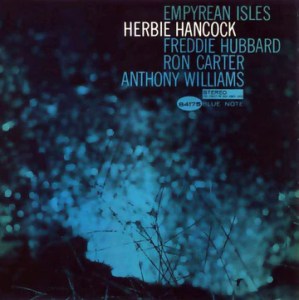
- With excellent Double Plus (A++) grades throughout, this vintage Blue Note stereo pressing will be very hard to beat
- Once again Rudy Van Gelder delivers the sound that audiophiles and jazz fans alike thrill to
- These sides are lively, dynamic and full-bodied, and there’s real weight to the piano, always critically important to the piano recordings we play
- 5 stars: “Working with cornetist Freddie Hubbard, bassist Ron Carter, and drummer Tony Williams — a trio just as young and adventurous as he was — Hancock pushes at the borders of hard bop, finding a brilliantly evocative balance between traditional bop, soul-injected grooves, and experimental, post-modal jazz.”
- If you’re a fan of the music of Herbie Hancock, this title from 1964 is surely one of his best, and one of his best sounding
- The complete list of titles from 1964 that we’ve reviewed to date can be found here.
This vintage Blue Note pressing has the kind of Tubey Magical Midrange that modern records can barely BEGIN to reproduce. Folks, that sound is gone and it sure isn’t showing signs of coming back. If you love hearing INTO a recording, actually being able to “see” the performers, and feeling as if you are sitting in the studio with the band, this is the record for you. It’s what vintage all analog recordings are known for — this sound.
If you exclusively play modern repressings of vintage recordings, I can say without fear of contradiction that you have never heard this kind of sound on vinyl. Old records have it — not often, and certainly not always — but maybe one out of a hundred new records do, and those are some pretty long odds.
What The Best Sides Of Empyrean Isles Have To Offer Is Not Hard To Hear
- The biggest, most immediate staging in the largest acoustic space
- The most Tubey Magic, without which you have almost nothing. CDs give you clean and clear. Only the best vintage vinyl pressings offer the kind of Tubey Magic that was on the tapes in 1964
- Tight, note-like, rich, full-bodied bass, with the correct amount of weight down low
- Natural tonality in the midrange — with all the instruments having the correct timbre
- Transparency and resolution, critical to hearing into the three-dimensional studio space
No doubt there’s more but we hope that should do for now. Playing the record is the only way to hear all of the qualities we discuss above, and playing the best pressings against a pile of other copies under rigorously controlled conditions is the only way to find a pressing that sounds as good as this one does.
Copies with rich lower mids and nice extension up top did the best in our shootout, assuming they weren’t veiled or smeary of course. So many things can go wrong on a record! We know, we’ve heard them all.
Top end extension is critical to the sound of the best copies. Lots of old records (and new ones) have no real top end; consequently, the studio or stage will be missing much of its natural air and space, and instruments will lack their full complement of harmonic information.
Tube smear is common to most vintage pressings. The copies that tend to do the best in a shootout will have the least (or none), yet are full-bodied, tubey and rich.
What We’re Listening For On Empyrean Isles
- Energy for starters. What could be more important than the life of the music?
- The Big Sound comes next — wall to wall, lots of depth, huge space, three-dimensionality, all that sort of thing.
- Then transient information — fast, clear, sharp attacks, not the smear and thickness so common to these LPs.
- Tight punchy bass — which ties in with good transient information, also the issue of frequency extension further down.
- Next: transparency — the quality that allows you to hear deep into the soundfield, showing you the space and air around all the instruments.
- Then: presence and immediacy. The piano isn’t “back there” somewhere, lost in the mix. It’s front and center where any recording engineer worth his salt — the incomparable Rudy Van Gelder in this instance — would put it.
- Extend the top and bottom and voila, you have The Real Thing — an honest to goodness Hot Stamper.
Size and Space
One of the qualities that we don’t talk about on the site nearly enough is the SIZE of the record’s presentation. Some copies of the album just sound small — they don’t extend all the way to the outside edges of the speakers, and they don’t seem to take up all the space from the floor to the ceiling. In addition, the sound can often be recessed, with a lack of presence and immediacy in the center.
Other copies — my notes for these copies often read “BIG and BOLD” — create a huge soundfield, with the music positively jumping out of the speakers. They’re not brighter, they’re not more aggressive, they’re not hyped-up in any way, they’re just bigger and clearer.
And most of the time those very special pressings are just plain more involving. When you hear a copy that does all that — a copy like this one — it’s an entirely different listening experience.
The Players
- Herbie Hancock – piano
- Ron Carter – bass
- Freddie Hubbard – cornet
- Anothony Williams – drums
TRACK LISTING
Side One
One Finger Snap
Oliloqui Valley
Side Two
Cantaloupe Island
The Egg
AMG 5 Star Rave Review
My Point of View and Inventions and Dimensions found Herbie Hancock exploring the fringes of hard bop, working with a big band and a Latin-flavored percussion section, respectively. On Empyrean Isles, he returns to hard bop, but the results are anything but conventional.
Working with cornetist Freddie Hubbard, bassist Ron Carter, and drummer Tony Williams — a trio just as young and adventurous as he was — Hancock pushes at the borders of hard bop, finding a brilliantly evocative balance between traditional bop, soul-injected grooves, and experimental, post-modal jazz. Hancock’s four original concepts are loosely based on the myths of the Empyrean Isles, and they are designed to push the limits of the band and of hard bop.
Even “Cantaloupe Island,” well-known for its funky piano riff, takes chances and doesn’t just ride the groove. “The Egg,” with its minimal melody and extended solo improvisations, is the riskiest number on the record, but it works because each musician spins inventive, challenging solos that defy convention. In comparison, “One Finger Snap” and “Oliloqui Valley” adhere to hard bop conventions, but each song finds the quartet vigorously searching for new sonic territory with convincing fire. That passion informs all of Empyrean Isles, a record that officially established Hancock as a major artist in his own right.