

More Percussion Recordings of Interest

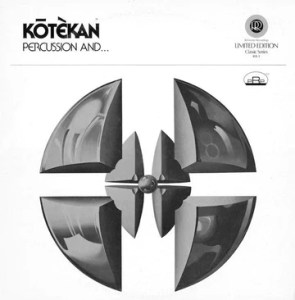
- You’ll find STUNNING Shootout Winning Triple Plus (A+++) grades or close to them on both sides of this original Reference LP
- So transparent, dynamic and REAL, this copy raises the bar for the sound of percussive music on vinyl
- Includes an extraordinary interpretation of Ravel’s La Flute Enchantee that must be heard to be believed
- “… heady, explosive, weird, bizarre and brilliant playing…” – S.F. Chronicle
This Reference LP, mastered by Stan Ricker, might just be the best sounding record this sorry excuse for an audiophile label ever made.
Any label that would release Audiophile BS records such as this one and this one has a lot of explaining to do.
I hadn’t played this Kōtèkan title in probably twenty years, but I remembered it sure sounded good to me back in the day, so we decided to get some in and do a shootout for them. This copy was an impressive reminder of just how good the recording can be.
This original pressing has the kind of Tubey Magical Midrange that modern records can barely BEGIN to reproduce. Folks, that sound is gone and it sure isn’t showing signs of coming back. If you love hearing INTO a recording, actually being able to “see” the performers, and feeling as if you are sitting in the studio with the band, this is the record for you. It’s what vintage all analog recordings are known for — this sound.
If you exclusively play modern repressings of vintage recordings, I can say without fear of contradiction that you have never heard this kind of sound on vinyl. Old records have it — not often, and certainly not always — but maybe one out of a hundred new records do, and those are some pretty long odds.
What The Best Sides Of Percussion And… Have To Offer Is Not Hard To Hear
- The biggest, most immediate staging in the largest acoustic space
- The most Tubey Magic, without which you have almost nothing. CDs give you clean and clear. Only the best vintage vinyl pressings offer the kind of Tubey Magic that was on the tapes in 1977
- Tight, note-like, rich, full-bodied bass, with the correct amount of weight down low
- Natural tonality in the midrange — with all the instruments having the correct timbre
- Transparency and resolution, critical to hearing into the three-dimensional studio space
No doubt there’s more but we hope that should do for now. Playing the record is the only way to hear all of the qualities we discuss above, and playing the best pressings against a pile of other copies under rigorously controlled conditions is the only way to find a pressing that sounds as good as this one does.
Copies with rich lower mids and nice extension up top did the best in our shootout, assuming they weren’t veiled or smeary of course. So many things can go wrong on a record! We know, we’ve heard them all.
Top end extension is critical to the sound of the best copies. Lots of old records (and new ones) have no real top end; consequently, the studio or stage will be missing much of its natural air and space, and instruments will lack their full complement of harmonic information.
Tube smear is common to most vintage pressings. The copies that tend to do the best in a shootout will have the least (or none), yet are full-bodied, tubey and rich.
Size and Space
One of the qualities that we don’t talk about on the site nearly enough is the SIZE of the record’s presentation. Some copies of the album just sound small — they don’t extend all the way to the outside edges of the speakers, and they don’t seem to take up all the space from the floor to the ceiling. In addition, the sound can often be recessed, with a lack of presence and immediacy in the center.
Other copies — my notes for these copies often read “BIG and BOLD” — create a huge soundfield, with the music positively jumping out of the speakers. They’re not brighter, they’re not more aggressive, they’re not hyped-up in any way, they’re just bigger and clearer.
One further point needs to be made: most of the time these very special pressings are just plain more involving. When you hear a copy do what this copy can, it’s an entirely different — and dare I say unforgettable — listening experience.
What We’re Listening For On Percussion And…
- Energy for starters. What could be more important than the life of the music?
- The Big Sound comes next — wall to wall, lots of depth, huge space, three-dimensionality, all that sort of thing.
- Then transient information — fast, clear, sharp attacks, not the smear and thickness so common to these LPs.
- Powerful bass — which ties in with good transient information, also the issue of frequency extension further down.
- Next: transparency — the quality that allows you to hear deep into the soundfield, showing you the space and air around all the instruments.
- Extend the top and bottom and voila, you have The Real Thing — an honest to goodness Hot Stamper.
TRACK LISTING
Side One
The Perilous Night 6th Movement – John Cage
La Flute Enchantee – Maurice Ravel
Dreaming Of Another – Richard Kvistad
Side Two
Rainbow Ripples – George Hamilton Green
Lift-Off – Russell Peck
Lo! Hear The Gentle Lark – Henry Bishop
Wikipedia on Kotekan
Kotekan is a style of playing fast interlocking parts in most varieties of Balinese Gamelan music, including Gamelan gong kebyar, Gamelan angklung, Gamelan jegog and others.
Kotekan are “sophisticated interlocking parts,” “characteristic of gong kebyar and several other Balinese gamelan styles, that combine to create the illusion of a single melodic line that often sounds faster than any single human could possibly play.” According to Colin McPhee: “Composed of two rhythmically opposing parts which…interlock to create a perpetual flow of sound, the kotekan adds sheen and intensity to the music, …calls for the utmost rhythmic precision…[and] lies in the top register of the gamelan.”
One of the most striking features of Balinese gamelan music…is kotekan, the rapid interlocking figuration that permeates nearly all kebyar compositions. It creates a unique sonic impression: a group of gangsa (bronze metallophones) struck with hard wooden mallets produce an intricately patterned lay of sound above the more sustained tones of the lower instruments; the reyong, a row of small tuned gongs played by four musicians, creates a different (but equally complex) figuration of a softer attack and sound color; and leading them all are a pair of drummers who play yet another kind of interlocking patterns.
— Wayne Vitale
In kotekan there are two independent parts called polos and sangsih, each of which fills in the gaps of the other to form a complete rhythmic texture. In Gamelan gong kebyar, Kotekan is usually played on the higher-pitched gangsa and reyong as embellishment to the main melody (pokok) played on the calung and ugal.
The busy upper registers of the gamelan are the domain of the gangsas and reyong. These instruments spin out kotekan, the crackling ornamental fireworks of Balinese music. Kotekan is usually expressed in English as ‘interlocking parts’, because although it sounds as one melody it is actually composed of two interdependent musical lines that are incomplete when played alone and dependent exclusively on each other for obtaining the desired result. That can range from stately murmuring some of the older, simpler styles of kotekan, to extroverted, jazzy acrobatics in modern music. The tight interaction of the two parts produces a supple texture that is pointillistic in detail and fluid as a whole. … Much of the excitement of Balinese music arises from these irresistible rhythms.
— Michael Tenzer
Further Reading