

More Hampton Hawes
More Contemporary Label Jazz Recordings

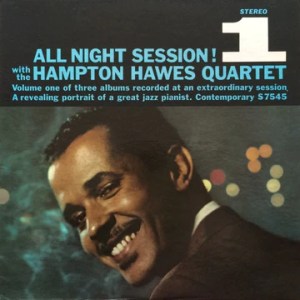
- A KILLER vintage Contemporary Stereo LP boasting top quality sound from the first note to the last
- Tubey Magic, richness, sweetness, dead-on timbres from top to bottom – this is a textbook example of Contemporary sound at its best, thanks to the engineering brilliance of Roy DuNann and producer Lester Keonig
- This copy is simply bigger, more transparent, less distorted, more three-dimensional and more REAL than all of what we played – it puts you front and center in the studio with the players
- The first of three albums of material recorded by Hawes, guitarist Jim Hall, bassist Red Mitchell, and drummer Eldridge “Bruz” Freeman on the night of November 12 and into the morning of November 13, 1956
- 4 1/2 stars: “The interplay between these four men is marvelous, particularly when heard [on] a sound system allowing for a full appreciation of the stereophonic balance achieved by the recording engineers.”
- “It’s hard to put into words how good it feels to play jazz when it’s really swinging…I’ve reached a point where the music fills you up so much emotionally that you feel like shouting hallelujah — like people do in church when they’re converted to God. That’s the way I was feeling the night we recorded All Night Session!” – Hampton Hawes
This vintage Contemporary pressing has the kind of Tubey Magical Midrange that modern records can barely BEGIN to reproduce. Folks, that sound is gone and it sure isn’t showing signs of coming back. If you love hearing INTO a recording, actually being able to “see” the performers, and feeling as if you are sitting in the studio with the band, this is the record for you. It’s what vintage all analog recordings are known for — this sound.
If you exclusively play modern repressings of vintage recordings, I can say without fear of contradiction that you have never heard this kind of sound on vinyl. Old records have it — not often, and certainly not always — but maybe one out of a hundred new records do, and those are some pretty long odds.
What The Best Sides Of All Night Session, Vol. 1 Have To Offer Is Not Hard To Hear
- The biggest, most immediate staging in the largest acoustic space
- The most Tubey Magic, without which you have almost nothing. CDs give you clean and clear. Only the best vintage vinyl pressings offer the kind of Tubey Magic that was on the tapes in 1958
- Tight, note-like, rich, full-bodied bass, with the correct amount of weight down low
- Natural tonality in the midrange — with all the instruments having the correct timbre
- Transparency and resolution, critical to hearing into the three-dimensional studio space
No doubt there’s more but we hope that should do for now. Playing the record is the only way to hear all of the qualities we discuss above, and playing the best pressings against a pile of other copies under rigorously controlled conditions is the only way to find a pressing that sounds as good as this one does.
Copies with rich lower mids and nice extension up top did the best in our shootout, assuming they weren’t veiled or smeary of course. So many things can go wrong on a record! We know, we’ve heard them all.
Top end extension is critical to the sound of the best copies. Lots of old records (and new ones) have no real top end; consequently, the studio or stage will be missing much of its natural air and space, and instruments will lack their full complement of harmonic information.
Tube smear is common to most vintage pressings and this is no exception. The copies that tend to do the best in a shootout will have the least (or none), yet are full-bodied, tubey and rich.
What We’re Listening For On All Night Session, Vol. 1
- Energy for starters. What could be more important than the life of the music?
- The Big Sound comes next — wall to wall, lots of depth, huge space, three-dimensionality, all that sort of thing.
- Then transient information — fast, clear, sharp attacks, not the smear and thickness so common to these LPs.
- Tight punchy bass — which ties in with good transient information, also the issue of frequency extension further down.
- Next: transparency — the quality that allows you to hear deep into the soundfield, showing you the space and air around all the instruments.
- Extend the top and bottom and voila, you have The Real Thing — an honest to goodness Hot Stamper.
TRACK LISTING
Side One
Jordu
Groovin’ High
Takin’ Care
Side Two
Broadway
Hampton’s Pulpit
AMG 4 1/2 Star Review
On the night of November 12 and into the morning of November 13, 1956, a quartet led by pianist Hampton Hawes recorded enough material to fill three long-playing phonograph record albums. This studio session contained many elements associated with a live gig: the work took place during regular nightclub performing hours, the improvisations were mostly extended, and there were no alternate takes. A remarkable freshness and spontaneity prevailed throughout the session. Although controversy continues regarding the original sequence of titles, Duke Jordan’s “Jordu” and Dizzy Gillespie’s “Groovin’ High” are superb openers for this first of three volumes. In addition to an invigorating run down “Broadway,” Hawes improvised two original themes: “Takin’ Care” and a bluesy walk entitled “Hampton’s Pulpit” that stretched out for more than 11 minutes, making it the longest track of the entire all-night session. Collaborating with the pianist on this historic date were guitarist Jim Hall, bassist Red Mitchell, and drummer Eldridge “Bruz” Freeman. The interplay between these four men is marvelous, particularly when heard with headphones or through a sound system allowing for a full appreciation of the stereophonic balance achieved by the recording engineers.
In 1958 Hawes was quoted as saying, “It’s hard to put into words how good it feels to play jazz when it’s really swinging…I’ve reached a point where the music fills you up so much emotionally that you feel like shouting hallelujah — like people do in church when they’re converted to God. That’s the way I was feeling the night we recorded All Night Session!”