

More of the music of Sergei Rachmaninoff (1873-1943)
More of the music of Peter Ilyich Tchaikovsky (1840-1893)

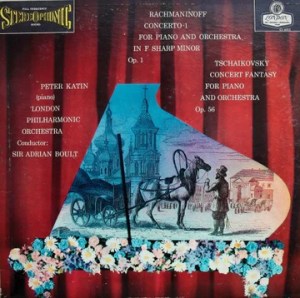
- This superb classical release makes its Hot Stamper debut here with outstanding Double Plus (A++) sound or BETTER throughout
- The orchestra is big, rich and tubey here, yet the dynamics and transparency are first rate
- Some old record collectors (like me) say classical recording quality ain’t what it used to be – here’s all the proof anyone with two working ears and top quality audiophile equipment needs to make the case
This vintage London Stereo pressing has the kind of Tubey Magical Midrange that modern records can barely BEGIN to reproduce. Folks, that sound is gone and it sure isn’t showing signs of coming back. If you love hearing INTO a recording, actually being able to “see” the performers, and feeling as if you are sitting in the studio with the band, this is the record for you. It’s what vintage all analog recordings are known for — this sound.
If you exclusively play modern repressings of vintage recordings, I can say without fear of contradiction that you have never heard this kind of sound on vinyl. Old records have it — not often, and certainly not always — but maybe one out of a hundred new records do, and those are some pretty long odds.
What the Best Sides of This Wonderful Classical Pressing Have to Offer Is Not Hard to Hear
- The biggest, most immediate staging in the largest acoustic space
- The most Tubey Magic, without which you have almost nothing. CDs give you clean and clear. Only the best vintage vinyl pressings offer the kind of Tubey Magic that was on the tapes in 1959
- Tight, note-like, rich, full-bodied bass, with the correct amount of weight down low
- Natural tonality in the midrange — with all the instruments having the correct timbre
- Transparency and resolution, critical to hearing into the three-dimensional studio space
No doubt there’s more but we hope that should do for now. Playing the record is the only way to hear all of the qualities we discuss above, and playing the best pressings against a pile of other copies under rigorously controlled conditions is the only way to find a pressing that sounds as good as this one does.
The Piano
Pay special attention to the piano. On the transparent and tonally correct copies it is clear and full-bodied. The piano in a dense recording such as this often makes for a good test. It’s in there, sure, but how easily can you see it and how much like a real piano does it sound? When the piano is right more often than not most every other instrument will be right as well.
If you have full-range speakers some of the qualities you may recognize in the sound of the piano are WEIGHT and WARMTH. The piano is not hard, brittle or tinkly. Instead the best copies show you a wonderfully full-bodied, warm, rich, smooth piano, one which sounds remarkably like the ones we’ve all heard countless times in piano bars and restaurants.
In other words like a real piano, not a recorded one. Bad mastering can ruin the sound, and often does, along with worn out stampers and bad vinyl and five gram needles that scrape off the high frequencies. But some copies survive all such hazards. They manage to reproduce the full spectrum of the piano’s wide range on vintage vinyl, showing us the kind of sound we simply cannot find any other way.
What We’re Listening For on Rachmaninoff’s Piano Concerto No. 1 and Tchaikovsky’s Concert Fantasia
- Energy for starters. What could be more important than the life of the music?
- The Big Sound comes next — wall to wall, lots of depth, huge space, three-dimensionality, all that sort of thing.
- Then transient information — fast, clear, sharp attacks, not the smear and thickness so common to these LPs.
- Next: transparency — the quality that allows you to hear deep into the soundfield, showing you the space and air around all the instruments.
- Extend the top and bottom and voila, you have The Real Thing — an honest to goodness Hot Stamper.
TRACK LISTING
Side One
Rachmaninoff Piano Concerto No. 1
1st Movement – Vivace
2nd Movement – Andante
3rd Movement – Allegro Vivace
Side Two
Tchaikovsky Concert Fantasia
1st Movement – Quasi Rondo
2nd Movement – Contrastes
Rachmaninoff’s Piano Concerto No. 1
First Version
This was actually Rachmaninoff’s second attempt at a piano concerto. In 1889 he had begun but abandoned a concerto in C minor (the same key, incidentally, in which he would later write his Second Piano Concerto). He wrote Natalya Skalon on 26 March 1891, “I am now composing a piano concerto. Two movements are already written; the last movement is not written, but is composed; I shall probably finish the whole concerto by the summer, and then in the summer orchestrate it.” He finished composing and scoring the piece on July 6 and was satisfied with what he had written. The first movement was premiered on 17 March 1892 at the Moscow Conservatoire, with the composer as soloist and Vasily Safonov conducting. This may have been the only time the composer played the concerto in its original form, although Siloti, to whom it is dedicated, programmed it to play himself on several occasions.
Composition students were usually advised to base their efforts on a specific model for their first exercises in new forms. In Rachmaninoff’s case this was the Grieg Piano Concerto, which was a favorite work of his and one which he had been familiar from Siloti practicing it at the Rachmaninoff household during the spring and summer of 1890 for future concerts. Rachmaninoff adapted the entire musical structure of the outer movements to the Grieg concerto, literally building his music into it. With all his other concertos, Rachmaninoff would prove more enterprising.
Revision and current structure
The public was already familiar with the Second and Third Concertos before Rachmaninoff revised the First in 1917. The First is very different from his later works; in exchange for less memorable melodies, this concerto incorporates elements of youthful vivacity and impetuosity.
The differences between the 1890–1891 original and the 1917 revision reveal a tremendous amount about the composer’s development in the intervening years. There is a considerable thinning of texture in the orchestral and piano parts and much material that made the original version diffuse and episodic is removed.
Of all the revisions Rachmaninoff made to various works, this one was perhaps the most successful. Using an acquired knowledge of harmony, orchestration, piano technique and musical form, he transformed an early, immature composition into a concise, spirited work. Nevertheless, he was perturbed that the revised work did not become popular with the public. He said to Albert Swan, “I have rewritten my First Concerto; it is really good now. All the youthful freshness is there, and yet it plays itself so much more easily. And nobody pays any attention. When I tell them in America that I will play the First Concerto, they do not protest, but I can see by their faces that they would prefer the Second or Third.”
-Wikipedia