

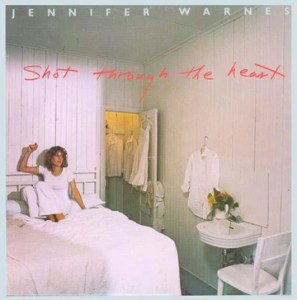

- Shot Through The Heart makes its Hot Stamper debut here with KILLER Shootout Winning Triple Plus (A+++) sound from start to finish
- You get clean, clear, full-bodied, lively and musical ANALOG sound from first note to last
- 4 stars: ” Jennifer Warnes took charge of the recording of [this] her second Arista album, co-producing it and writing three songs, including the title track… On her own, her taste was impeccable… She proved an adept producer, achieving a smooth pop/rock sound… With session stars like Andrew Gold aboard, Warnes succeeded in making what sounded like the great lost Linda Ronstadt album.”
This vintage Arista pressing has the kind of Tubey Magical Midrange that modern records can barely BEGIN to reproduce. Folks, that sound is gone and it sure isn’t showing signs of coming back. If you love hearing INTO a recording, actually being able to “see” the performers, and feeling as if you are sitting in the studio with the band, this is the record for you. It’s what vintage all analog recordings are known for — this sound.
If you exclusively play modern repressings of vintage recordings, I can say without fear of contradiction that you have never heard this kind of sound on vinyl. Old records have it — not often, and certainly not always — but maybe one out of a hundred new records do, and those are some pretty long odds.
What Amazing Sides Such as These Have to Offer Is Not Hard to Hear
- The biggest, most immediate staging in the largest acoustic space
- The most Tubey Magic, without which you have almost nothing. CDs give you clean and clear. Only the best vintage vinyl pressings offer the kind of Tubey Magic that was on the tapes in 1979
- Tight, note-like, rich, full-bodied bass, with the correct amount of weight down low
- Natural tonality in the midrange — with all the instruments having the correct timbre
- Transparency and resolution, critical to hearing into the three-dimensional studio space
No doubt there’s more but we hope that should do for now. Playing the record is the only way to hear all of the qualities we discuss above, and playing the best pressings against a pile of other copies under rigorously controlled conditions is the only way to find a pressing that sounds as good as this one does.
What We’re Listening For on Shot Through the Heart
- Energy for starters. What could be more important than the life of the music?
- Then: presence and immediacy. The vocals aren’t “back there” somewhere, lost in the mix. They’re front and center where any recording engineer worth his salt would put them.
- The Big Sound comes next — wall to wall, lots of depth, huge space, three-dimensionality, all that sort of thing.
- Then transient information — fast, clear, sharp attacks, not the smear and thickness so common to these LPs.
- Tight punchy bass — which ties in with good transient information, also the issue of frequency extension further down.
- Next: transparency — the quality that allows you to hear deep into the soundfield, showing you the space and air around all the instruments.
- Extend the top and bottom and voila, you have The Real Thing — an honest to goodness Hot Stamper.
TRACK LISTING
Side One
Shot Through The Heart
I Know A Heartache When I See One
Don’t Make Me Over
You Remember Me
Sign On The Window
Side Two
I’m Restless
Tell Me Just One More Time
When The Feeling Come Around
Frankie In The Rain
Hard Times, Come Again No More
AMG 4 Star Review
Having compromised on her Arista debut and gotten a hit single for her trouble, Jennifer Warnes took charge of the recording of her second Arista album, co-producing it and writing three songs, including the title track. It was hard to miss the point when Warnes covered Dionne Warwick’s 1963 hit “Don’t Make Me Over” (written by Burt Bacharach and Hal David) that she was finished with having people tell her what to do. On her own, her taste was impeccable, her song choices including the work of Jesse Winchester, Bob Dylan, and Stephen Foster, and her own songwriting was good, too. She also managed to satisfy the commercial expectations aroused by her previous album, with “I Know a Heartache When I See One” rising into the country Top Ten and the pop and adult contemporary Top 40. (She also made it into all three charts with “Don’t Make Me Over” and into the pop and AC charts with “When the Feeling Comes Around.”)
She proved an adept producer, achieving a smooth pop/rock sound. With session stars like Andrew Gold aboard, Warnes succeeded in making what sounded like the great lost Linda Ronstadt album. Granted, she handled strong material like Dylan’s “Sign on the Window” better than Ronstadt could, but Ronstadt had originated this kind of ’70s L.A. country/pop/rock style, and it was impossible to do it without sounding like you were copying her. Maybe that was why, despite three chart singles, the album wasn’t a big commercial success. In turn, the disappointing sales may have injured Warnes’ relationship with Arista. Instead of releasing another new album, Arista followed with a best-of, and Warnes didn’t release another new album until 1987.