

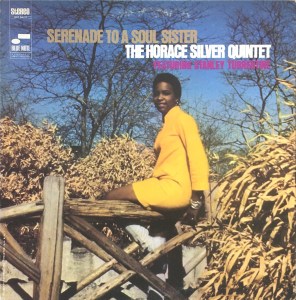

- This copy was clearly cut with super-low distortion mastering equipment, and boy does it help the sound
- Rudy Van Gelder did an outstanding job as usual engineering these 1968 quintet sessions, some of which include one of our favorite tenor men, Stanley Turrentine
- 4 1/2 stars: “One of the last great Horace Silver albums for Blue Note, Serenade to a Soul Sister is also one of the pianist’s most infectiously cheerful, good-humored outings… it’s hard to argue with musical results as joyous and tightly performed as Serenade to a Soul Sister.”
This vintage Blue Note pressing has the kind of Tubey Magical Midrange that modern records can barely BEGIN to reproduce. Folks, that sound is gone and it sure isn’t showing signs of coming back. If you love hearing INTO a recording, actually being able to “see” the performers, and feeling as if you are sitting in the studio with the band, this is the record for you. It’s what vintage all analog recordings are known for — this sound.
If you exclusively play modern repressings of vintage recordings, I can say without fear of contradiction that you have never heard this kind of sound on vinyl. Old records have it — not often, and certainly not always — but maybe one out of a hundred new records do, and those are some pretty long odds.
What amazing sides such as these have to offer is not hard to hear:
- The biggest, most immediate staging in the largest acoustic space
- The most Tubey Magic, without which you have almost nothing. CDs give you clean and clear. Only the best vintage vinyl pressings offer the kind of Tubey Magic that was on the tapes in 1968
- Tight, note-like, rich, full-bodied bass, with the correct amount of weight down low
- Natural tonality in the midrange — with all the instruments having the correct timbre
- Transparency and resolution, critical to hearing into the three-dimensional studio space
No doubt there’s more but we hope that should do for now. Playing the record is the only way to hear all of the qualities we discuss above, and playing the best pressings against a pile of other copies under rigorously controlled conditions is the only way to find a pressing that sounds as good as this one does.
What We Listen For on Serenade to a Soul Sister
- Energy for starters. What could be more important than the life of the music?
- Then: presence and immediacy. The instruments aren’t “back there” somewhere, lost in the mix. They’re front and center where any recording engineer worth his salt would put them.
- The Big Sound comes next — wall to wall, lots of depth, huge space, three-dimensionality, all that sort of thing.
- Then transient information — fast, clear, sharp attacks, not the smear and thickness so common to these LPs.
- Tight punchy bass — which ties in with good transient information, also the issue of frequency extension further down.
- Next: transparency — the quality that allows you to hear deep into the soundfield, showing you the space and air around all the instruments.
- Extend the top and bottom and voila, you have The Real Thing — an honest to goodness Hot Stamper.
TRACK LISTING
Side One
Psychedelic Sally
Serenade To A Soul Sister
Rain Dance
Side Two
Jungle Juice
Kindred Spirits
Next Time I Fall In Love
AMG Review
“One of the last great Horace Silver albums for Blue Note, Serenade to a Soul Sister is also one of the pianist’s most infectiously cheerful, good-humored outings. It was recorded at two separate early-1968 sessions with two mostly different quintets, both featuring trumpeter Charles Tolliver and alternating tenor saxophonists Stanley Turrentine and Bennie Maupin, bassists Bob Cranshaw and John Williams, and drummers Mickey Roker and Billy Cobham… it’s hard to argue with musical results as joyous and tightly performed as Serenade to a Soul Sister.” – AMG