

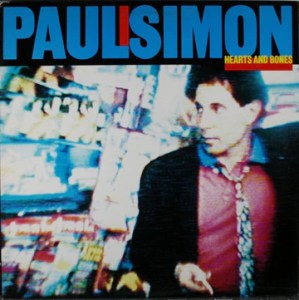

- Hearts and Bones returns to the site for the first time in almost 10 years, with STUNNING Shootout Winning Triple Plus (A+++) sound from first note to last – mostly quiet vinyl too
- Compared to every other copy in our recent shootout, this one was bigger and bolder with more Tubey Magic, clarity and separation
- Turn this one up good and loud (which you can do when the sound is THIS good) and you’ll have a living, breathing Paul Simon standing right between your speakers
- 4 1/2 stars: “… his most personal collection of songs, one of his most ambitious, and one of his best. It retains a personal vision… Simon’s most impressive collection in a decade and the most underrated album in his catalog.”
This copy has the kind of sound we look for in a top quality Paul Simon record: immediacy in the vocals (so many copies are veiled and distant); natural tonal balance (most copies are either bright or dark; ones with the right balance are the exception, not the rule); good solid weight; spaciousness (the best copies have studio ambience like you would not believe); and last but not least, TRANSPARENCY, the effect of being able to see INTO the soundfield all the way to the back, where there is plenty going on in this remarkably sophisticated studio recording.
If you exclusively play modern repressings of vintage recordings, I can say without fear of contradiction that you have never heard this kind of sound on vinyl. Old records have it — not often, and certainly not always — but maybe one out of a hundred new records do, and those are some pretty long odds.
What the best sides of Hearts and Bones have to offer is not hard to hear:
- The biggest, most immediate staging in the largest acoustic space
- The most Tubey Magic, without which you have almost nothing. CDs give you clean and clear. Only the best vintage vinyl pressings offer the kind of Tubey Magic that was on the tapes even as late as 1983
- Tight, note-like, rich, full-bodied bass, with the correct amount of weight down low
- Natural tonality in the midrange — with all the instruments having the correct timbre
- Transparency and resolution, critical to hearing into the three-dimensional space of the studio
No doubt there’s more but we hope that should do for now. Playing the record is the only way to hear all of the qualities we discuss above, and playing the best pressings against a pile of other copies under rigorously controlled conditions is the only way to find a pressing that sounds as good as this one does.
What We’re Listening For on Hearts and Bones
- Energy for starters. What could be more important than the life of the music?
- The Big Sound comes next — wall to wall, lots of depth, huge space, three-dimensionality, all that sort of thing.
- Then transient information — fast, clear, sharp attacks for the guitars, keyboards and drums, not the smear and thickness common to most LPs.
- Tight, note-like bass with clear fingering — which ties in with good transient information, as well as the issue of frequency extension further down.
- Next: transparency — the quality that allows you to hear deep into the soundfield, showing you the space and air around all the players.
- Then: presence and immediacy. The vocals aren’t “back there” somewhere, way behind the speakers. They’re front and center where any recording engineer worth his salt would have put them.
- Extend the top and bottom and voila, you have The Real Thing — an honest to goodness Hot Stamper.
TRACK LISTING
Side One
Allergies
Hearts and Bones
When Numbers Get Serious
Think Too Much (b)
Song About The Moon
Side Two
Think Too Much (a)
Train In The Distance
René And Georgette Magritte With Their Dog After The War
Cars Are Cars
The Late Great Johnny Ace
AMG 4 1/2 Star Review
Hearts and Bones was a commercial disaster, the lowest-charting new studio album of Paul Simon’s career. It is also his most personal collection of songs, one of his most ambitious, and one of his best.
It retains a personal vision, one largely devoted to the challenges of middle-aged life, among them a renewed commitment to love; the title song was a notable testament to new romance, while “Train in the Distance” reflected on romantic discord. Elsewhere, “The Late Great Johnny Ace” was his meditation on John Lennon’s murder and how it related to the mythology of pop music.
Musically, Simon moved forward and backward simultaneously, taking off from the jazz fusion style of his last two albums into his old loves of doo wop and rock & roll while also incorporating current sounds with such new collaborators as dance music producer Nile Rodgers and minimalist composer Philip Glass. The result was Simon’s most impressive collection in a decade and the most underrated album in his catalog.