

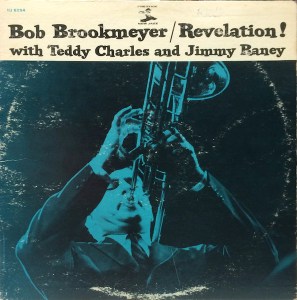

- This superb 1956 mono album makes its Hot Stamper debut with Shootout Winning Triple Plus (A+++) sound or close to it from start to finish
- We have never seen the original, but our retitled pressing here from 1964 will show you just how big, solid and musical this session by Rudy Van Gelder can sound
- If you can tolerate the somewhat noisier surfaces on side two you are in for some amazing Bob Brookmeyer music with top quality sound
- “Bob Brookmeyer plays valve trombone and piano on two songs apiece with his 1955 quartet, a group also including guitarist Jimmy Raney, bassist Teddy Kotick and drummer Mel Lewis… the music is pleasing and reasonably creative.”
Sometimes the copy with the best sound is not the copy with the quietest vinyl. The best sounding copy is always going to win the shootout, the condition of its vinyl not withstanding. If for any reason you are not happy with the sound or condition of the album we are of course happy to take it back for a full refund, including the domestic return postage.
This Prestige New Jazz mono pressing has the kind of Tubey Magical Midrange that modern records rarely even BEGIN to reproduce. Folks, that sound is gone and it sure isn’t showing signs of coming back. If you love hearing INTO a recording, actually being able to “see” the performers, and feeling as if you are sitting in the studio with the band, this is the record for you. It’s what vintage all analog recordings are known for — this sound.
If you exclusively play modern repressings of vintage recordings, I can say without fear of contradiction that you have never heard this kind of sound on vinyl. Old records have it — not often, and certainly not always — but maybe one out of a hundred new records do, and those are some pretty long odds.
What the best sides of The Dual Role of Bob Brookmeyer have to offer is not hard to hear:
- The biggest, most immediate staging in the largest acoustic space
- The most Tubey Magic, without which you have almost nothing. CDs give you clean and clear. Only the best vintage vinyl pressings offer the kind of Tubey Magic that was on the tapes in 1956
- Tight, note-like, rich, full-bodied bass, with the correct amount of weight down low
- Natural tonality in the midrange — with all the instruments having the correct timbre
- Transparency and resolution, critical to hearing into the three-dimensional space of the studio
No doubt there’s more but we hope that should do for now. Playing the record is the only way to hear all of the qualities we discuss above, and playing the best pressings against a pile of other copies under rigorously controlled conditions is the only way to find a pressing that sounds as good as this one does.
Copies with rich lower mids and nice extension up top did the best in our shootout, assuming they weren’t veiled or smeary of course. So many things can go wrong on a record! We know, we’ve heard them all.
Top end extension is critical to the sound of the best copies. Lots of old records (and new ones) have no real top end; consequently, the studio or stage will be missing much of its natural air and space, and instruments will lack their full complement of harmonic information.
Tube smear is common to most vintage pressings and this is no exception. The copies that tend to do the best in a shootout will have the least (or none), yet are full-bodied, tubey and rich.
What We’re Listening For on The Dual Role of Bob Brookmeyer
- Energy for starters. What could be more important than the life of the music?
- The Big Sound comes next — wall to wall, lots of depth, huge space, three-dimensionality, all that sort of thing.
- Then transient information — fast, clear, sharp attack, not the smear and thickness common to most LPs.
- Tight, note-like bass with clear fingering — which ties in with good transient information, as well as the issue of frequency extension further down.
- Next: transparency — the quality that allows you to hear deep into the soundfield, showing you the space and air around all the players.
- Then: presence and immediacy. The musicians aren’t “back there” somewhere, lost in the mix. They’re front and center where any recording engineer worth his salt — Rudy Van Gelder in this case — would put them.
- Extend the top and bottom and voila, you have The Real Thing — an honest to goodness Hot Stamper.
The Players
Bob Brookmeyer – valve trombone, piano
Jimmy Raney – guitar
Teddy Charles – vibraphone
Teddy Kotick – bass
Mel Lewis, Ed Shaughnessy – drums
Nancy Overton – vocals
TRACK LISTING
Side One
Rocky Scotch
Under The Lilacs
They Say It’s Wonderful
Potrezebie
Side Two
Revelation
Star Eyes
Nobody’s Heart
Loupe-Garou
AMG Review
Bob Brookmeyer plays valve trombone and piano on two songs apiece with his 1955 quartet, a group also including guitarist Jimmy Raney, bassist Teddy Kotick and drummer Mel Lewis. The other half of this disc is actually led by vibraphonist Teddy Charles who features Brookmeyer on both of his instruments along with bassist Teddy Kotick and drummer Ed Shaughnessy; Nancy Overton takes a vocal on “Nobody’s Heart.” Although the overall set is not all that essential, the music is pleasing and reasonably creative.