

More Oscar Peterson
Reviews and Commentaries for the Music of Oscar Peterson
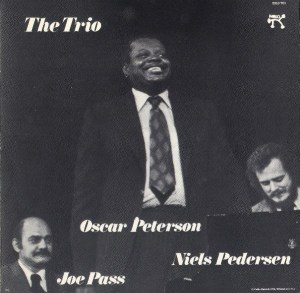

- This vintage Pablo LP boasts Shootout Winning Triple Plus (A+++) sound from first note to last
- An exceptional pressing of this epic live jazz recording, with a very strong bottom end, lovely richness and warmth, real space and separation between the instruments and wonderful immediacy throughout
- In collaboration with bassist Niels-Henning Ørsted Pedersen and guitarist Joe Pass, Peterson “brilliantly investigates several jazz styles” with his melodically inventive approach
- 5 stars: “Peterson really flourished during his years with Norman Granz’s Pablo label, and this was one of his finest recordings of the period.”
This Pablo pressing has the kind of Tubey Magical Midrange that modern records rarely even BEGIN to reproduce. Folks, that sound is gone and it sure isn’t showing signs of coming back. If you love hearing INTO a recording, actually being able to “see” the performers, and feeling as if you are sitting in Chicago’s London House with Oscar, this is the record for you. It’s what Vintage Records are known for — this sound.
If you exclusively play modern repressings of vintage recordings, I can say without fear of contradiction that you have never heard this kind of sound on vinyl. Old records have it — not often, and certainly not always — but maybe one out of a hundred new records do, and those are some pretty long odds.
What is lost in these newly remastered recordings? Lots of things, but the most obvious and bothersome is TRANSPARENCY. And the loss of transparency in a live jazz club recording is practically the kiss of death.
What the best sides of this vintage pressing have to offer is not hard to hear:
- The biggest, most immediate staging in the largest acoustic space
- The most Tubey Magic, without which you have almost nothing. CDs give you clean and clear. Only the best vintage vinyl pressings offer the kind of Tubey Magic that was on the tapes in 1973
- Tight, note-like, rich, full-bodied bass, with the correct amount of weight down low
- Natural tonality in the midrange — with all the instruments of this stellar piano trio having the correct timbre
- Transparency and resolution, critical to hearing into the three-dimensional space of the club
No doubt there’s more but we hope that should do for now. Playing the record is the only way to hear all of the qualities we describe above, and for that, you will need to take this copy of the record home and throw it on your table.
What We’re Listening For on The Trio
- Energy for starters. What could be more important than the life of the music?
- The Big Sound comes next — wall to wall, lots of depth, huge space, three-dimensionality, all that sort of thing.
- Then transient information — fast, clear, sharp attacks, not the smear and thickness common to most LPs.
- Tight, note-like bass with clear fingering — which ties in with good transient information, as well as the issue of frequency extension further down.
- Next: transparency — the quality that allows you to hear deep into the soundfield, showing you the space and air around all the players.
- Then: presence and immediacy. The musicians aren’t “back there” somewhere, way behind the speakers. They’re front and center where any recording engineer worth his salt would have put them.
- Extend the top and bottom and voila, you have The Real Thing — an honest to goodness Hot Stamper.
TRACK LISTING
Side One
Blues Etude
Chicago Blues
Side Two
Easy Listening Blues
Come Sunday
Secret Love
AMG 5 Star Review
Guitarist Joe Pass and bassist Niels-Henning Ørsted Pedersen both play well on these live performances, but the reason to acquire this set is for the remarkable Oscar Peterson. The pianist brilliantly investigates several jazz styles on “Blues Etude” (including stride and boogie-woogie), plays exciting versions of his “Chicago Blues” and “Easy Listening Blues,” tears into “Secret Love,” and shows honest emotion on “Come Sunday.”
Peterson really flourished during his years with Norman Granz’s Pablo label, and this was one of his finest recordings of the period.