

More of the Music of Claude Debussy
More of the Music of Maurice Ravel

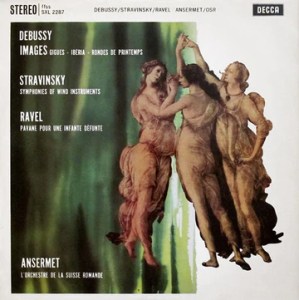
- Solid Double Plus (A++) sound or close to it brings Ansermet and the Suisse Romande’s performance to life on this original Decca Stereo pressing
- It’s also fairly quiet at Mint Minus Minus, and for recordings of Debussy, that is quiet indeed
- We often run into condition issues with this title – the two copies with the highest grades had problems in the vinyl that make them unsuitable for audiophiles (especially at these prices)
- If you want to go digging for your own copy, we tell you how to do that on the blog, and we wish you good luck, you’re going to need it
- This copy is remarkably lively and dynamic, particularly on side two – the RCA with Munch is also excellent, but you will find very little to fault in the sound of this record if you don’t have precisely the right stampers for that one
- It’s worth noting that only the London pressings ever win the shootout, which is something that we run into on a regular basis but for some reason surprises audiophile record lovers to this very day
- Why the disparity, we have no idea – they are all mastered by Decca in England from the same tapes, and by the same engineers!
This vintage Decca pressing has the kind of Tubey Magical Midrange that modern records can barely BEGIN to reproduce. Folks, that sound is gone and it sure isn’t showing signs of coming back. If you love hearing INTO a recording, actually being able to “see” the performers, and feeling as if you are sitting in the studio with the band, this is the record for you. It’s what vintage all analog recordings are known for — this sound.
If you exclusively play modern repressings of vintage recordings, I can say without fear of contradiction that you have never heard this kind of sound on vinyl. Old records have it — not often, and certainly not always — but maybe one out of a hundred new records do, and those are some pretty long odds.
What The Best Sides Of Images for Orchestra Have To Offer Is Not Hard to Hear
- The biggest, most immediate staging in the largest acoustic space
- The most Tubey Magic, without which you have almost nothing. CDs give you clean and clear. Only the best vintage vinyl pressings offer the kind of Tubey Magic that was on the tapes in 1961
- Tight, note-like, rich, full-bodied bass, with the correct amount of weight down low
- Natural tonality in the midrange — with all the instruments having the correct timbre
- Transparency and resolution, critical to hearing into the three-dimensional studio space
No doubt there’s more but we hope that should do for now. Playing the record is the only way to hear all of the qualities we discuss above, and playing the best pressings against a pile of other copies under rigorously controlled conditions is the only way to find a pressing that sounds as good as this one does.
Copies with rich lower mids and nice extension up top did the best in our shootout, assuming they weren’t veiled or smeary of course. So many things can go wrong on a record! We know, we’ve heard them all.
Top end extension is critical to the sound of the best copies. Lots of old records (and new ones) have no real top end; consequently, the studio or stage will be missing much of its natural air and space, and instruments will lack their full complement of harmonic information.
Tube smear is common to most vintage pressings and this is no exception. The copies that tend to do the best in a shootout will have the least (or none), yet are full-bodied, tubey and rich.
What We’re Listening For On Images for Orchestra
- Energy for starters. What could be more important than the life of the music?
- The Big Sound comes next — wall to wall, lots of depth, huge space, three-dimensionality, all that sort of thing.
- Then transient information — fast, clear, sharp attacks, not the smear and thickness so common to these LPs.
- Tight punchy bass — which ties in with good transient information, also the issue of frequency extension further down.
- Next: transparency — the quality that allows you to hear deep into the soundfield, showing you the space and air around all the instruments.
- Extend the top and bottom and voila, you have The Real Thing — an honest to goodness Hot Stamper.
Side One
Debussy
Images For Orchestra
No. 1 Gigues
No. 2 Ibéria – A) Par Les Rues Et Par Les Chemins
No. 2 Ibéria – B) Les Parfums De La Nuit
No. 2 Ibéria – C) Le Matin D’Un Jour De Fête
Side Two
Images For Orchestra
No. 3 Rondes De Printemps
Stravinsky
Symphonies Of Wind Instruments
Ravel
Pavane Pour Une Infante Défunte
Images For Orchestra – Debussy
Images pour orchestre, L. 122, is an orchestral composition in three sections by Claude Debussy, written between 1905 and 1912.
Sections
Gigues
The original title of Gigues was Gigues tristes. Debussy used his memories of England as inspiration for the music, in addition to the song “Dansons la gigue” by Charles Bordes and the Tyneside folk tune “The Keel Row,” which are used as key themes. Revolving around Gigues are musical cells which give a sense of unity to the piece. Most are short motifs which appear once or twice or are reused in fragments throughout the piece. Other themes are long solo passages written particularly for the oboe d’amore.
Ibéria
Ibéria is the most popular of the three orchestral Images and itself forms a triptych within the triptych. Its sections are:
-
- Par les rues et par les chemins (Along the streets and along the paths)
- Les parfums de la nuit (The scents of the night)
- Le matin d’un jour de fête (The morning of a festive day) – a procession of a ‘banda de guitarras’
Impressions of Spain inspired this music.
Rondes de printemps (“Round dances of spring”)
[Debussy] used two folk tunes, “Nous n’irons plus au bois” and “Do, do l’enfant do” in this movement. The first song plays a prominent role from the start of the 15/8 time until the end of the movement, in the solos and in the accompaniments and countermelodies.
-Wikipedia