

More Kenny Burrell
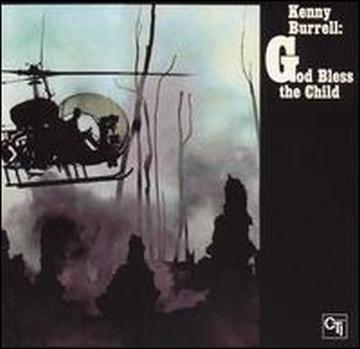
- Incredible sound throughout this original copy (only the second to hit the site in years), with both sides earning Shootout Winning Triple Plus (A+++) grades or close to them
- Here are just a few of the things we had to say about this stunning copy in our notes: “spacious and rich guitar and strings”…”big and open and clear”…”jumping out of the speakers”
- One of our favorite CTI albums, and surely one of the best sounding, especially on this pressing
- If you’re looking for the best sounding jazz from the 70s and 80s, you might want to check out these titles
- Credit goes to Rudy Van Gelder once again for the huge space that the superbly well-recorded orchestra occupies
- 4 stars: “This is Burrell at his level best as a player to be sure, but also as a composer and as a bandleader. Magnificent.”
God Bless The Child is one of our favorite orchestra-backed jazz records here at Better Records. A few others at the top of my list would be Wes Montgomery’s California Dreaming (1966, and also Sebesky-arranged), Grover Washington’s All the King’s Horses (1973) and Deodato’s Prelude (also 1973, with brilliant arrangements by the man himself).
What’s especially notable is how well-recorded the strings are. They have just the right amount of texture and immediacy without being forced or shrill. They’re also very well integrated into the mix. I wouldn’t have expected RVG to pull it off so well — I’ve heard other CTI records where the orchestration was abominable — but here it works as well as on any album I know of.
The bass is deep and defined; the tonality of the guitar and its overall harmonic richness are beautifully rendered. The piano has the weight and heft of the real thing.
This kind of warm, rich, Tubey Magical analog sound is gone forever. You have to go back to 1971 to find it.
The Music
The high point for side one is clearly the first track. It’s got a Midnight Blue relaxed groove going on, the kind that Kenny Burrell seems to be able to bring to any session he plays on. Or maybe it’s the rhythms Ray Barretto works out in the songs that make them so relaxed and swinging at the same time.
Side two is magical from start to finish. The two extended songs, both more than eight minutes in length, leave plenty of room for the band and the orchestra to stretch out.
What The Best Sides Of God Bless the Child Have To Offer Is Not Hard To Hear
- The biggest, most immediate staging in the largest acoustic space
- The most Tubey Magic, without which you have almost nothing. CDs give you clean and clear. Only the best vintage vinyl pressings offer the kind of Tubey Magic that was on the tapes in 1971
- Tight, note-like, rich, full-bodied bass, with the correct amount of weight down low
- Natural tonality in the midrange — with all the instruments having the correct timbre
- Transparency and resolution, critical to hearing into the three-dimensional studio space
No doubt there’s more but we hope that should do for now. Playing the record is the only way to hear all of the qualities we discuss above, and playing the best pressings against a pile of other copies under rigorously controlled conditions is the only way to find a pressing that sounds as good as this one does.
Copies with rich lower mids and nice extension up top did the best in our shootout, assuming they weren’t veiled or smeary of course. So many things can go wrong on a record. We know, we’ve heard them all.
Top end extension is critical to the sound of the best copies. Lots of old records (and new ones) have no real top end; consequently, the studio or stage will be missing much of its natural air and space, and instruments will lack their full complement of harmonic information.
Tube smear is common to most vintage pressings. The copies that tend to do the best in a shootout will have the least (or none), yet are full-bodied, tubey and rich.
What We’re Listening For On God Bless the Child
- Energy for starters. What could be more important than the life of the music?
- The Big Sound comes next — wall to wall, lots of depth, huge space, three-dimensionality, all that sort of thing.
- Then transient information — fast, clear, sharp attacks, not the smear and thickness so common to these LPs.
- Tight, full-bodied bass — which ties in with good transient information, also the issue of frequency extension further down.
- Next: transparency — the quality that allows you to hear deep into the soundfield, showing you the space and air around all the instruments.
- Extend the top and bottom and voila, you have The Real Thing — an honest to goodness Hot Stamper.
Side One
Be Yourself
Love Is the Answer
Do What You Gotta Do
Side Two
A Child Is Born
God Bless the Child
AMG Review
Kenny Burrell’s guitar artistry is well-documented in his years with Oscar Peterson and on his first dates as a leader on the Blue Note label, but God Bless the Child, his only date for CTI in 1971, is an under-heard masterpiece in his catalog. Burrell’s band for the set includes bassist Ron Carter, percussionist Ray Barretto, Richard Wyands on piano, flutist Hubert Laws, trumpeter Freddie Hubbard, and drummer Billy Cobham.
CTI’s house arranger, Don Sebesky, assembled and conducted the strings in a manner that stands strangely and beautifully apart from his other work on the label. Sebesky understood Burrell’s understated approach to playing guitar. Burrell didn’t belong with the fusioneers, but he could groove better than any of them.
Sebesky built a moody, atmospheric soundscape behind him, one that was as impressionistic as it was illuminating of a player who could dig in and chop it up — as he does on his own composition “Love Is the Answer” and “Do What You Gotta Do” — and stroke it smooth and mellow as on the title track, the truly sublime “Be Yourself,” and Thad Jones’ “A Child Is Born.”
This is Burrell at his level best as a player to be sure, but also as a composer and as a bandleader. Magnificent.
Further Reading
- This is why we love Rudy Van Gelder in the 60s
- Rudy Van Gelder is one of our favorite engineers
- Could this be the sound audiophiles complain about with RVG’s mastering?