

More of the Music of Tchaikovsky

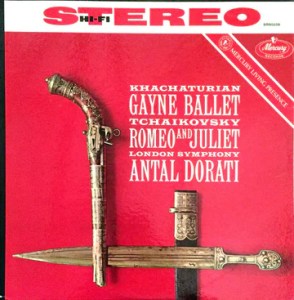
- Dorati and the LSO’s masterful performance of Gayne Ballet returns to the site for only the second time in years, here with solid Double Plus (A++) grades on both sides of this Plum Label Mercury Stereo pressing
- It’s also fairly quiet at Mint Minus Minus, a grade that even our most well-cared-for vintage classical titles have trouble playing at
- An abundance of energy, loads of rich detail and texture, superb transparency and excellent clarity – the very definition of Demo Disc sound
- The top is correct, even sweet, and you can’t say that about very many vintage Mercury recordings
- One listen and we think you’ll see why we consider both the performance and recording of the Khachaturian to be the equal of the famous Golschmann LP on Vanguard, and both are in a different league than the Decca on the TAS List
Both of these sides are Demo Disc quality, thanks to their superb low-distortion mastering. It’s yet another exciting Mercury recording. The quiet passages have unusually sweet sound.
This kind of sound is not easy to cut. This copy gets rid of the cutter head distortion and coloration and allows you to hear what the Mercury engineers (Robert Fine and Wilma Cozart) accomplished.
This vintage pressing has the kind of Tubey Magical Midrange that modern records can barely BEGIN to reproduce. Folks, that sound is gone and it sure isn’t showing signs of coming back. If you love hearing INTO a recording, actually being able to “see” the performers, and feeling as if you are sitting in the studio with the band, this is the record for you. It’s what vintage all analog recordings are known for — this sound.
If you exclusively play modern repressings of vintage recordings, I can say without fear of contradiction that you have never heard this kind of sound on vinyl. Old records have it — not often, and certainly not always — but maybe one out of a hundred new records do, and those are some pretty long odds.
What The Best Sides Of Gayne Ballet / Romeo and Juliet Have To Offer Is Not Hard To Hear
- The biggest, most immediate staging in the largest acoustic space
- The most Tubey Magic, without which you have almost nothing. CDs give you clean and clear. Only the best vintage vinyl pressings offer the kind of Tubey Magic that was on the tapes in 1961
- Tight, note-like, rich, full-bodied bass, with the correct amount of weight down low
- Natural tonality in the midrange — with all the instruments having the correct timbre
- Transparency and resolution, critical to hearing into the three-dimensional studio space
No doubt there’s more but we hope that should do for now. Playing the record is the only way to hear all of the qualities we discuss above, and playing the best pressings against a pile of other copies under rigorously controlled conditions is the only way to find a pressing that sounds as good as this one does.
Copies with rich lower mids and nice extension up top did the best in our shootout, assuming they weren’t veiled or smeary of course. So many things can go wrong on a record. We know, we’ve heard them all.
Top end extension is critical to the sound of the best copies. Lots of old records (and new ones) have no real top end; consequently, the studio or stage will be missing much of its natural air and space, and instruments will lack their full complement of harmonic information.
Tube smear is common to most vintage pressings. The copies that tend to do the best in a shootout will have the least (or none), yet are full-bodied, tubey and rich.
Compromises
The best classical recordings of the 50s and 60s, compromised in every imaginable way, stand head and shoulders above practically anything that has come along since. The music lives and breathes on those old LPs. Playing them you find yourself in the Living Presence of the musicians. You become lost in their performances.
Whatever the limitations of the medium, they seem to fade quickly from consciousness. What remains is the rapture of the pure musical experience.
That’s what happens when a good record meets a good turntable.
We live for records like these. It’s the reason we get up in the morning and come to work, to find and play good records. It’s what this site is all about — offering the audiophile music lover recordings that provide real musical satisfaction.
It’s hard work — apparently it’s so hard nobody else seems to want to do it — but the payoff makes it all worthwhile. To us anyway. We hope you feel the same.
This work is difficult to find with anything but harsh sound. Such powerful and exciting orchestration must surely be problematic to capture on tape.
But Mercury managed to do it, a feat few other labels can claim.
What We’re Listening For On Gayne Ballet / Romeo and Juliet
- Energy for starters. What could be more important than the life of the music?
- The Big Sound comes next — wall to wall, lots of depth, huge space, three-dimensionality, all that sort of thing.
- Then transient information — fast, clear, sharp attacks, not the smear and thickness so common to these LPs.
- Powerful bass — which ties in with good transient information, also the issue of frequency extension further down.
- Next: transparency — the quality that allows you to hear deep into the soundfield, showing you the space and air around all the instruments.
- Extend the top and bottom and voila, you have The Real Thing — an honest to goodness Hot Stamper.
Side One
Gayne Ballet Music – Khachaturian
Sabre Dance
Ayesha’s Dance
Dance Of The Rose Maidens
Dance Of The Kurds
Lullaby
Dance Of The Young Kurds
Armen’s Variation
Lezghinka
Side Two
Romeo And Juliet Overture – Fantasy After Shakespeare
Gayne Ballet
Gayane (Gayaneh or Gayne, the e is pronounced) is a four-act ballet with music by Aram Khachaturian. Khachaturian’s original Gayane was the story of a young Armenian woman whose patriotic convictions conflict with her personal feelings on discovering her husband’s treason. In later years the plot was modified several times, the resultant story emphasizing romance over nationalistic zeal.
The orchestral score calls for:
- woodwinds: 3 flutes (3rd doubling piccolo), 2 oboes, English horn, 3 clarinets (3rd doubling bass clarinet), alto saxophone, 2 bassoons;
- Brass: 4 horns, cornet, 3 trumpets, alto trumpet, 3 trombones, bass tuba;
- Timpani and percussion: triangle, tambourine, 2 side drums, cymbals, bass drum, tam-tam, doli, daira, Glockenspiel, xylophone, marimba, vibraphone, chimes;
- keyboards: celesta, piano;
- strings: 2 harps, violins (1st and 2nd), violas, cellos and double basses.
Plot
Many themes of interethnic love, betrayal and friendship interact in an Armenian setting. The central character is a young woman named Gayane, who works in a kolkhoz in a mountainous district near the national border.
Act I
In the Armenian kolkhoz, farmers are busy reaping cotton. Among them are heroine Gayane, her father Ovanes, brother Armen and younger sister Nune. They are all models of hard work with the only exception of Gayane’s husband Giko, a lazy drunkard. She admonishes Giko for his misconduct and this escalates into a quarrel. Then arrives Kazakov, commander of the Soviet frontier guard, and a dance of welcome begins. Seeing Gayane present a bouquet to Kazakov, Giko violently snatches the bouquet from her and ignoring everybody’s reproach, disappears.
Act II
At Gayane’s home, people console Gayane who is deploring her husband’s misconduct. The singing voices of carpet weavers are heard. As Giko returns, all go out. Gayane sings her child Ripsime to sleep. Three smugglers come to see Giko. They conspire to share the public money they have embezzled, to set fire to the cotton warehouse and to flee abroad. Overhearing their conspiracy, Gayane admonishes her husband, but he thrusts her into another room and locks her up.
Act III
At a Kurdish settlement in a mountainous area near the kolkhoz are many people, including Gayane’s brother Armen, a Kurdish girl Aishe, and a Kurdish young man Izmail who loves her. Giko and the three smugglers arrive, asking Armen their way. Wondering about their intentions and activity, he sends some Kurdish youths to fetch Kazakov. Noticing this, Giko and his gang try to kill Armen, but Kazakov appears just in time and arrests the three smugglers. Giko escapes, however, and sets fire to the cotton warehouse. Trying to flee in the confusion of the moment, Giko is found by Gayane, who has managed to break out of the room in which she was imprisoned. Giko threatens Gayane that he will drop their child Ripsime from a cliff. As Gayane does not yield, Giko stabs her with a dagger. Hearing her shriek, Kazakov rushes in and arrests Giko, who will be brought to justice. Kazakov tends Gayane devotedly, and she recovers. Love grows between the two.
Act IV
A year later, at the kolkhoz, a dedication ceremony of the reconstructed warehouse occurs, as well as three weddings: Gayane and Kazakov, Armen and Aishe, Karen and Nune. Folk dances, rich in local color, are performed one after another. The ballet ends amid blessings by all.
-Wikipedia