

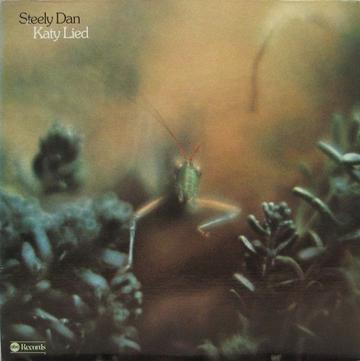
As a huge Steely Dan fan starting with their second album, Countdown to Ecstasy, in 1975 I went right down to my local Tower Records and bought Katy Lied as soon as it came out. It has been a personal favorite since the day I first played it.
Much like our longstanding customer Roger, when the album didn’t sound all that good to me, I just assumed it was a bad recording. 35 years of hard work and perseverance later, I was finally able to hear the album in all its glory.
It’s only fitting that it’s a member of our extensive listening in depth series.
Any record we get obsessed with tends to get played hundreds and hundreds of times. Knowing the record as well as we do makes it easy to recognize what to listen for in order to separate the best copies from the merely good ones.
And of course, as a card carrying audiophile, I had to buy the MoFi pressing when it came out a few years later. A company that would release a record with sound that bad should have gone out of business a long time ago. For some reason they are still in business, a fact that does not reflect well on the audiophile community.
The Key
The trick with Katy Lied Is to find the right balance between richness, sweetness and clarity.
Take three or four Katy Lied pressings, clean them up and play just one or two of the tracks we discuss below. On a highly resolving system, you shouldn’t be able to find any two copies that get those tracks to sound the same. We used to do our shootouts with up to a dozen copies at a time — now more like 6-8 since we can’t find that many clean copies anymore — and no two sound the same to us.
Side One
Black Friday
Arguably the most musically aggressive track on the album, “Black Friday” is without question the most sonically aggressive and a quick indicator of what you can expect from the rest of the side. The typical copy is an overly-compressed sonic assault on the ears. The glaring upper midrange and tizzy grit that passes for highs will have you jumping out of your easy chair to turn down the volume. Even my younger employees who grew up playing in loud punk rock bands were cringing at the sound.
However, the good copies take this aggressive energy and turn it into pure excitement. The boys are ready to rock, and they’ve got the pulsing bass, hammering drums, and screaming guitars to do it.
Without the grit and tizz and radio EQ, which could have been added during mastering or caused by the sound of some bad ABC vinyl, who can say which, the sound is actually quite good on the best of the best copies. It’s one of the toughest tests for side one. Sad to say, most copies earn a failing grade right out of the gate on this album.
In that respect it’s very similar to Royal Scam. Kid Charlemagne is no walk in the park. We noted:
This song will always be a little bright and upper midrangy. That’s the way it’s mixed. It will never sound as good as the songs that follow on side one. It will sound really irritating, hard and aggressive on the average domestic pressing.
Bad Sneakers
This is my favorite track on the album. I love this song! On the best copies, the sound is very punchy, but the most important qualities I listen for are richness and sweetness, especially on the backing vocals. Michael McDonald et al. should sound like they were recorded with ribbon mics and an Ampex 300 Tube tape recorder, like the one Contemporary Records used. The vocals are that good.
Another quality the chorus should have is clarity. By that I mean there should be separation between each of the vocalists that make up the group. When this record is mastered from sub-generation tapes (or sub-sub-generation tapes, which is more often the case) the voices take on a smeary quality and there is a noticeable increase in the harmonic distortion.
I first discovered this sound when listening to a Hot Stamper copy of Countdown To Ecstasy while doing a shootout with a Japanese pressing, which until that time I thought was the better sounding version. On the chorus of one of the tracks the domestic copy was clear, clean and undistorted. The Japanese pressing had noticeable harmonic distortion, which I’m inferring came from their use of a sub-generation tape.
In every other way, the Japanese pressing sounded fine. When the mix got complicated, the flaws showed up.
So when Bad Sneakers gets loud and complex, the shortcomings of some pressings will become obvious. This is what shootouts are all about. Everything is relative. The three most important words in the English language when it comes to evaluating records are “compared to what?“
More often than not it takes a better record to show you what’s wrong with the record you’re playing.
And turning up your volume is key to testing a song like Bad Sneakers. The louder the problem, the harder it is to ignore.
Check out the electric sitar at the opening. If it sounds thin and brittle, run for cover. If you can hear the texture and musicality of the instrument, you’re off to a good start.
Some other key things to pay attention to: Jeff Porcaro’s rimshots in the verses should really knock. (We love this guy!)
Also, Fagen’s vocals are present and transparent on the better copies; they come across veiled and compressed on the standard issue. You can really hear this effect clearly when his doubled vocal comes in on the line “Honey, when they gonna send me home?” It should really jump.
Rose Darling
The piano is a great test on this track. If the piano don’t sound right, this track will be a mess. It’s big and bold in the mix and should really sound solid and weighty. Thin or washed out and you are in trouble.
This track punishes equipment that is slow, or has blubbery bass response. Vintage tube equipment is not what the doctor ordered.
If your woofers are too small, or you do not have enough low end definition and weight to reproduce such a powerful piano, the piano will suffer and so will the song.
Daddy Don’t Live in That New York City No More
Doctor Wu
Doctor Wu is actually the most difficult track to get right. Phil Wood’s saxophone can sound hard on some copies, especially if they have any brightness or harshness. The vocals, however, tend to be on the smooth side. The trick is getting the vocals and the saxophone to both sound properly balanced relative to each other. Neither should be advantaged during mastering at the expense of the other, but that’s precisely what happens with most pressings.
It presents a fairly tough test for even the best copies. The compression inherent in the sound of most LPs can make the vocals overly smooth and just plain lifeless. It doesn’t have to be this way.
The killer copies afforded us an insight into the sax solo for this song that made the listening panel really sit up and take notice. Phil Woods’ solo most of the time sounds like exactly what it is: an overdub laid onto a finished song. It usually sounds (and feels) disconnected from the band playing behind it.
While doing this shootout, the super hot side ones made us forget he was playing his bit after the fact. It suddenly started to sound like a real live band rockin’ together. The effect was uncanny. Phil was in the room with these guys, even though we knew he couldn’t have been.
Proof positive that when it all comes together in the mastering, the sound isn’t the only thing that gets better — the music does too. Non-audiophiles have no experience of this phenomenon, but anybody lucky enough to own a Hot Copy of Katy Lied knows what I’m talking about.
One last note: listen to how tasty Porcaro’s fills are in the fade. Yummy. Of any musician to ever play on any Steely Dan album, Porcaro on Katy Lied is The Man. Play the whole album through a few times listening to nothing but the drumming and see if you don’t agree. (Hal Blaine plays on the track Any World… so ignore that one.)
Side Two
Everyone’s Gone to the Movies
Your Gold Teeth II
Chain Lightning
The thing to listen for here is the huge amount of ambience — the distance the echo goes back behind the speakers must be 20 or 30 feet on a good system. Maximum echo equals maximum resolution in the midrange. (Resolution is not the be-all and end-all of good mastering, but it helps.)
Some of the biggest sound on the record. That huge snare drum is an immediate sign of things to come. We found that poorer pressings made this snare sound like it was coated in digital reverb, which hadn’t even been invented yet. The good copies revealed that it was instead meaty-thick and powerful, surrounded by room ambience – the way it was intended to sound.
The group vocals were also ruined on the baddies. They became smeary and muddled. The hot copies allowed the background singers to separate themselves, giving the impression that Fagen is being backed by real singers and not an indeterminate processed mass.
Any World (That I’m Welcome To)
Dynamics, Dynamics, DYNAMICS
Let’s play a game. Where does the dynamic contrast of this track really kick in, making it about 1-2 db louder? (That’s a significant change by the way.) Well, if you find it, you’ll be floored to hear that our hot copies made this dynamic contrast kick up even more — maybe even as much as 4 db. Wow. What an impact it has this music.
Also, listen for the delicate acoustic guitar in the left channel. The overly compressed versions practically makes it disappear. It’s clearly part of the mix on any good LP. Just for fun see how clear it is on your copy.
Let’s face it: This is the toughest track to get to sound good on side two. The chorus can be a little strained toward the end of this song. I think there’s a certain amount of upper midrangy-ness in the mix that no amount of TLC in the mastering can really get out.
But the best copies make you forget such minor shortcomings. The bad copies throw them in your face like a bucket of cold water.
Throw Back the Little Ones
I’ve been listening to Waka/Jawaka quite a bit lately. Steely Dan has an homage to Zappa’s unique woodwind and horn arrangements starting at about 1:48. Go to youtube and check it out when you have a minute.
The Big Seven
- Reviews and commentaries for Can’t Buy A Thrill
- Reviews and commentaries for Countdown to Ecstasy
- Reviews and commentaries for Pretzel Logic
- Reviews and commentaries for Katy Lied
- Reviews and commentaries for The Royal Scam
- Reviews and commentaries for Aja
- Reviews and commentaries for Gaucho