



You can feel the cool air of the studio the minute the needle hits the groove on this killer copy.
What we are offering here is the superior sounding re-recording from 1961, produced by Dick Peirce.
Chet took the orchestra tapes back to his home studio in 1961 and re-recorded his parts over them, and we think he managed to do a much better job the second time around.
This TAS list recording will have you asking why so few Living Stereo pressings actually do what this one does. The more critical listeners among you will recognize that this is a very special copy indeed.
I suppose we owe a debt of gratitude to Harry Pearson for pointing out to us with his TAS List what a great record this is, although I’m pretty sure anybody playing this album would have no trouble telling after a minute or two that this copy is very special indeed.
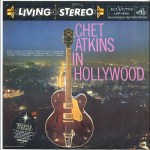
The pressing that Harry seems to have preferred — it’s the one recommended on his list, along with the Classic Records repress — is the inferior-sounding original recording, the one with the cover showing a guitar superimposed over the cityscape.
Size and Space
One of the qualities that we don’t talk about on the site nearly enough is the SIZE of the record’s presentation. Some copies of the album just sound small — they don’t extend all the way to the outside edges of the speakers, and they don’t seem to take up all the space from the floor to the ceiling. In addition, the sound can often be recessed, with a lack of presence and immediacy in the center.
Other copies — my notes for these copies often read “BIG and BOLD” — create a huge soundfield, with the music positively jumping out of the speakers. They’re not brighter, they’re not more aggressive, they’re not hyped-up in any way, they’re just bigger and clearer.
We often have to go back and downgrade the copies that we were initially impressed with in light of such a standout pressing. Who knew the recording could be that huge, spacious and three dimensional? We sure didn’t, not until we played the copy that had those qualities, and that copy might have been number 8 or 9 in the rotation.
Think about it: if you had only seven copies, you might not have ever gotten to hear a copy that sounded that open and clear. And how many even dedicated audiophiles would have more than one or two clean vintage copies with which to do a shootout? These records are expensive and hard to come by in good shape. Believe us, we know whereof we speak.
One further point needs to be made: most of the time these very special pressings are just plain more involving. When you hear a copy do what this copy can, it’s an entirely different — and dare I say unforgettable — listening experience.
Further Reading
- Hot Stamper pressings of Living Stereo titles available now
- More reviews and commentaries for the music of Chet Atkins
- Hot Stamper pressings of TAS Super Disc list records available now