

More Chico Hamilton
More Jazz Recordings of Interest

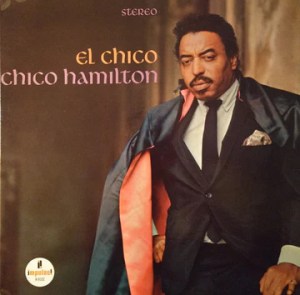
- El Chico makes its Hot Stamper debut with solid Double Plus (A++) sound or BETTER throughout this original Impulse Stereo pressing – exceptionally QUIET vinyl, the kind we would not expect to find on Impulse in 1965
- These sides, recorded brilliantly by one of our favorite engineers, Bob Simpson, are big, full-bodied and present, with plenty of Tubey Magic and set on a huge, three-dimensional soundstage
- The record features the amazing Gabor Szabo, Japanese altoist Sadao Watanabe, bassist Al Stinson, guest trombonist Jimmy Cheatham, and the Latin percussion of Willie Bobo and Victor Pantoja
This vintage Impulse pressing has the kind of Tubey Magical Midrange that modern records can barely BEGIN to reproduce. Folks, that sound is gone and it sure isn’t showing signs of coming back. If you love hearing INTO a recording, actually being able to “see” the performers, and feeling as if you are sitting in the studio with the band, this is the record for you. It’s what vintage all analog recordings are known for — this sound.
If you exclusively play modern repressings of vintage recordings, I can say without fear of contradiction that you have never heard this kind of sound on vinyl. Old records have it — not often, and certainly not always — but maybe one out of a hundred new records do, and those are some pretty long odds.
What The Best Sides Of El Chico Have To Offer Is Not Hard To Hear
- The biggest, most immediate staging in the largest acoustic space
- The most Tubey Magic, without which you have almost nothing. CDs give you clean and clear. Only the best vintage vinyl pressings offer the kind of Tubey Magic that was on the tapes in 1965
- Tight, note-like, rich, full-bodied bass, with the correct amount of weight down low
- Natural tonality in the midrange — with all the instruments having the correct timbre
- Transparency and resolution, critical to hearing into the three-dimensional studio space
No doubt there’s more but we hope that should do for now. Playing the record is the only way to hear all of the qualities we discuss above, and playing the best pressings against a pile of other copies under rigorously controlled conditions is the only way to find a pressing that sounds as good as this one does.
Copies with rich lower mids and nice extension up top did the best in our shootout, assuming they weren’t veiled or smeary of course. So many things can go wrong on a record! We know, we’ve heard them all.
Top end extension is critical to the sound of the best copies. Lots of old records (and new ones) have no real top end; consequently, the studio or stage will be missing much of its natural air and space, and instruments will lack their full complement of harmonic information.
Tube smear is common to most vintage pressings. The copies that tend to do the best in a shootout will have the least (or none), yet are full-bodied, tubey and rich.
Size and Space
One of the qualities that we don’t talk about on the site nearly enough is the SIZE of the record’s presentation. Some copies of the album just sound small — they don’t extend all the way to the outside edges of the speakers, and they don’t seem to take up all the space from the floor to the ceiling. In addition, the sound can often be recessed, with a lack of presence and immediacy in the center.
Other copies — my notes for these copies often read “BIG and BOLD” — create a huge soundfield, with the music positively jumping out of the speakers. They’re not brighter, they’re not more aggressive, they’re not hyped-up in any way, they’re just bigger and clearer.
And most of the time those very special pressings are just plain more involving. When you hear a copy that does all that — a copy like this one — it’s an entirely different listening experience.
What We’re Listening For On El Chico
- Energy for starters. What could be more important than the life of the music?
- The Big Sound comes next — wall to wall, lots of depth, huge space, three-dimensionality, all that sort of thing.
- Then transient information — fast, clear, sharp attacks, not the smear and thickness so common to these LPs.
- Tight punchy bass — which ties in with good transient information, also the issue of frequency extension further down.
- Next: transparency — the quality that allows you to hear deep into the soundfield, showing you the space and air around all the instruments.
- Extend the top and bottom and voila, you have The Real Thing — an honest to goodness Hot Stamper.
TRACK LISTING
Side One
El Chico
People
Marcheta
This Dream
Side Two
Conquistadores = The Conquerors
El Moors
Strange
Helena
Review
You know Chico Hamilton and you don’t; he’s upfront with purpose but the mystery is preserved.
There was always a wide variety of instrumentation in Chico’s ensembles (featuring unorthodox Jazz instruments like cellos, guitars, and trombones), and, as would make sense from an award-winning drummer, rhythm was always at the forefront of the rearrangements and reimaginings. Miles Davis seems like a relevant correlative here, but Chico had a very different thing going on.
Known for a sprawling 50-album-plus discography of his own albums—and as a side-person cutting his teeth with Lester Young, Chet Baker and Lena Horn—Chico might be best pigeon-holed as one of the greatest interpreters of American song. Chico’s proclivity for eclecticism had an interesting impact on his arrangements: a blend of bossa, swing, and rumba was cast over old songs and classic standards. No album is more illustrative of this characteristic swirl than the Impulse!–released El Chico from 1965.
El Chico takes Hamilton’s swinganova reworkings of the old songbook to new heights, with the added sound of Hungarian psychedelic-jazz troubadour Gabor Szabo’s acoustic guitar added to the fray alongside members of Hamilton’s somewhat commercially successful quintet: Albert Stinson on upright; Jimmy Cheatham on Trombone; Sadao Watanabe on alto sax/flute; and guest percussionists Willie Bobo and Victor Pantoja. The results of this confluence are romping and ragged: at one point on “Conquistadores” (basically a studio jam), the percussionists can be heard egging Szabo on with yells and yips while the whole thing reaches out into the sunset ether. There are a lot of fades on the album, but it holds together as a sort of cinematic, latin-inflected noir which is humanistic and modern in the same breath. (Watanabe’s boppish lines are often the urbane foil to the tribal rhythms underneath, while Hamilton’s own drum set is mapped on a driving boogaloo beat that is bouncy but driving.)
The repertoire on El Chico contains four Hamilton originals, each on-brand with a certain melodic and chordal language that the drummer-composer would explore on more conceptual late-career albums like the funk-inflected Nomad (1980), and the long-form crossover success Peregrenations (Blue Note, 1975). “El Moors” ends with a drum feature, speeding up into mayhem, before returning to the modal, eastern-tinged main theme, while “Helena” feels like the soundtrack to a dance sequence in a Polanski film—it’s no surprise that Chico and his quintet starred in the 1957 crime drama Sweet Smell of Success and scored it as well.
The covers on El Chico wind the obscure into a rarefied groove space. The group’s Bossa-Nova version of “People,” originally recorded by Barbra Streisand for the Broadway show Funny Girl, was probably Chico’s most signature track, with Szabo’s raw, bent strings twisting it to and fro. “Strange” was a common-sounding melody popularized by Nat King Cole; “This Dream” was boiled down to a samba-ish vehicle for improvisation, with Szabo’s fretboard work stealing the show. The real curveball is “Marcheta,” which was written as a Mexican Love Song for a Hollywood film by one of Johnny Mercer’s favorite collaborators, Victor Schertzinger: here it’s reworked into a repeated form which moves between unison playing and a heart-wrenching chord progression while Watanabe floats on top, this time with a flute.
The record is in some ways a sign of things to come with Mr. Hamilton: the addition of Charles Lloyd on flute and saxophone a few years later would explode the group into fame and later disabandement as each of the younger players—after being discovered and mentored by Chico—moved on to become a star with their own groups, sometimes with the maestro himself steering the drum chair (Gabor Szabo’s Spellbinder for instance).
This is effortless music with pulse and an eye towards the unknown.
-t csatari, aquariumdrunkard.com