

More Contemporary Label Jazz Recordings

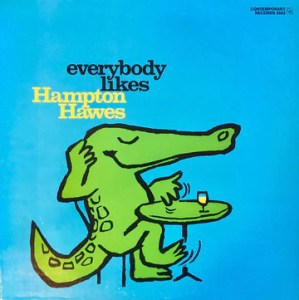
- We have been big fans of Hampton Hawes for many years – it’s records like this that impressed the hell out of us back in the day and they only get better with age
- This side one is rich, clear, undistorted, open, spacious, and has jazz trio energy to rival the best recordings you may have heard, and side two is not far behind in all those areas
- This is a textbook example of Contemporary sound at its best, thanks to the engineering brilliance of Roy DuNann and producer Lester Koenig
- “The third of three Hampton Hawes trio dates with bassist Red Mitchell and drummer Chuck Thompson is on the same high level as his first two…. [Hawes] comes up with consistently creative ideas throughout this swinging bop date.”
- If you’re a fan of jazz piano trios playing live-in-the-studio, this Contemporary from 1956 surely belongs in your collection
We don’t run into Hawes’ LPs the way we used to, so it was indeed a delight to find enough copies of this album to do a shootout recently.
Note how correct the sound of the instruments is on both sides. This is the unquestionably the hallmark of any Contemporary recording: correct instrumental timbres.
This vintage Contemporary pressing has the kind of Tubey Magical Midrange that modern records can barely BEGIN to reproduce. Folks, that sound is gone and it sure isn’t showing signs of coming back. If you love hearing INTO a recording, actually being able to “see” the performers, and feeling as if you are sitting in the studio with the band, this is the record for you. It’s what vintage all analog recordings are known for — this sound.
If you exclusively play modern repressings of vintage recordings, I can say without fear of contradiction that you have never heard this kind of sound on vinyl. Old records have it — not often, and certainly not always — but maybe one out of a hundred new records do, and those are some pretty long odds.
What The Best Sides Of Everybody Likes Hampton Hawes Have To Offer Is Not Hard To Hear
- The biggest, most immediate staging in the largest acoustic space
- The most Tubey Magic, without which you have almost nothing. CDs give you clean and clear. Only the best vintage vinyl pressings offer the kind of Tubey Magic that was on the tapes in 1956
- Tight, note-like, rich, full-bodied bass, with the correct amount of weight down low
- Natural tonality in the midrange — with all the instruments having the correct timbre
- Transparency and resolution, critical to hearing into the three-dimensional studio space
No doubt there’s more but we hope that should do for now. Playing this record is the only way to hear all of the qualities we discuss above, and playing the best pressing against a pile of other copies under rigorously controlled conditions is the only way to find a pressing that sounds as good as this one does.
Copies with rich lower mids and nice extension up top did the best in our shootout, assuming they weren’t veiled or smeary of course. So many things can go wrong on a record! We know, we’ve heard them all.
Top end extension is critical to the sound of the best copies. Lots of old records (and new ones) have no real top end; consequently, the studio or stage will be missing much of its natural air and space, and instruments will lack their full complement of harmonic information.
Tube smear is common to most vintage pressings. The copies that tend to do the best in a shootout will have the least (or none), yet are full-bodied, tubey and rich.
What We’re Listening For On Everybody Likes Hampton Hawes
- Energy for starters. What could be more important than the life of the music?
- The Big Sound comes next — wall to wall, lots of depth, huge space, three-dimensionality, all that sort of thing.
- Then transient information — fast, clear, sharp attacks, not the smear and thickness so common to these LPs.
- Tight punchy bass — which ties in with good transient information, also the issue of frequency extension further down.
- Next: transparency — the quality that allows you to hear deep into the soundfield, showing you the space and air around all the instruments.
- Then: presence and immediacy. The piano isn’t “back there” somewhere, lost in the mix. It’s front and center where any recording engineer worth his salt — the legendary Roy DuNann in this case — would put it.
- Extend the top and bottom and voila, you have The Real Thing — an honest to goodness Hot Stamper.
David Rickert Review
Hawes has an elegant style typical of West Coast playing, but infused with bebop flourishes. His powerfully rhythmic left hand anchors the forceful dancing of his right, apparent on tunes like “Somebody Loves Me” and “A Night in Tunisia.” But he also can run through a ballad without making it sound overly sentimental and of course throws in a few blues numbers to show he’s got the chops for that, too. Mitchell gets in a few enthusiastic bass solos and Thompson keeps a tight rhythmic snap behind.
The selection of tunes on this 1956 date may not be all that adventurous, but it allows Hawes to do what he does best: give a little extra juice to some well-worn standards. No groundbreaking work here, but Hawes and company have, as usual, crafted a worthwhile session of piano jazz.
Side One
Somebody Loves Me
The Sermon
Embraceable You
I Remember You
Night in Tunisia
Side Two
Lover, Come Back to Me
Polka Dots and Moonbeams
Billy Boy
Body and Soul
Coolin’ the Blues
AMG Review
The third of three Hampton Hawes trio dates with bassist Red Mitchell and drummer Chuck Thompson is on the same high level as his first two. Hawes introduces his “Coolin’ the Blues” and “The Sermon,” digs into eight standards (including “Somebody Loves Me,” “Night In Tunisia” and “Billy Boy”) and comes up with consistently creative ideas throughout this swinging bop date.
David Rickert Review
Hawes has an elegant style typical of West Coast playing, but infused with bebop flourishes. His powerfully rhythmic left hand anchors the forceful dancing of his right, apparent on tunes like “Somebody Loves Me” and “A Night in Tunisia.” But he also can run through a ballad without making it sound overly sentimental and of course throws in a few blues numbers to show he’s got the chops for that, too. Mitchell gets in a few enthusiastic bass solos and Thompson keeps a tight rhythmic snap behind.
The selection of tunes on this 1956 date may not be all that adventurous, but it allows Hawes to do what he does best: give a little extra juice to some well-worn standards. No groundbreaking work here, but Hawes and company have, as usual, crafted a worthwhile session of piano jazz.