

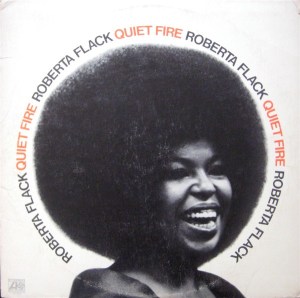

- Quiet Fire finally arrives on the site with superb Nearly Triple Plus (A++ to A+++) sound from start to finish – just shy of our Shootout Winner
- Tubey Magical, lively and clear, with the naturally smooth analog sound that only vintage pressings seem to offer
- “… thanks to top players like guitarist Hugh McCracken, organist Richard Tee, bassist Chuck Rainey, and drummer Bernard Purdie, the varied mix all comes off sounding seamless.”
- 4 1/2 stars: “Quiet Fire proves to be an apt title, as Flack’s MOR-informed jazz and gospel vocals simmer just below the surface on the eight [titles] here. Forgoing the full-throttled delivery of, say, Aretha Franklin, Flack translates the pathos of gospel expression into measured intensity and sighing, elongated phrases… One of Flack’s best.”
These Nearly White Hot Stamper pressings have top quality sound that’s often surprisingly close to our White Hots, but they sell at substantial discounts to our Shootout Winners, making them a relative bargain in the world of Hot Stampers (“relative” being relative considering the prices we charge). We feel you get what you pay for here at Better Records, and if ever you don’t agree, please feel free to return the record for a full refund, no questions asked.
This vintage Atlantic pressing has the kind of Tubey Magical Midrange that modern records can barely BEGIN to reproduce. Folks, that sound is gone and it sure isn’t showing signs of coming back. If you love hearing INTO a recording, actually being able to “see” the performers, and feeling as if you are sitting in the studio with the band, this is the record for you. It’s what vintage all analog recordings are known for — this sound.
If you exclusively play modern repressings of vintage recordings, I can say without fear of contradiction that you have never heard this kind of sound on vinyl. Old records have it — not often, and certainly not always — but maybe one out of a hundred new records do, and those are some pretty long odds.
What amazing sides such as these have to offer is not hard to hear:
- The biggest, most immediate staging in the largest acoustic space
- The most Tubey Magic, without which you have almost nothing. CDs give you clean and clear. Only the best vintage vinyl pressings offer the kind of Tubey Magic that was on the tapes in 1971
- Tight, note-like, rich, full-bodied bass, with the correct amount of weight down low
- Natural tonality in the midrange — with all the instruments having the correct timbre
- Transparency and resolution, critical to hearing into the three-dimensional studio space
No doubt there’s more but we hope that should do for now. Playing the record is the only way to hear all of the qualities we discuss above, and playing the best pressings against a pile of other copies under rigorously controlled conditions is the only way to find a pressing that sounds as good as this one does.
What We Listen For on Quiet Fire
- Energy for starters. What could be more important than the life of the music?
- Then: presence and immediacy. The vocals aren’t “back there” somewhere, lost in the mix. They’re front and center where any recording engineer worth his salt would put them.
- The Big Sound comes next — wall to wall, lots of depth, huge space, three-dimensionality, all that sort of thing.
- Then transient information — fast, clear, sharp attacks, not the smear and thickness so common to these LPs.
- Tight punchy bass — which ties in with good transient information, also the issue of frequency extension further down.
- Next: transparency — the quality that allows you to hear deep into the soundfield, showing you the space and air around all the instruments.
- Extend the top and bottom and voila, you have The Real Thing — an honest to goodness Hot Stamper.
TRACK LISTING
Side One
Go Up Moses
Bridge Over Troubled Water
Sunday And Sister Jones
See You Then
Side Two
Will You Still Love Me Tomorrow
To Love SomebodyLove
Let Them Talk
Sweet Bitter Love
AMG 4 1/2 Star Review
Quiet Fire proves to be an apt title, as Flack’s MOR-informed jazz and gospel vocals simmer just below the surface on the eight sides here. Forgoing the full-throttled delivery of, say, Aretha Franklin, Flack translates the pathos of gospel expression into measured intensity and sighing, elongated phrases. There’s even a bit of Carole King’s ashen tone in Flack’s voice, as manifested on songs like “Let Them Talk,” Van McCoy’s “Sweet Bitter Love,” and a meditative reworking of King’s “Will You Still Love Me Tomorrow.”
The album’s other high-profile cover, “Bridge Over Troubled Waters,” features the ideal setting for Flack’s airy pipes with a tasteful backdrop of strings and a chorus featuring soul songstress Cissy Houston (Whitney’s mom). Switching from this hushed sanctity, Flack digs into some groove-heavy southern soul on “Go Up Moses,” “Sunday and Sister Jones,” and an amazing version of the Bee Gees hit “To Love Somebody” (this perennial number has been done by everyone from Rita Marley to Hank Williams, Jr.).
Flack finally completes the modern triumvirate of southern music, adding the country tones of Jimmy Webb’s “See You Then” to the Quiet Fire’s stock of gospel and soul. And thanks to top players like guitarist Hugh McCracken, organist Richard Tee, bassist Chuck Rainey, and drummer Bernard Purdie, the varied mix all comes off sounding seamless. One of Flack’s best.