

More Saxophone Jazz
More Recordings Engineered by Bob Simpson
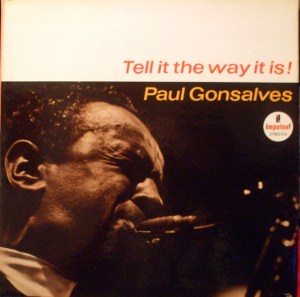

- You’ll find solid Double Plus (A++) sound on both sides of this outstanding copy of Tell It The Way It Is!
- The sound is huge and spacious with richness and Tubey Magic like nothing you’ve heard
- Engineered by the great Bob Simpson, this album has it going on – musically and sonically
- Gonsalves was Ellington’s tenor man, and his wonderfully expressive tone is what makes many of Ellington’s recordings the joy they are to this day
This vintage Impulse! pressing has the kind of Tubey Magical Midrange that modern records can barely BEGIN to reproduce. Folks, that sound is gone and it sure isn’t showing signs of coming back. If you love hearing INTO a recording, actually being able to “see” the performers, and feeling as if you are sitting in the studio with the band, this is the record for you. It’s what vintage all analog recordings are known for — this sound.
If you exclusively play modern repressings of vintage recordings, I can say without fear of contradiction that you have never heard this kind of sound on vinyl. Old records have it — not often, and certainly not always — but maybe one out of a hundred new records do, and those are some pretty long odds.
What the best sides of Tell It The Way It Is have to offer is not hard to hear:
- The biggest, most immediate staging in the largest acoustic space
- The most Tubey Magic, without which you have almost nothing. CDs give you clean and clear. Only the best vintage vinyl pressings offer the kind of Tubey Magic that was on the tapes in 1963
- Tight, note-like, rich, full-bodied bass, with the correct amount of weight down low
- Natural tonality in the midrange — with all the instruments having the correct timbre
- Transparency and resolution, critical to hearing into the three-dimensional studio space
No doubt there’s more but we hope that should do for now. Playing the record is the only way to hear all of the qualities we discuss above, and playing the best pressings against a pile of other copies under rigorously controlled conditions is the only way to find a pressing that sounds as good as this one does.
What We’re Listening For on Tell It The Way It Is!
- Energy for starters. What could be more important than the life of the music?
- The Big Sound comes next — wall to wall, lots of depth, huge space, three-dimensionality, all that sort of thing.
- Then transient information — fast, clear, sharp attacks, not the smear and thickness so common to these LPs.
- Tight punchy bass — which ties in with good transient information, also the issue of frequency extension further down.
- Next: transparency — the quality that allows you to hear deep into the soundfield, showing you the space and air around all the instruments.
- Extend the top and bottom and voila, you have The Real Thing — an honest to goodness Hot Stamper.
The Players
- Paul Gonsalves – tenor saxophone
- Johnny Hodges – alto saxophone
- Ray Nance – trumpet, violin
- Rolf Ericson – trumpet
- Walter Bishop Jr. – piano
- Ernie Shepard – bass, vocals
- Osie Johnson – drums
Vinyl Condition
Mint Minus Minus and maybe a bit better is about as quiet as any vintage pressing will play, and since only the right vintage pressings have any hope of sounding good on this album, that will most often be the playing condition of the copies we sell. (The copies that are even a bit noisier get listed on the site are seriously reduced prices or traded back in to the local record stores we shop at.)
Those of you looking for quiet vinyl will have to settle for the sound of other pressings and Heavy Vinyl reissues, purchased elsewhere of course as we have no interest in selling records that don’t have the vintage analog magic of these wonderful recordings.
If you want to make the trade-off between bad sound and quiet surfaces with whatever Heavy Vinyl pressing might be available, well, that’s certainly your prerogative, but we can’t imagine losing what’s good about this music — the size, the energy, the presence, the clarity, the weight — just to hear it with less background noise.
TRACK LISTING
Side One
Tell It The Way It Is
Things Ain’t What They Used To Be
Side Two
Duke’s Place
impulsive
Rapscallion In Rab’s Canyon
Body And Soul
AMG Review
When Duke Ellington’s sidemen recorded on their own, the Duke’s influence often had a way of asserting itself even if he was nowhere near the studio. This was true in the 1930s and 1940s, and it was true on some of Paul Gonsalves’ recordings of the 1960s. Nonetheless, Gonsalves was his own man, and this excellent [recording] points to the fact that the breathy tenor saxophonist wasn’t afraid to enter a variety of musical situations….
AMG Bio
Before joining Duke Ellington’s orchestra in 1950, he had also played in big bands led by Count Basie (1947–1949) and Dizzy Gillespie (1949–1950).
At the 1956 Newport Jazz Festival, Gonsalves’ solo in Ellington’s song “Diminuendo and Crescendo in Blue” went through 27 choruses; the publicity from this performance is credited with reviving Ellington’s career. The performance is captured on the album Ellington at Newport. Gonsalves was a featured soloist in numerous Ellingtonian settings. He received the nickname “The Strolling Violins” from Ellington for playing solos while walking through the crowd.
Gonsalves died in London a few days before Duke Ellington’s death, after a lifetime of addiction to alcohol and narcotics. Mercer Ellington refused to tell Duke of the passing of Gonsalves, fearing the shock might further accelerate his father’s decline. Ellington and Gonsalves, along with trombonist Tyree Glenn, lay side-by-side in the same New York funeral home for a period of time.

