TAS List Not-So-Good

These records have no business being on anything called a list of “Super Discs.”

Gaite Parisienne Is Just More Smeary Dreck from Classic Records

More of the Music of Jacques Offenbach (1819-1880)

Sonic Grade: F

The last time I played the Classic I thought it was nothing but a smeary mess, as awful as their awful Scheherazade. If I were to play it today, I’m guessing it would join the other Classic Records entries in our audiophile hall of shame.

Here are some other records we played and found had smeary strings. They did not last long on our turntable.

I love Arthur Fiedler‘s performance with the Boston Pops and the 1954 two track RCA Living Stereo sound, but finding an original Shaded Dog pressing in clean condition under $500 with the right stampers is all but impossible nowadays.

If you want to go that way, more power to you. 

This 1954 2-track recording is RCA’s first stereo recording of the work. 1954. Can you believe it? A few mics and two channels and it blows away most of the classical recordings ever done! Some old record collectors and tube lovers say classical recording quality ain’t what it used to be. This record proves it.

Click on this link to read more reviews and commentaries for Gaite Parisienne.

(more…)

Scheherazade Is a Classic Records Disaster

Hot Stamper Pressings of the Music of Rimsky-Korsakov Available Now

An audiophile record hall of shame pressing and a Heavy Vinyl disaster poorly mastered for the benefit of audiophiles looking for easy answers and quick fixes.

In 2009 or 2010, during our testing of the TT Weights turntable products, the record I played again and again — close to a hundred times over the course of two days — was a wonderful White Dog pressing of LSC 2446. The sound was glorious, some of the finest reproduction of a large orchestral work I have ever heard.  

(Late in life, Harry Pearson disgraced himself by putting this Classic Record on his TAS list of Super Discs.)

A week later I was still testing the system, and again using Scheherazade. A friend brought over his Classic pressing, probably the same one I would have sold him in the mid-90s. Now we could compare the two.

It was a massacre. The sound on the reissue is simply AWFUL.

There is no transient information anywhere on that Heavy Vinyl pressing whatsoever.

No instruments have any texture — not the strings, not the woodwinds, nothing.

There is no air going through the flutes.

There is no rosin on the bow of the solo violin.

The tympani are a blurry mess.

Triangle: okay.

Bass drum: okay.

Everything else: FAIL.

Not having played it in years, I could not believe how much worse the record sounded than I remember. The gulf between the real thing and the Classic wannabe was now so huge that the reissue was nothing less than positively UNPLEASANT to listen to.

Enjoyment? Out of the question.

TAS List? The original is, but the Classic is too. Now how messed up is that?

Disgraceful, that’s all I have to say about it.

If I were in charge of the TAS Super Disc list, obviously I would not have put this record on it.

Here are some others that we do not think qualify as Super Discs.

Here are some Hot Stamper pressings of TAS List titles that actually have audiophile sound quality, guaranteed.

And if for some reason you disagree with us about how good they sound, we will be happy to give you your money back.

Our favorite performance of Scheherazade is Ansermet’s with the Suisse Romande from 1961.

(more…)

Audiophile Reviewers Raved About This Doug Sax Tube-Mastered Mess

User comments

More of the music of Sergei Rachmaninoff (1873-1943)

The reviews below will sound depressingly familiar to you if you have been in audio for as long as I have.

Sonic Grade: F

This Athena LP is now long out of print, but it received rave reviews when it was released. (We quote many of them below.) This album is a member of the TAS Super Disc list, but we found the sound awfully opaque, smeary, slow and compressed, the kind of bad “analog” sound that Doug Sax brought to the early AP releases. 

The sticker on the shrink wrap of a previous copy had these quotes:

“…for this is the definitive symphonic recording to date.” – J. Gordon Holt/ Stereophile

“Wins ‘Best Record of the Year’ award against tough competition.” – Joe Hart/High End Audio Press & Music Review

“HP heard the Athena remastering of the Rachmaninoff and found it stunning. He could recommend it without reservation.” – Harry Pearson/The Absolute Sound #57

I guess things never change.

And doubtlessly he continued to refer to himself in the third person until the end.

Reviewer malpractice? We’ve been writing about it for more than 25 years.

(more…)

Albeniz / Falla / Spain / Reiner

Hot Stamper Pressings of Living Stereo Recordings Available Now

Spain has been an audiophile favorite for a very long time.

Everybody should know it by now, what with both Chesky and Classic Records having remastered it in the 90s, dismally of course, as neither of these companies have ever demonstrated that the slightest sense how lackluster, if not downright awful, the result of their efforts turned out.

No doubt Analogue Productions will see fit to ruin the recording the way they ruined Scheherazade.

This has never been one of the best Living Stereo titles in our experience.

The highest grade I would give it would probably be a B.

“Our experience” is the key phrase in the above sentence. I can’t say there aren’t amazing sounding pressings of the album, it’s simply the case that we have never played one.

If I saw one for cheap I would of course pick it up, but in the modern world of records, that is very unlikely indeed.

(more…)

This Lousy Gershwin Set Is on the TAS List?

More of the Music of George Gershwin

Hall of Shame 3 Record set that had us asking: Why would anyone want to own these awful records? Isn’t the music of George Gershwin better than this?

TAS List or no TAS List, the performances of the works listed below are much too slow to be taken seriously.

This is one of those records that make you wonder what the hell some audiophile reviewers, including Harry Pearson himself, must have been smoking back in the day.

I get that The TAS Super Disc List is about sound, not music, but the sound is not that great here either, and the bargain vinyl is the typical gritty, grainy, noisy crap that VOX records tend to be made with.

(more…)

Breakaway Is Generally Grainy, Harsh and Shrill

Reviews and Commentaries for TAS Super Disc Recordings

The problem with this album is that, for whatever reason, practically every copy you find is, to some degree, grainy, harsh and shrill in the loudest passages of the music. When the music gets loud, the sound often becomes strained and unpleasant. A copy like this one that doesn’t do that is the exception, not the rule.

Listen to the song ‘Disney Girls’ on side one. If you own the average pressing – odds are your copy is in fact quite average unless you went through a pile of copies and played them in order to find a good one – parts of that song will sound painfully hard and shrill, assuming your playing the record at the kinds of levels we do.

Which is the main reason I’ve never understand what qualified this record to be on the TAS Super Disc list. Now, having heard the best of the best copies sounding so big, rich and tubey, I can certainly say I hear what impressed HP (he likes that sound, as do we). It may indeed be a very well recorded album, but we feel it falls a bit short for our own Rock and Pop Top 100 List. (To be fair, as you know we play a lot of amazing albums around here.)

The Best Songs

The late Harry Pearson knew little about popular music and may have been more impressed by this album than those of us who play pop and rock albums by the boatload.

Most of the pop albums on his Super Disc TAS list are a joke. Only the people who listen almost exclusively to classical or jazz seem to take them seriously, in my experience anyway. (Check out the 12″ pop singles for a good laugh.)

(more…)

Blue on Heavy Vinyl – We Broke Through in 2007

Hot Stamper Pressing of the Music of Joni Mitchell Available Now

Thoughts on the so-called definitive vinyl version

Yet another milestone event in the history of Better Records.

In 2007 a customer took issue with our decision to reject the sale of the newly remastered Heavy Vinyl pressing of Blue, the one put out by Rhino and mastered by Steve Hoffman and Kevin Gray.

We actually used to give the record away for free with every purchase of a Hot Stamper Blue, making it easy for our customers to hear for themselves just how superior sounding our Hot Stamper pressings were.


UPDATE 2024

With every purchase of a Hot Stamper Led Zeppelin II, we give our customers the Page-remastered version for free so that they can hear for themselves why our pressing costs well over $1000 and Jimmy’s a small fraction of that figure, sometimes as small as one hundredth!


We did this partly out of necessity. I had foolishly taken the advice of a Mr. Robert Pincus (the discoverer of Hot Stampers let us never forget) that the new version was indeed all it was cracked up to be and proceeded to put in an advance order for twenty copies to sell to our audiophile customers.

We were still selling Heavy Vinyl in 2007, but it would not be long before we decided to end the practice. Within a few years we were only selling records that we had cleaned and played and could guarantee both their superior sound quality and audiophile-quality playing surfaces.

So we had about twenty copies of Blue we did not think qualified as “better records” and decided to just give them away.

After spending quite a number of hours evaluating the new version, I got fairly worked up over the disappointing sound, worked up enough to write a very long commentary about the album, which I entitled Blue, The Game.

Rather than detailing the shortcomings of the new pressing, in this particular commentary, the first of its kind, I decided to take a different tack.

I implored the reader to do his own shootout for the album and tell me what he heard on the various pressings he might have at hand to work with. (Nothing much came of it of course, and not too surprisingly. Shootouts are hard and the vast majority of audiophiles are averse to them in our experience, hence the sorry state of audiophile records and the systems that fail to reveal their shortcomings — but that’s a horse that gets flogged regularly enough on this site. Enough is enough.)

Tom, 

I find it curious you are not carrying the new Joni Mitchell Blue vinyl issue. Even to the point of saying you can do better… for 25 bucks? After clicking on the LP cover and reading the comments from over the years it makes me wonder what your agenda really is. I paid $250 for a wonderful WLP and this Rhino issue smokes it, even as good as it is. I even have a CD cut from this mastering session off the analog FLAT, not Dolby tapes and this vinyl even beats it…. of course just my opinion.

I have listened on $100,000 systems, all the way down to portable units, solid state and tube and there is no denying this is the definitive vinyl version….. and again for 25.00. What a bargain.

Maybe all you did was look at that Rhino sticker and think back to the Grateful Dead records they did a few years ago (horrible) and just assumed this wasn’t up to Better Records standards.

Thanks for reading. I enjoy your e mails and store….

Tom

Tom,

We don’t review records based on their labels or stickers. And of course we never assume anything about the sound of a record. We talk about this stuff all the time. Here’s a relevant quote:

My approach to reviewing records is pure skepticism: a record sounds good if it sounds good, regardless of how it was made, who made it, or why. I’ve heard lots of expensive so-called audiophile equipment do a pretty poor job of making music over the years, the owners of which had an armful of reasons for why the sound should be truly awe-inspiring. But it just wasn’t. Most fancy gold faceplates are nothing but lipstick on a pig in my opinion.

I once heard Blue poorly reproduced at a friend’s house, and this is probably the best explanation for this letter writer’s inability to understand our position on Blue.

And paying $250 for a White Label Demo that apparently doesn’t sound good is the height of audiophile collector foolishness.

That money should have gone for better equipment or room treatments or tweaks, something, anything, to make this guy’s stereo and room work better than they apparently do.

Actually this brings up a good point. If I had to choose one record that separates the men from the boys, the stereos that really work from the artificial, restricted audiophile systems you might read about in the magazines or hear in a showroom or at an audio show, Blue would be a darn good choice.

(more…)

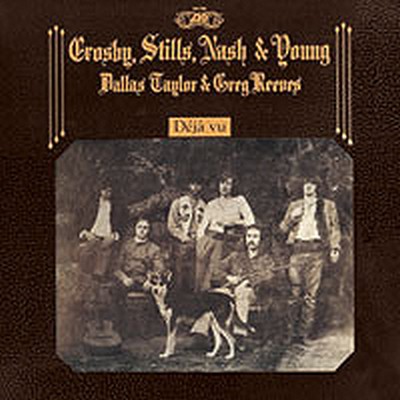
Deja Vu – This Classic Records Knockoff Is Not the Answer, But We Have One

Letters and Commentaries for Deja Vu

More CrosbyMore Stills / More Nash / More Young

An audiophile hall of shame pressing and another Classic Records rock LP badly mastered for the benefit of audiophiles looking for easy answers and quick fixes.

If you bought the Classic Record Heavy Vinyl pressing of Deja Vu, I hope you know how badly Classic Records ripped you off.

If you feel disrespected, you should. They took your money and gave you nothing of real value for it. The right CD (not the current one, that’s for damn sure) is dramatically better sounding than their vinyl reissue.

On the other hand, if you’re not too picky about sound quality and just want to play new records, perhaps because old records are hard to find and often noisy, then fine, the Classic should get that job done for you.

We of course want nothing to do with records like those remastered by Classic Records.

We only want to play good sounding records, and most Classic Records, including this title, are definitely not good sounding, not by our standards anyway.

Records Are in a Sorry State – Here’s What You Can Do About It

It’s a sad state that we currently find ourselves in, but is it really any different than it used to be? Audiophiles used to like half-speeds, they used to like Japanese pressings, they used to like direct to disc recordings with questionable sound and even more questionable music.

Now they like SACDs, Heavy Vinyl and 45s. If you ask me it’s the same old wine in a different bottle.

(more…)

Le Cid on Klavier – Now With Added Smile Curve

Presenting Yet Another Pressing Perfectly Suited to the Stereos of the Past

This hi-fi-ish Doug Sax/ Acoustic Sounds butchering of Fremaux’s performance from 1971 is insufferable. These Klavier pressings of EMI recordings are nothing but Audiophile Bullshit.

Can this possibly be the sound that EMI engineer Stuart Eltham was after?

Back in the day, audiophiles in droves bought this pressing from all the major mail order audiophile record dealers (you know who I’m talking about), apparently not noticing the overblown bass and spark-spark-sparkling top end. 

Perhaps the same audiophiles who think that Mobile Fidelity makes good sounding records? It would not surprise me. Same odd-tasting wine, different bottle.

The Smile Curve

If you’ve spent any time on this site, you should know by now that many audiophile records sound worse than the typical CD. The typical CD does not have an equalization curve resembling a smile. The classic smile curve starts up high on the left, gets low in the middle, and rises again at the end, resulting in boosted bass, boosted top end, and a sucked out midrange — the Mobile Fidelity formula in a nutshell.

If your system needs boosted bass and highs, perhaps because your speakers are too small, well, I suppose you could try this Klavier pressing.

Here’s a better idea.

Fix your f-ing stereo so you won’t need phony audiophile records like this one to make it sound good.

Either of the two records you see below will be dramatically better sounding than the Klavier Heavy Vinyl. The best pressings of this one win all the shootouts, but the Greensleeves Budget reissue pressing can also sound very good, with the better pressings earning a grade of 2+ or thereabouts.

(more…)

The Fox Touch Is Not As Good As We Thought, Sorry!

Hot Stamper Pressings of the Music of J.S. Bach Available Now

The review reproduced below was written in 2010. More recently (2015 or so) I have played copies of these Crystal Clear organ recordings and been much less impressed.

The ambience is a fraction of what it should be, and the reason I know that is that the vintage organ recordings we play these days have dramatically more size and space than these audiophile pressings do. (We wrote about it here.)

A classic case of live and learn.

As we like to say, all these audiophile records sound great sitting on the shelf. When you finally pull one out to play it, you may find that it doesn’t sound the nearly as good as you remember, and that’s a good thing.

It’s a sign you are making progress in this hobby.

Ten years from now, if during that time you’ve worked hard on your stereo system, room, electricity and all the rest, your Heavy Vinyl pressings will also have plenty of flaws you never knew were there.

Our customers know what I am talking about. Some have even written us letters about it.

Linked here are some other records that are good for testing orchestral depth, size and space.


Our old review — way off the mark it seems!

White Hot on both sides, a DEMO DISC quality organ Direct to Disc recording.

Full, rich, spacious, big and transparent, with no smear.

The size and power of a huge church organ captured in glorious direct to disc analog.

We’ve never been fans of Crystal Clear, but even we must admit this recording is Hard To Fault.

Are we changing our tune about Audiophile records? Not in the least; we love the ones that sound right.

The fact that so few of them do is not our fault. 

The methods used to make a given record are of no interest whatsoever to us. We clean and play the pressings that we have on hand and judge the sound and music according to a single standard that we set for all such recordings. Organ records, in this case, get judged against other organ records. If you’ve been an audiophile for forty years as I have, you’ve heard plenty of organ records.

Practically every audiophile label on the planet produced at least one, and most made more than one. Some of the major labels made them by the dozen in the ’50s and ’60s, and many of those can sound quite wonderful.

Who made this one, how they made it or why they made it the way they did is none of our concern, nor in our mind should it be of any concern to you. The music, the sound and the surfaces are what are important in a record, nothing else.

Richter was making recordings of this caliber for London in the ’50s. Clearly the direct to disc process is not revelatory when it comes to organ records (or any other records for that matter), but finding vintage Londons with quiet vinyl that sound as good as this disc does is neither easy nor cheap these days, so we are happy to offer our Bach loving customers a chance to hear these classic works sounding as good as they can outside of a church or concert hall.

(more…)